

World Birds IUCN statusLC · Least ConcernGlobal IUCN category. BirdLife v10 (2025); taxon matching: AviList 2026 / IOC 15.2; checked: 29.10.2026. The list year is not the species assessment date. Source and method · BirdLife OrderPasseriformesPasserines FamilyTurdidaeTurdidae
Bare-eyed Thrush
Turdus tephronotus
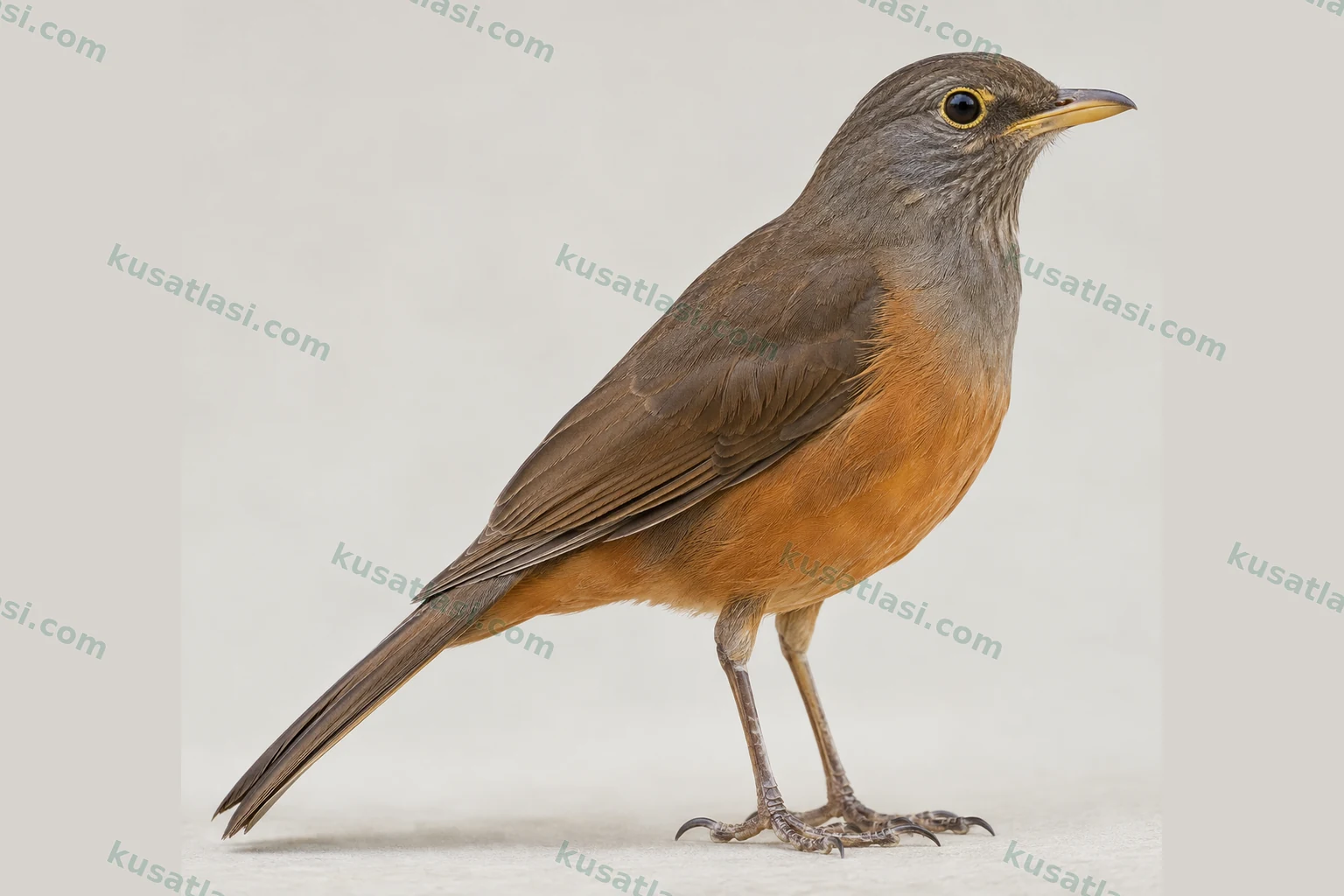
A thrush of East African scrub with grey upperparts and orange-rufous underparts. The broad bare yellow eye area, pale streaked throat and grey breast are assessed together.
Biometrics
Length
Male20–22 cm
Female20–22 cm
Shared species value
Wing length
Male10.81 cm
Female10.81 cm
Shared species value
Weight
Male48.7 g
Female48 g
Male: 48.7 g. Published entry in the biometric compilation of Lislevand et al. (2007), sample size n=6. Locality, season, age and subspecies are not specified in this row; it is not assumed to represent all populations. The compilation generally uses mean values; the original handbook page and calculation of this entry were not independently verified. The existing opposite-sex value is from another source; the two cannot establish a sex difference.
Bare-eyed Thrush
Southern Somalia and Ethiopia, eastern Kenya and northeastern TanzaniaObservation guide in its natural range
Look for three features together
Do not rely on a single featureDistinct from a narrow eye-ring; the whole face must be seen.
Compare with the grey breast and pale, streaked throat.
Searches leaf litter and retreats briefly into cover when disturbed.
Compare male and female
 FemaleMale
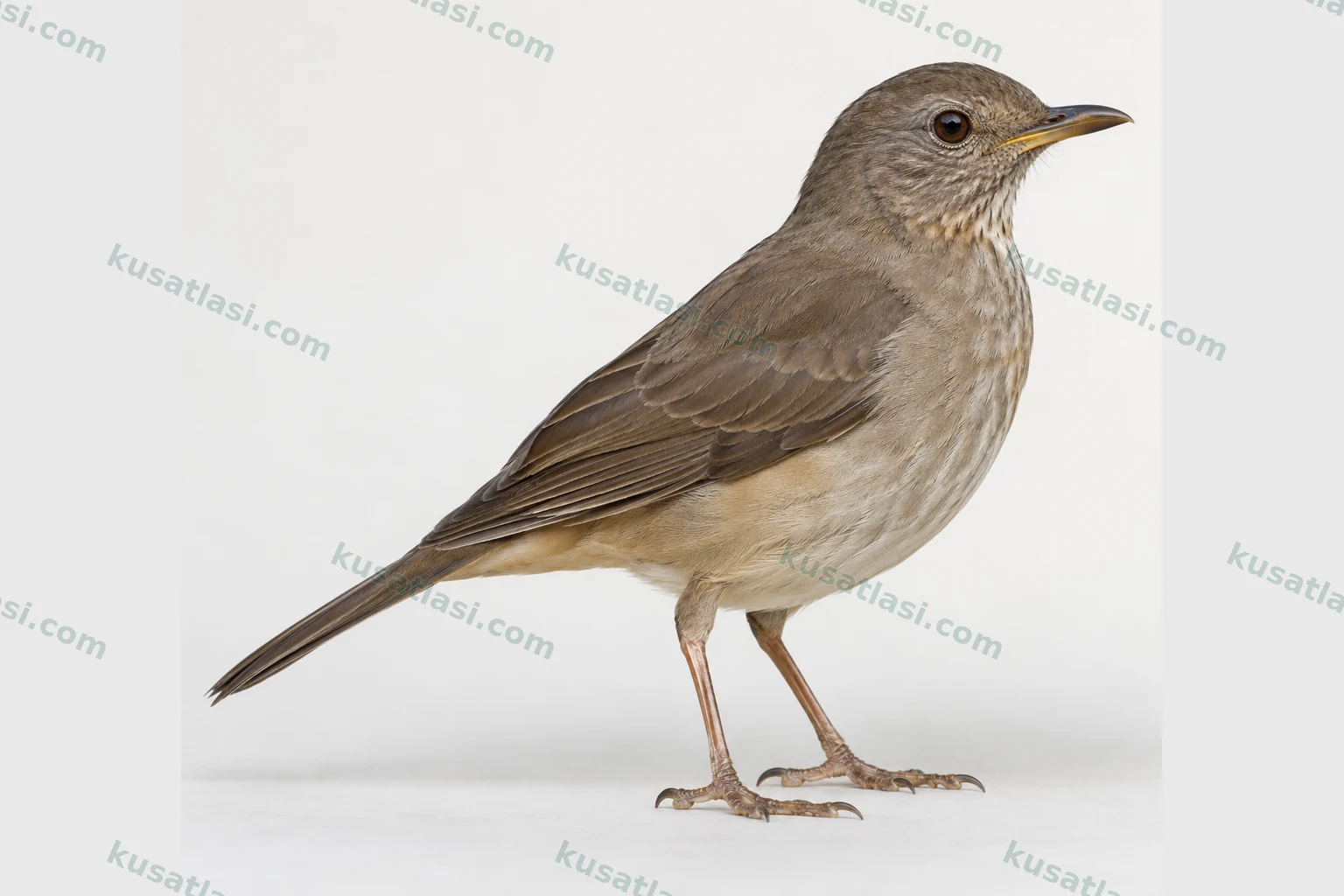
Adult sexes are very similar. Slightly paler underparts are not a reliable field sexing mark. Dark spots on the breast and upper belly of first-year birds can help assess age; uncertain observations do not establish age or sex.
Where to look in its natural range?
From existing paths watch leaf litter beneath bushes and wooded field margins. Waiting for the bird to appear naturally gives better views than following it into scrub.
Basically resident. The specialist account gives May breeding examples for Somalia and March–June and November–December elsewhere. These are neither a common calendar for the entire native range nor proof of no breeding outside those months.
January
Basically resident. Regional rainfall and breeding timing vary.
February
Basically resident. Regional rainfall and breeding timing vary.
March
Basically resident. Regional rainfall and breeding timing vary. Other regions have breeding examples in this period; it is not a shared season throughout the range.
April
Basically resident. Regional rainfall and breeding timing vary. Other regions have breeding examples in this period; it is not a shared season throughout the range.
May
Basically resident. Regional rainfall and breeding timing vary. A May breeding example is reported for Somalia. Other regions have breeding examples in this period; it is not a shared season throughout the range.
June
Basically resident. Regional rainfall and breeding timing vary. Other regions have breeding examples in this period; it is not a shared season throughout the range.
July
Basically resident. Regional rainfall and breeding timing vary.
August
Basically resident. Regional rainfall and breeding timing vary.
September
Basically resident. Regional rainfall and breeding timing vary.
October
Basically resident. Regional rainfall and breeding timing vary.
November
Basically resident. Regional rainfall and breeding timing vary. Other regions have breeding examples in this period; it is not a shared season throughout the range.
December
Basically resident. Regional rainfall and breeding timing vary. Other regions have breeding examples in this period; it is not a shared season throughout the range.
Nest, egg and incubation
The nest is a cup in a bush or tree, built of grass, twigs, roots and dry leaves and lined with fine plant material. The specialist account describes nests 3.5–10 m above ground and clutches of two–three eggs. A reliable species-specific incubation duration, age at first flight and detailed periods of parental care were not found. Do not open nest cover or closely follow birds carrying food.
Thin repeated ground calls, harsh rapid alarm series, and musical notes and trills from a high perch may be heard. Assess rhythm and behaviour with the bird seen; written sound comparisons alone do not identify it.
Do not play recordings to attract birds; observe quietly, especially near nests.
Species information
Quick Identification
The Bare-eyed Thrush, Turdus tephronotus, inhabits scrub and lightly wooded country in East Africa. Its grey head and back contrast with an orange-rufous belly and flanks, a paler grey breast and dark streaks on a pale throat. The most striking facial feature is the broad area of bare yellow skin around the eye. Identify it by the whole face, throat streaking and belly colour together, rather than naming it from this yellow patch alone. An orange fragment glimpsed beneath a bush, or a yellow bill, is insufficient.
Bare-eyed Thrush on this page refers to the African Turdus tephronotus. The name was also formerly used for the American Turdus nudigenis, now distinguished as Spectacled Thrush. Checking the scientific name is especially important when researching eggs, incubation or measurements. Similar English names do not mean the same species or birds on the same continent. This description is tied to the accepted record identity of the African bird.
It is usually noticed feeding on the ground beside fallen leaves or at the base of bushes. It walks cautiously, pauses to watch its surroundings, then returns to cover. In the field, first check the width of the bare eye area, then the boundary between grey upperparts and orange-rufous underparts. Colours looking pale in shade do not establish another sex or a separate form. Watching the same individual from several angles reduces errors caused by the lighting of one photograph.
General Appearance and Posture
The crown, nape and back are dark grey, with some areas appearing lighter ash-grey. Wings and tail continue the plain upperpart pattern; flight feathers may be darker grey-brown. Close views may reveal thin pale feather edges, but these do not form bold white wingbars at a distance. Grey cheeks contrast strongly with the yellow skin around the eye. The yellow area is bare skin surrounding the eye, not a feathered eyebrow.
The throat is whitish with dark streaks. Below it, the grey breast is distinct from the deep orange or orange-rufous belly and flanks. Do not treat the whole lower belly and undertail as one colour: the lower belly and vent have white areas, while undertail feathers may continue the rufous tones of the flanks. Only the breast may show through leaves; waiting for the bird to emerge makes the positions of these colours easier to understand.
The bill is yellow-orange or brownish orange; feet and legs also appear yellow-orange. Considering the bill together with the bare yellow eye area clarifies the facial pattern. Tail quivering may be seen on branches. This is useful behaviour to watch but is not unique to the species. Retreating into scrub, remaining silent or appearing accustomed to people in a garden likewise does not identify it alone.
Males, Females and Young Birds
Adult males and females look very similar. A specialist account suggests slightly paler female underparts, but against lighting, feather condition and individual variation this small difference is not a reliable field sexing key. A darker orange bird is not thereby male, nor a paler one female. The page presents the two adults separately without requiring the viewer to find a definite colour difference.
First-year birds resemble adults in general shape. Their underparts may be greyer, with dark spots on the breast and upper belly. Adult colour boundaries may therefore be less clear. To assess age, check whether the spots are actual feather markings rather than shadows. A momentary view of the breast cannot establish age with certainty. If juvenile features are unclear, leaving age unspecified is preferable to false precision.
Being alone does not reveal a bird's sex. Nor does presence near a nest establish which individual incubates or how frequently it feeds young. Verified information on incubation duration and detailed parental care is limited for this species. Close nest inspection or disrupting the bird's movements is not an appropriate way to fill that gap. Appearance, behaviour and the context of the record should be considered separately.
Appearance in Flight
When disturbed, it escapes quickly, often silently, between trees and bushes into cover. Such short flights may conceal much of the body detail. From above, grey-brown wings and a dark tail join the plain back. A suitable view from below or the side reveals conspicuous orange underwing and axillary areas. Upper and lower surfaces differ; note the viewing angle in the observation record.
Orange underwings help when combined with the orange-rufous body, but other thrushes have warm underpart colours, so this alone is not decisive. Do not record an area hidden by the closed wing as though it had been seen. A colour glimpsed at take-off is more convincing if the face and throat of the bird can subsequently be checked on the ground. Wait for natural movement rather than flushing it again, preserving both observation quality and the bird's comfort.
Research movement measurements must also be distinguished from flight speed. Positions recorded at intervals from radio-tagged birds in Kenya were used to study daily space use. Distances between these positions do not describe the complete flight path, maximum speed or seasonal migration distance. Short movements between patches of cover are not presented here as migration.
Voice and Behaviour
Thin, whining calls repeated on the ground may be heard, with faster, harsher series during alarm. The song combines short trilling passages with clear, high musical notes and may be delivered from a higher tree perch. Written sound comparisons vary with the listener's language and the bird's behaviour. Assess rhythm, repetition, location and the bird seen together. A thrush-like sound alone does not determine the species.
It is usually alone or with a few others; the specialist account mentions small groups of up to three. Shy and inconspicuous in dense cover, it may be more accustomed to people near settlements. Watching leaf-pushing, tail movements and short retreats into cover is often more rewarding than waiting for it to stay in the open. Increase distance if it stops feeding as a person approaches; do not force it into view with playback.
Field studies near Kitui, Kenya, found the species in streamside scrub fragmented by farmland. Researchers used radio transmitters to examine the cover individuals could use. Persistence in a modified landscape does not imply resistance to every kind of habitat loss. Publications covering different years of the same project are not wholly independent sets of observations. Read the findings with their study place and period in mind.
Similar Species
1. Kurrichane Thrush, Turdus libonyana, has a similar thrush shape, grey upperparts, pale throat and orange flanks. Its narrow orange eye-ring differs from the Bare-eyed Thrush's broad bare yellow eye area. Compare the strong dark throat-side streaks, paler centre of the belly and whole face. Where encounters occur within its range, including Tanzania, do not decide from a single orange fragment of the body.
2. Abyssinian Thrush, Turdus abyssinicus, can attract attention with its yellow-orange bill and rufous underparts. A narrow eye-ring, generally darker appearance and mountain habitats are helpful; the rufous underparts vary geographically. The Bare-eyed Thrush's broad bare yellow skin must actually be seen around the eye. Altitude alone cannot select the species, and labels such as forest, garden or scrub do not distinguish the two in every situation.
Global Distribution
The Bare-eyed Thrush is native to East Africa. The main specialist account gives southern Somalia, southern Ethiopia, eastern Kenya and northeastern Tanzania, extending towards Dodoma in Tanzania. Country names do not imply continuous occupancy: suitable scrub and woodland may occur as patches among open land. One coastal, mountain or agricultural record does not mean an entire country shares that habitat. It is not endemic to Kenya; “endemic” in the title of a Kenyan study concerns another bird included in that research.
Status Within Its Native Range
Look for it in scrub, light woodland and some human-influenced wooded habitats of dry and semi-arid regions. The specialist account also includes low coastal forest near Mombasa. Research near Kitui examined a different landscape, with streamside scrub interspersed with fields. These examples show why the species should not be regarded as confined to dense, tall forest. Coastal forest and dry streamside cover nevertheless should not be presented as identical ecological conditions.
Global conservation category and abundance at a particular site are different matters. The bird may be locally scarce or easier to find; retained scrub and observation effort affect the number recorded. Few map points do not prove an area empty, and many do not establish an entire region as breeding habitat. A modelled map layer, sampled records and the written native range are not interchangeable.
Migration
It is regarded as basically resident. Details of non-breeding movements are poorly known; the specialist account mentions outlying reports towards Dar es Salaam and southern Tanzania. These do not establish a regular north–south migration route or an annually repeated timetable. Without a verified route, country sequences, kilometres and seasonal arrows are not drawn on the map.
Radio tracking in Kitui provides information about daily space use. Scrub patches used on particular days and intercontinental migration are different movement scales. Rain-related breeding examples are not termed migration seasons. The month of a Somali nest record and the date of a bird tracked in Kenyan farmland must retain their separate local contexts.
Breeding Habitat
Dry or semi-arid woodland, thorn scrub, cover among rocks and feeding ground used alongside scrub are among its main environments. It may also occur in wooded grassland, orchards, field margins and large gardens with sufficient cover. The relationship between open ground and shelter matters: a field label alone does not describe a suitable nest site. Regional breeding is described as rain-related, with May examples from Somalia and March–June and November–December elsewhere. These months do not form one season beginning simultaneously throughout the range.
Nest Site
The nest is a cup incorporating grasses, fine twigs, roots and dry leaves, lined with finer grass and rootlets. The specialist account describes nests in bushes or trees at 3.5–10 m above ground. This does not place every nest in an identical branch position. A clutch usually contains two–three eggs, with dark rufous, grey or purplish markings on a blue-green ground.
The examined species account and comparative life-history sources did not provide a reliable incubation duration. First-flight age and detailed periods of parental care could not be verified either. Another thrush's number of days is not transferred to this bird. Do not pull branches aside, open scrub or touch eggs to see a nest; leave without blocking a food-carrying bird's route.
Daily Space Use
Daily feeding is mostly on the ground in leaf litter beneath scrub. Radio tracking at Kitui also recorded use of streamside cover and dense scrub patches within farmland. Presence in patches dominated by the introduced Lantana camara does not justify replacing native habitat with that plant everywhere. Observed use and long-term breeding success are not the same measurement.
Watch open ground and scrub edges from existing paths rather than walking through cover to search it. A ground-feeding bird may appear and then disappear again. Following it after an approach drives it into shelter repeatedly records escape behaviour instead of normal space use.
What Does It Eat?
Insects and their larvae form an important part of the diet; the specialist account lists beetles, flies and caterpillars. Fruit, berries and seeds may also be eaten. This variety helps explain sightings in orchards, but a bird in a fruit tree is not proof of fruit consumption. If the item in its bill cannot be seen, record only the plant used and the action observed.
The Kenyan movement study placed the species in an insectivorous feeding guild. That classification does not mean every meal of every individual was analysed. In particular, the ground-foraging percentage in tables comes from a comparative trait compilation; it does not imply that one insect group makes up the whole daily diet. A predominantly insect diet and occasional plant food are compatible.
How Does It Forage?
It searches the ground beneath dense cover and may move fallen leaves aside to find small animals underneath. Pauses to scan the surroundings allow feeding and vigilance to be observed together. Small movements in the litter can help an observer follow its bill and head. Do not scatter leaves to watch it feed: changing the ground it searches also changes the behaviour being observed.
The arrangement of scrub and neighbouring farmland may affect a ground-feeding thrush's access to shelter. Kitui data examined this relationship in a local landscape, not the same foraging distances in every country. Bait, bread and other human foods are unnecessary for observing natural food. Wait far enough away for the bird to continue feeding, helping reveal its actual behaviour and food source.
One Name, Different Continents
Bare-eyed Thrush can refer to two different thrushes in older sources. Africa's Turdus tephronotus and America's Turdus nudigenis are not local forms of one another. A measurement or incubation duration obtained without matching the scientific name may belong to a bird on the wrong continent. The scientific name is more than a label here: it is the clearest way to check which animal a study concerns. Especially when breeding information is missing, a readily found account with a similar name must not fill the gap.
Radio Tracking Life in Scrub
Near Kitui, radio transmitters followed individuals that were difficult to see. The study published in 2016 involved fourteen individuals of four bird species, including six Bare-eyed Thrushes. It could therefore examine positions inside cover rather than only places where birds happened to appear before observers. A later study covered more species and years; shared project data mean these publications are not wholly independent replications.
Use of dense cover partly composed of introduced plants shows that the bird can find habitat in modified landscapes. Presence in a bush, successful breeding there and maintaining a healthy population for many years are nevertheless separate questions. The findings do not mean native scrub is unimportant or that an invasive plant should be spread. Understanding space use informs conservation decisions; it cannot decide everything alone.