

World Birds IUCN statusLC · Least ConcernGlobal IUCN. BirdLife v10 (2025); taxon matching AviList 2026 / IOC 15.2; checked: 29.10.2026. The list year is not the species’ assessment date. Source and method · BirdLife OrderPasseriformesPasserines FamilyMuscicapidaeMuscicapidae
White-vented Shama
Copsychus niger
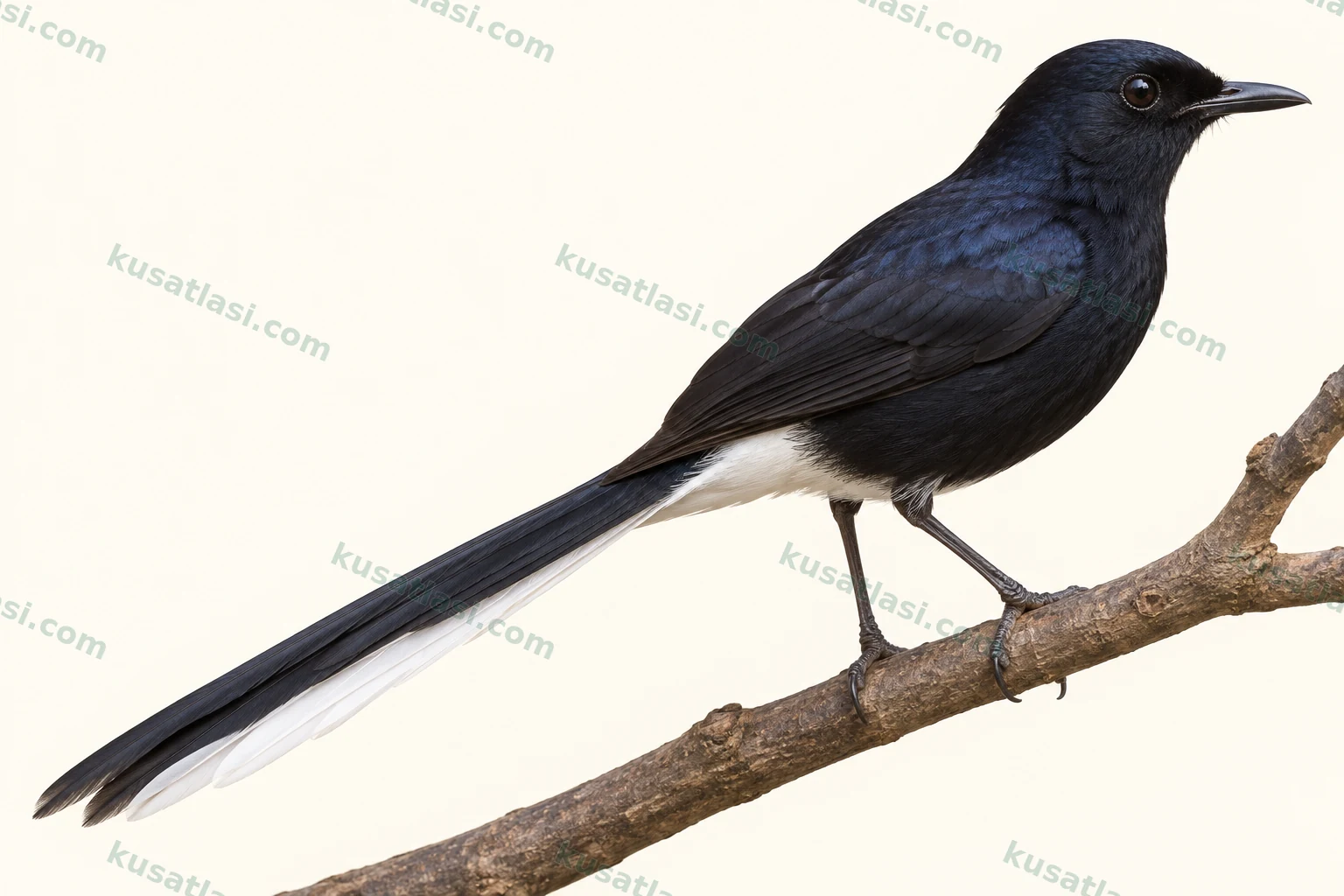
A dark shama of the Palawan island group; purplish gloss, white outer tail feathers and white undertail are considered together.
Biometrics
Length
Male18–21 cm
Female18–21 cm
Shared species value
Wing length
Male8.22 cm
Female8.22 cm
Shared species value
Weight
Male25.5–31.8 g
Female25.5–31.8 g
Shared species value
White-vented Shama
Philippines — Palawan island groupObservation guide in its natural range
Look for three features together
Do not rely on a single featureMostly black; a purplish gloss is visible according to the light.
See the white outer feathers together with the white area on the lower belly.
Flowing song from inside the forest; see the singer when possible.
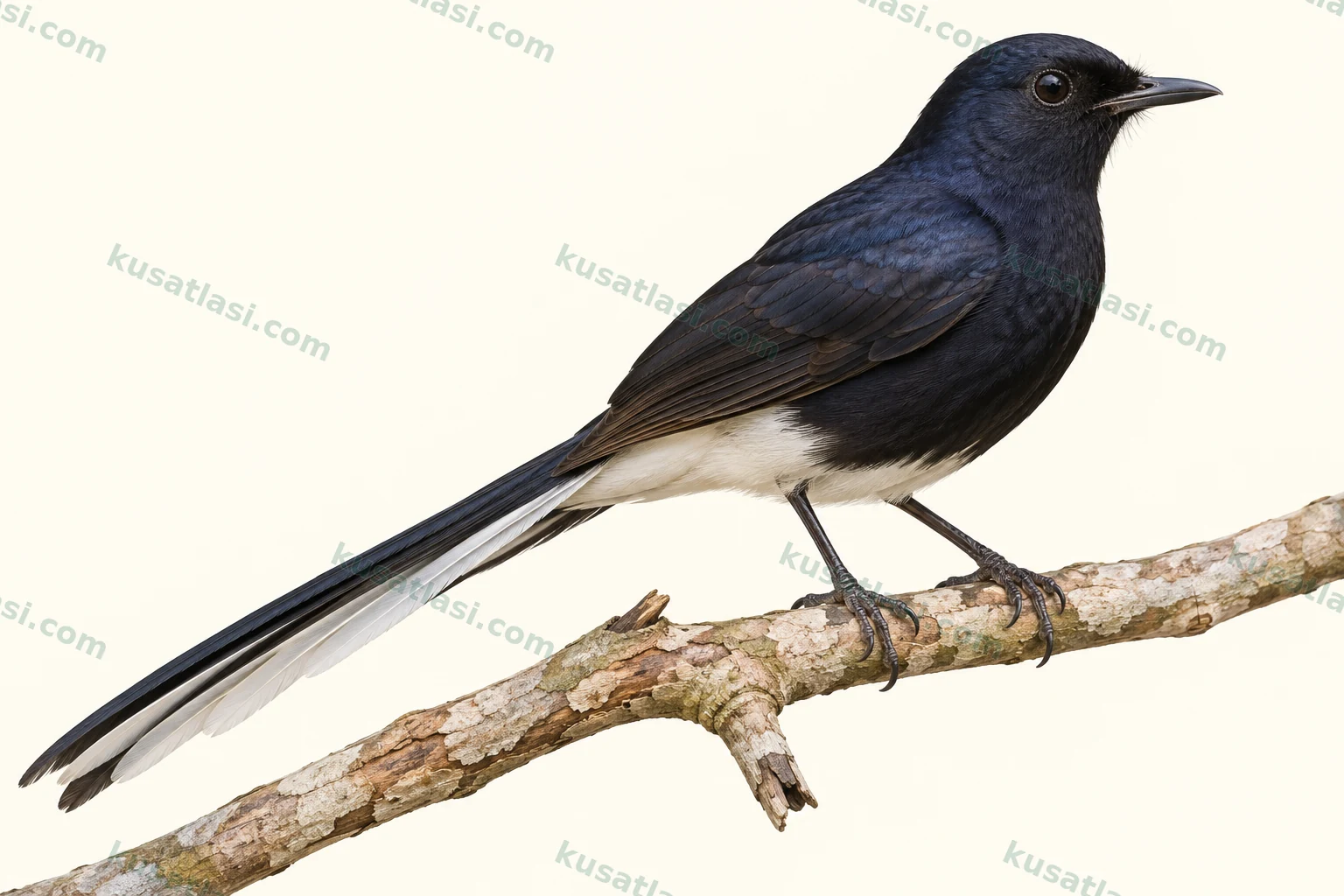
Compare male and female
 FemaleMale
No reliable detailed male–female or juvenile key was found in this review; shared adult identification is shown.
Where to look in its natural range?
Lowland forest, secondary vegetation and scrub; old-growth forest is especially important in the local study.
Resident in the Palawan island group; exact species-specific breeding months throughout the range were not verified. Movements within forest do not constitute a long-distance migration route.
All months: Data unavailable
January
February
March
April
May
June
July
August
September
October
November
December
Nest, egg and incubation
Nest structure, typical clutch size and incubation period were not sufficiently verified for this species.
Pleasant, flowing and varied song; often heard before it is seen. No detailed exact syllable key was found.
Do not play recordings to attract birds; observe quietly, especially near nests.
Species information
Quick identification
The White-vented Shama Copsychus niger is a mostly black-looking forest songbird endemic to the Palawan island group in the Philippines. Its purplish gloss, medium-length tail, white outer tail feathers and white area extending from the lower belly to the undertail are considered together. Look for the dark head, breast and back and the white tail edges on the same individual.
The bird is often heard before it is seen. When the singer responsible for a flowing, varied song from forest or scrub naturally comes onto an exposed branch, examine its body proportions. On a perched bird, the white tail edges can be concealed when the tail is closed.
General appearance and posture
The slender songbird shape and tail length help distinguish it from small, short-tailed forest birds. In dark foliage the body can look entirely black; in better light a purplish sheen becomes visible. This sheen does not form a separate purple patch with a fixed outline.
When watching the bird in the forest understorey, try to see the head, breast, lower belly and tail separately. A bright gap among branch shadows must not be mistaken for white plumage. As the bird moves, check that the same white area moves with it.
Males, females and young birds
Adult identification relies on the dark body, purplish gloss and white undertail and outer-tail pattern. The reliable open sources examined did not provide an independent colour key that distinguishes males and females under all conditions for this account. A slightly glossier bird is therefore not automatically a male, nor a bird in shade a female.
A detailed, species-specific verified description of juvenile plumage could not be completed for this page either. The spotted juvenile plumage of other shamas is not transferred here as established fact. On a bird that has not yet acquired an adult appearance, the visible feather pattern can be documented in photographs; leave its age uncertain if there is insufficient evidence for an age label.
Appearance in flight
On a moving bird, the white outer tail feathers and undertail contrast with the dark body. Spreading the tail can reveal white that was hidden while perching. However, if only a pale line is seen in a very brief passage, its precise feather tract cannot be established.
No detailed flight feature providing certain identification solely from an upperwing or underwing view was verified for this species. A generally black flight silhouette does not rule out all other dark songbirds on the Philippine island of Palawan. Consider tail length, the placement of white and behaviour inside the forest together. Waiting for a natural passage instead of trying to flush the bird provides better observation with less disturbance.
Voice and behaviour
The Cornell account describes the song as pleasant, flowing and varied, noting that the bird is more often heard than seen. Sound helps locate it in the forest, but no identification key based on a definite sequence of syllables was verified for this account. Especially when several birds are singing, link the visible individual to the sound being heard at the same time. A written human imitation of a sound is not a substitute for a scientific recording.
In the field study on the Philippine island of Palawan, this shama was among the birds evaluated in the forest understorey. Its use of forest and secondary vegetation does not mean that it occurs equally often in all open habitats. A clearing where song is easily heard need not be the place where the bird depends most on nest sites or food. Do not play recordings near a nest; observe the bird’s own calls and natural movements from a distance.
Similar species
The Black Shama Copsychus cebuensis of Cebu requires care when matching names and photographs because of its similar dark shama appearance and close relationship. Its natural island range, however, is different from that of the Palawan shama. The two species’ nest, measurement or conservation data are not combined merely because they are close relatives.
The White-browed Shama Copsychus luzoniensis is another distinct species encountered in Philippine shama records. Results from studies bearing its scientific name are not attributed to Copsychus niger. On a dark bird on the Philippine island of Palawan, look for this page’s white undertail and outer-tail features. The shared word “shama” in a photograph’s caption does not establish species identity on its own.
World distribution
Its natural range is the Palawan island group in the Philippines. The current taxonomic list gives this island range for Copsychus niger. Older publications may use the name Kittacincla nigra, the former generic placement of the taxon treated here. The Cebu shama and other Philippine shamas are considered under separate identities. Being endemic to an island group does not mean that every island and every open area in that group is used equally often.
Status within its natural range
In the current list snapshot, the global category is Least Concern. A peer-reviewed study in the Philippines’ Puerto Princesa Subterranean River National Park found higher densities in old-growth forest and lower densities in cultivation. This is a measurement from a particular park, not the present population of all Palawan or the density in every part of the island. Local forest quality remains important separately from the broad conservation category.
Migration
The specialist dataset treats the bird as resident. No regular long-distance migration or month-by-month tracked intercontinental route was verified. Daily movements within forest are not evidence for seasonal migration to other islands. Dated observations on the map show actual recording locations; they are not tracking points describing successive flights by a single individual. Geographic zooming preserves Palawan’s position in relation to surrounding islands.
Breeding habitat
Lowland forests, advanced secondary forest and scrub are the main environments. The park study on the Philippine island of Palawan compared cultivation, early secondary growth, advanced secondary growth and old-growth forest. Shama density increased in that sequence from cultivation towards old growth. This does not mean that secondary forest has no value; it shows that different vegetation types are not used in the same way.
Nest site
For this account, the nest structure, typical clutch size and incubation period of Copsychus niger could not be verified with sufficient species-specific evidence. Cavity nests or day counts from other Copsychus species are not used to fill this gap. A branch on which a bird sings is not treated as a nest site; breeding is not inferred without observing material-carrying or actual care behaviour.
Daily use of space
The bird uses cover and scrub in the forest understorey. The study’s density comparison was based on birds seen and heard along transect lines, not derived from a single photographic location. A record at a clearing edge does not show that nearby forest is unimportant. Instead of opening the vegetation or calling the bird out, wait quietly at a trail edge where it can be seen naturally.
What does it eat?
The specialist species data identify invertebrates as the main food group. This gives a broad dietary framework for a bird using the forest understorey; individual insect species or prey percentages applying throughout all seasons were not verified. A detailed food list from other shamas is not added simply because they share a genus. A small object seen in the bill must also be distinguished as live prey or nesting material.
How does it forage?
The lower forest vegetation in which it searches for food helps establish the setting of its foraging. However, this review did not find a separate study measuring the full range of prey-capture movements of this species. No absolute rule is given that every individual takes prey only from the ground, only from leaves or only in the air. During observation, record the vegetation level, reaching or darting movement and the object actually taken into the bill separately. Do not damage foliage or offer food to watch feeding.
Forest age matters within the same park
In the Palawan study in the Philippines, estimated White-vented Shama density increased from cultivation through early and advanced secondary forest to old-growth forest. Using different vegetation types does not make all habitats equivalent. The study covers only this park; the authors also stress that its results should not be extrapolated directly to the whole island. Protecting forest quality involves more than simply counting trees.
Beautiful song does not mean easy viewing
Cornell’s specialist account notes that the bird is heard more often than it is seen. Song can be the start of an observation, but the individual singing in dark cover may not be immediately apparent. Establishing that an audio recording and a photograph represent the same species requires a connection in time and place. Check the white tail markings when the bird becomes visible of its own accord.
White does not cover the whole tail
The white on the outer tail feathers and that on the lower belly and undertail occupy different anatomical areas. When the tail closes, the outer feathers may be partly covered, and brightness can diminish in shade. A feature not being visible in a dark silhouette therefore does not prove the absence of white feathers. A natural tail-spreading movement can reveal the position of the colour area more clearly.
An old genus name does not mean a different bird
Records published under Kittacincla nigra are matched to the current identity Copsychus niger. By contrast, the similarly named Cebu and other Philippine shamas are separate species. Following an old name helps in searching the literature; kinship does not permit the transfer of a neighbouring species’ measurements or incubation period to this species. Keeping island origin and scientific name together makes such confusion easier to detect.