

World Birds IUCN statusLC · Least ConcernGlobal IUCN category. BirdLife v10 (2025); taxon matching: AviList 2026 / IOC 15.2; checked: 29.10.2026. The list year is not the species assessment date. Source and method · BirdLife OrderPasseriformesPasserines FamilyMuscicapidaeMuscicapidae
African Gray Flycatcher
Bradornis microrhynchus
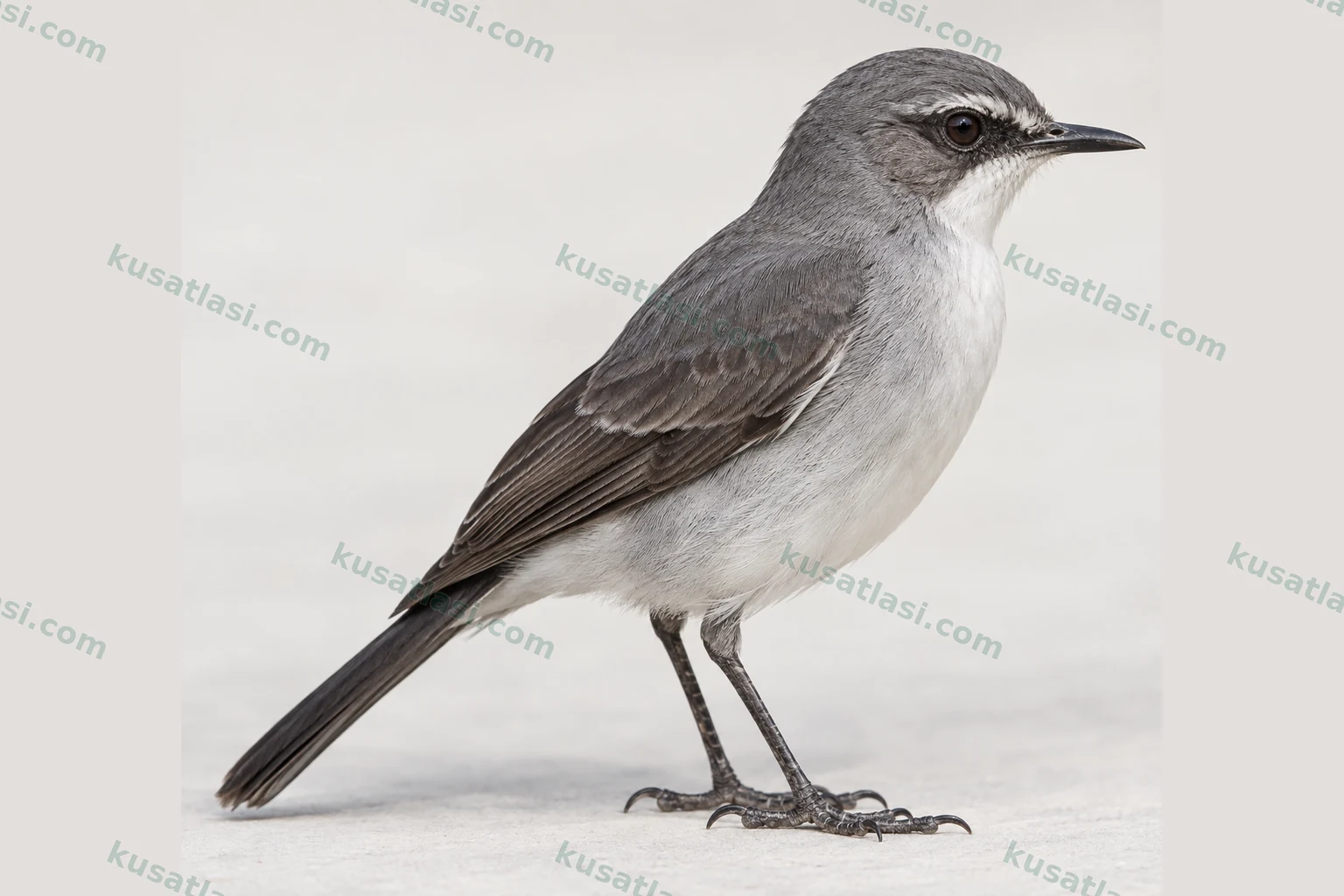
A grey-brown flycatcher of dry East African woodland. The adult has fine dark crown streaks and no conspicuous breast streaking; young birds are not identified by that breast rule.
Biometrics
Length
Male14 cm
Female14 cm
Shared species value
Wing length
Male8.13 cm
Female8.13 cm
Shared species value
Weight
Male11–22 g
Female17–24 g
African Gray Flycatcher
Kenya, northern Tanzania, the Ethiopian Rift and suitable areas of Somalia and South SudanObservation guide in its natural range
Look for three features together
Do not rely on a single featureView crown and breast separately; young birds may have streaked underparts.
The bill has a broad base; plain body colour alone does not separate the species.
It makes short sallies to the ground or air around dry woodland and scrub.
Compare male and female
 FemaleMale
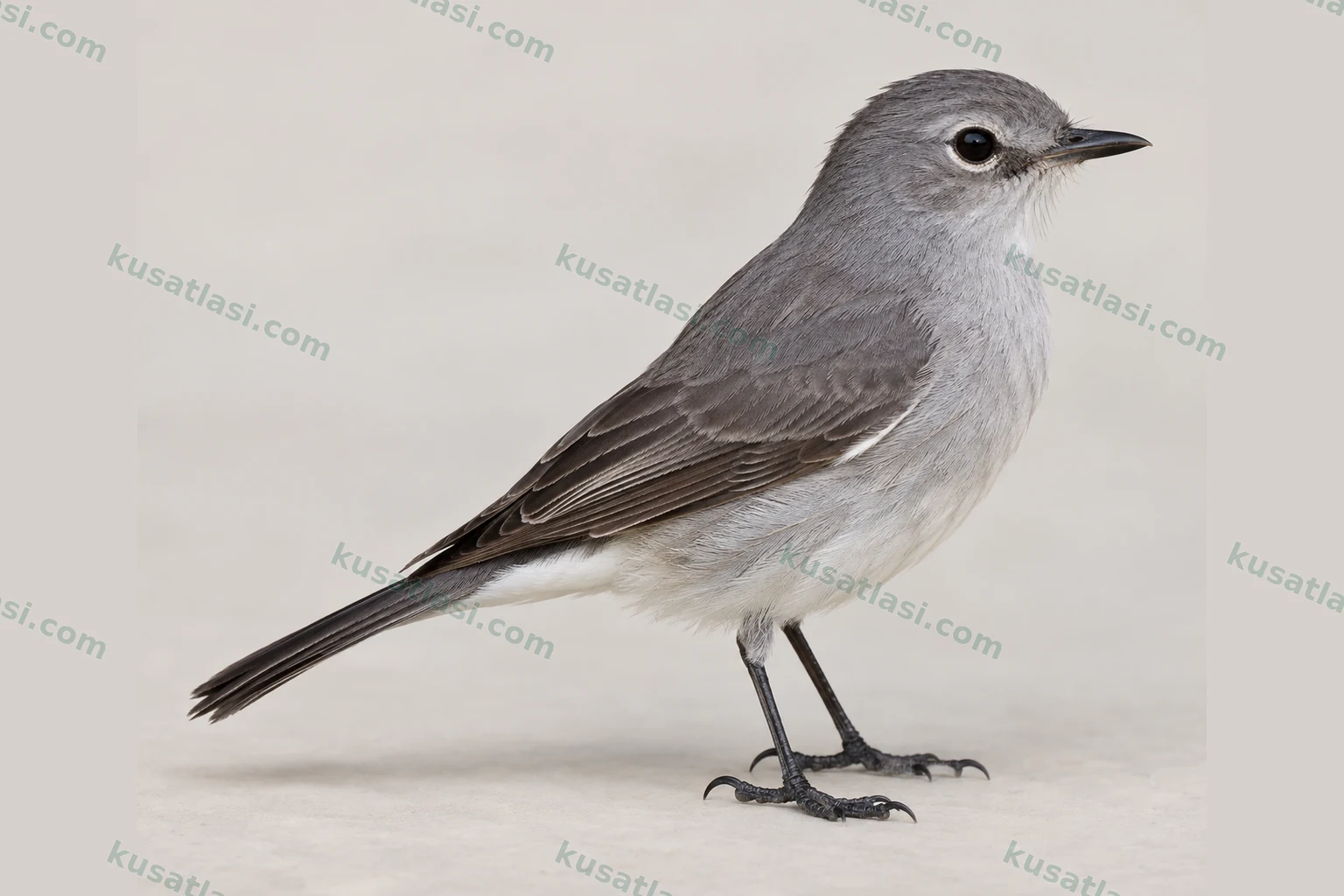
Adult males and females look alike; grey tone alone does not determine sex. Young birds’ pale upperpart marks and breast streaks are assessed in their age context.
Where to look in its natural range?
Watch outer branches in dry, semi-open woodland. Check crown, breast and age-related appearance together; do not enter scrub to look for nests.
Primarily resident. Ethiopian and Somali breeding examples are shown separately; no common monthly breeding or absence calendar is produced for all East Africa.
January
Primarily resident; monthly status is assessed with local records and rainfall patterns. No verified regional date specific to this month was supplied; this does not mean local absence.
February
Primarily resident; monthly status is assessed with local records and rainfall patterns. No verified regional date specific to this month was supplied; this does not mean local absence.
March
Primarily resident; monthly status is assessed with local records and rainfall patterns. No verified regional date specific to this month was supplied; this does not mean local absence.
April
Primarily resident; monthly status is assessed with local records and rainfall patterns. Ethiopian specialist account: within the April or August–October breeding examples.
May
Primarily resident; monthly status is assessed with local records and rainfall patterns. Somali specialist account: May is a month with a reported breeding example.
June
Primarily resident; monthly status is assessed with local records and rainfall patterns. No verified regional date specific to this month was supplied; this does not mean local absence.
July
Primarily resident; monthly status is assessed with local records and rainfall patterns. No verified regional date specific to this month was supplied; this does not mean local absence.
August
Primarily resident; monthly status is assessed with local records and rainfall patterns. Ethiopian specialist account: within the April or August–October breeding examples.
September
Primarily resident; monthly status is assessed with local records and rainfall patterns. Ethiopian specialist account: within the April or August–October breeding examples.
October
Primarily resident; monthly status is assessed with local records and rainfall patterns. Ethiopian specialist account: within the April or August–October breeding examples.
November
Primarily resident; monthly status is assessed with local records and rainfall patterns. No verified regional date specific to this month was supplied; this does not mean local absence.
December
Primarily resident; monthly status is assessed with local records and rainfall patterns. No verified regional date specific to this month was supplied; this does not mean local absence.
Nest, egg and incubation
A shallow open cup in a thorny bush. The specialist synthesis gives one–four eggs, about 12 days of female incubation and about 15 days in the nest with both adults feeding; these are not global experimental averages.
Thin, dry, slightly creaky calls. Check that the voice belongs to the visible bird.
Do not play recordings to attract birds; observe quietly, especially near nests.
Species information
Quick identification
African Gray Flycatcher Bradornis microrhynchus is a small grey-brown flycatcher of dry, semi-open woodland in East Africa. Fine dark streaks on the crown, the absence of conspicuous streaking on the adult’s breast, and a short bill with a broad base are useful together. When examining a bird waiting upright on an outer branch of a bush, first obtain separate views of its head and breast. The overall grey body colour does not identify this species on its own; other plainly coloured flycatchers occur in the same surroundings.
The accepted scientific name is Bradornis microrhynchus and the English name is African Gray Flycatcher. Older compilations of measurements and life-history data may use Melaenornis microrhynchus. That former generic placement refers to the same species, but data for other flycatchers named Melaenornis are not added here. The word African in the Turkish name does not mean that the bird occurs throughout the continent. The identification account and map retain the scope of this East African taxon.
General appearance and posture
The upperparts are greyish brown and the underparts a dull pale grey. The fine dark feather centres on the crown are easier to see in a steady view with suitable light. It is important not to confuse head streaks with breast streaks: the adult is not expected to show the conspicuously streaked breast of Spotted Flycatcher. The shadow of a slender branch or a dark line between feathers can be misread in a photograph as a broad breast pattern.
The dark bill is short and broad at the base. In flycatchers, seeing the bill only from the side makes its basal width harder to assess; waiting for the bird to turn its head naturally is more useful. Bill length is not a feature that can simply be measured from a photograph either. A bill that is not in the same plane as the head may look shorter or longer than it really is. The feet are dark; the posture of a bird waiting on a branch and the head movements with which it watches its surroundings also help with identification.
The wings have pale feather edges, while the tail is relatively inconspicuous beside the body. Those pale edges may create a slight pattern on the dark wing. Wear and light alter their prominence. Failure to see pale wing edges in one frame does not immediately make a bird whose other marks fit a different species. Crown streaks, breast, bill and habitat should be assessed together.
Males, females and young birds
Adult males and females share the same basic grey-brown appearance. A slightly darker or paler body alone does not allow reliable sex determination in the field. Exposure, shade and feather wear can easily change such small tonal differences.
Young birds may have pale spots and streaks above and more conspicuous brown streaking below. The adult’s unstreaked-breast mark is therefore not applied mechanically to young birds. Pale feather tips on the head and wing should be seen together with the pattern below. Breast streaking on a young bird is not sufficient to identify it as Spotted Flycatcher. Age is considered at the start of the comparison.
Some pale feather edges may remain during the transition from young to adult. A definite age label should not be assigned on the assumption that all feathers are replaced at once. A food-begging individual beside adults in a family group can help with age assessment, but does not establish the sex or relationship of every group member. Occurrence in small groups alone does not show cooperative care of the young either.
Appearance in flight
While looking for prey, it may make a short sally from an exposed branch and perch again. The bill, tail and body proportions may be visible briefly, but the short flight makes details hard to resolve. It can descend towards an insect on the ground or pursue prey in the air. Other flycatchers use the same feeding methods; leaving a branch and returning does not identify the species on its own.
Although the resident status and short hunting sallies are compatible observations, they do not establish a rule that a short-winged bird cannot make long movements. Head and breast details that were not visible in flight are checked when the bird perches again.
Voice and behaviour
Calls are described as thin, dry and slightly creaky. A bird waiting quietly can easily be overlooked; watching around the branch from which the sound comes is more useful. Written sound imitations do not reproduce the exact rhythm and tone of a real recording. For identification, make sure that the sound and the visible bird belong to the same individual.
It uses exposed branches as lookout points. Waiting motionless and then moving briefly when prey appears may be more noticeable than this small bird’s colours. Pairs or small groups can also be seen. A perch is not assumed to be the nest site: an open branch chosen for feeding and a nest built in cover serve different functions. Do not follow the bird into scrub in order to find its nest.
Similar species
When comparing it with Pale Flycatcher Agricola pallidus, the African Gray Flycatcher’s streaked crown is particularly useful. Pale Flycatcher has a plainer crown; body proportions and underparts are also examined together. Having pale in its name does not mean that every flycatcher looking light in sunshine belongs to that species. If the crown is hidden, the mark needed for the comparison has not been seen.
Adult Spotted Flycatcher Muscicapa striata has more conspicuous breast streaks. However, young African Gray Flycatchers can also be streaked below. In that case, compare age, pale spotting above, head pattern, bill and overall posture rather than breast alone. In an uncertain record or one showing only the rear, noting the marks actually seen is more reliable than assigning a definite species.
Global distribution
African Gray Flycatcher is an East African taxon. The specialist foreign-language species account lists Kenya, northern Tanzania and the Ethiopian Rift Valley among its main areas, with a sparser distribution in Somalia and South Sudan. These countries should not be treated as continuously suitable habitat in their entirety. Distribution can be patchy among dry open woodland and scrub; closed forest or a part of the same country with a very different climate is not equivalent.
Status within its natural range
The current specialist account gives the global status as Least Concern. This category does not mean that the numbers of every local population are known or that they are unaffected by habitat loss. Occurrence in some protected areas does not prove that the entire range is secure either. Local observation frequency and the global conservation category are separate information. The structure of woodland clearings and thorn scrub may affect the area available to the bird.
The area on the map is shown through a distribution model whose licence and taxon match have been checked. Its coloured portion is not a verified breeding boundary. Licensed observation points are also sampled records; a place without records appearing empty does not mean the bird is certainly absent. The map provides geographical context within its natural regions, without converting an observation into breeding evidence.
Migration
The species is considered primarily resident. No unverified intercontinental migration route or fixed monthly passage line is drawn on this page. Residence does not mean that an individual uses the same tree every day or that young birds never change location. Actual records are needed when assessing local changes in food and vegetation. The Ethiopian and Somali examples in the breeding calendar are not generalized into a shared timetable for the whole range.
Breeding habitat
Dry, semi-open woodland, thorn scrub and grassland with scattered trees are typical surroundings. Sites combining open lookout branches and cover are more appropriate places to identify it than the interior of closed forest. Habitat is not reduced to a plant name: an exposed branch, ground where prey can be sought and nesting cover complement one another. Seeing it beside a lake does not mean that it is a water-dependent species.
Nest site
The specialist account describes a shallow open cup placed in a horizontal branch fork in a thorny bush. It reports one–four eggs, about 12 days of incubation by the female and a nestling period of about 15 days during which both adults feed the young (values from the specialist synthesis for African Gray Flycatcher, not measured global averages). Because some fields in the compiled data are empty, these are not presented as durations verified by an independent experiment. Leaving the nest does not mean that a young bird immediately feeds independently.
Daily space use
The bird perches on an exposed branch, watches its surroundings and moves towards small prey on the ground or in the air. For observation, it is enough to wait at a fixed point outside the bush. It is inappropriate to open thorny cover, move a branch or use playback to draw an adult closer in order to see the nest. If a bird carrying food cannot approach for a long time, move the observation point farther away. An exact breeding territory boundary is not drawn around a single perch.
What does it eat?
Insects and their larvae form the basis of its diet. The specialist account lists prey groups such as caterpillars, beetles, grasshoppers and termites. This list does not show that the foods are eaten in the same proportions in every region. AVONET’s ecological classification also places it among birds feeding on small invertebrates. Recording a prey group and claiming that the entire diet consists of it are different statements; no verified percentage is given here.
How does it hunt?
An exposed branch is used as a lookout; on seeing prey, the bird may make a short sally towards the ground or into the air. The place where prey is caught may differ from the perch. Flight around flowers does not by itself show that it drinks plant sap or nectar either; insects visiting the flowers may be its target. What the bird eats should not be deduced solely from the plant species on which it perches.
The ground opposite the branch and nearby low vegetation are places where its movement can be followed. Waiting for a natural hunting sally without flushing the bird allows both behaviour and species to be assessed better. Food supplied by people does not replace evidence of the natural diet. A single prey item brought during nesting does not represent the young’s entire food list either; the scope of the observation is retained when interpreting feeding and care.
The location of streaks changes identification
The adult African Gray Flycatcher’s fine crown streaks and the young bird’s breast streaks belong to different age and anatomical contexts. That difference is lost if a guide’s short identification sentence is applied in the same way to all ages. When the crown is hidden, one cannot say that the mark is absent, only that it has not been seen. Distinguishing a visible mark from an expected one is particularly useful in plainly coloured birds.
Former genus name
In Myhrvold and colleagues’ life-history compilation, this species appears under the former genus name Melaenornis.
A resident bird’s regional calendar
The specialist account gives breeding examples for Ethiopia in August–October and April, and for Somalia in May. These are times reported for particular regions. A month listed collectively by a source does not establish that the whole species does not breed in the same month. Nor does a month with no date in the calendar mean that the bird is absent there. Keeping rainfall patterns and local records separate makes clearer why a single continental calendar can be misleading.
Seeing the bird in a small family group does not prove that helpers participate in breeding. The nest and care behaviour must be followed separately to establish the breeding system. Observed group size and verified care of the young are therefore not interchangeable; an ordinary field record need not fill in details it does not know.