

World Birds IUCN statusLC · Least ConcernGlobal IUCN category. BirdLife v10 (2025); taxon matching: AviList 2026 / IOC 15.2; checked: 29.10.2026. The list year is not the species assessment date. Source and method · BirdLife OrderPasseriformesPasserines FamilyMuscicapidaeMuscicapidae
African Dusky Flycatcher
Muscicapa adusta
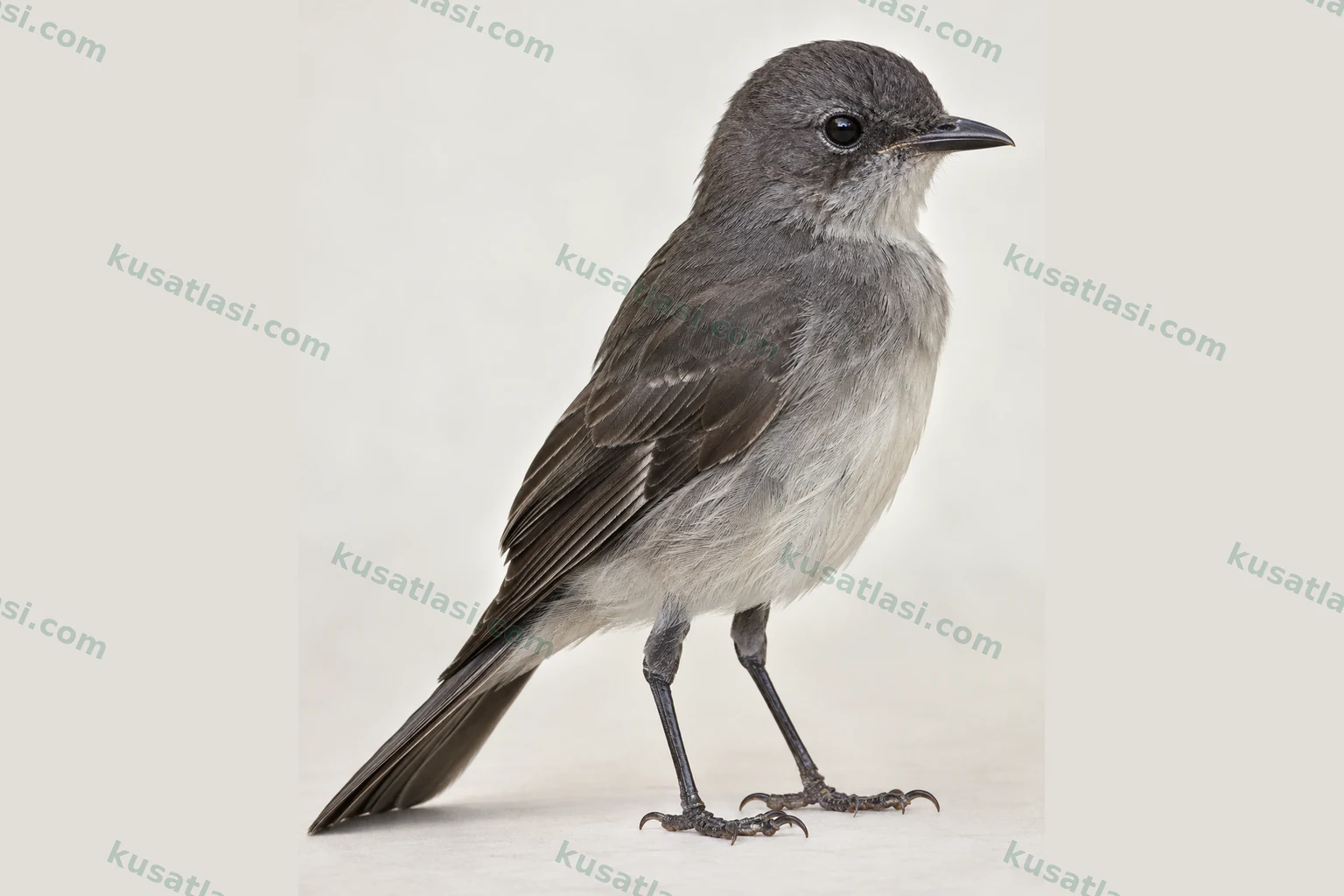
This short, compact brown flycatcher catches small insects in brief sallies at shaded woodland edges. Its pale throat, short pale eyebrow and faint breast pattern are assessed together.
Biometrics
Length
Male13 cm
Female13 cm
Shared species value
Wing length
Male6.34 cm
Female6.34 cm
Shared species value
Weight
Male9.5–13 g
Female9.5–13 g
Shared species value
African Dusky Flycatcher
Eastern and southern African woodlands; separate populations around Cameroon and BiokoObservation guide in its natural range
Look for three features together
Do not rely on a single featureShorter wings and tail than Spotted Flycatcher are sought together with head and breast pattern.
The short pale area before the eye and pale throat help; the entire breast is not assumed to be unmarked.
The bird may use low and middle branches. A short feeding sally alone does not identify the species.
Compare male and female
 FemaleMale
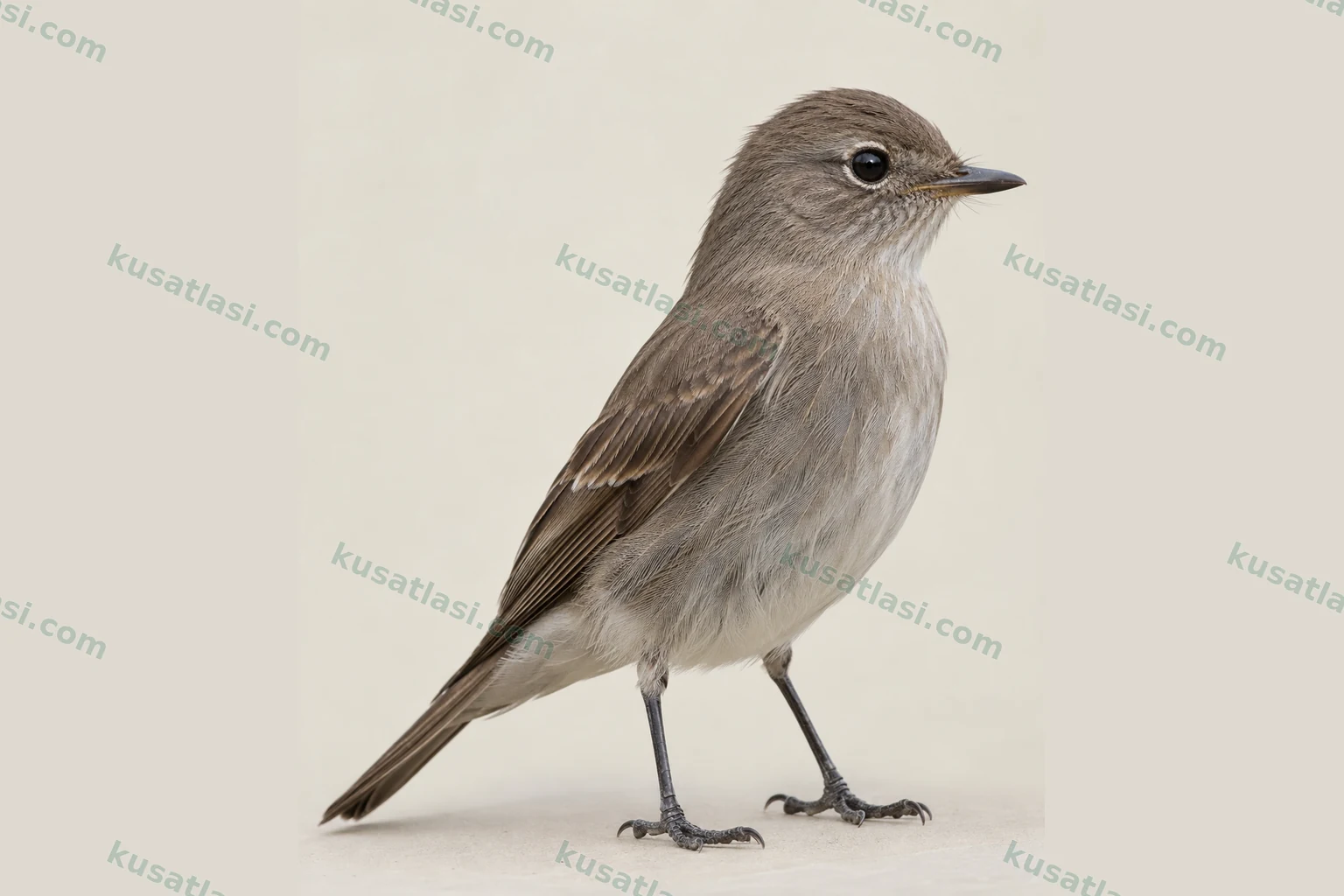
Adult males and females are similar in plumage. Darkness, fluffed feathers or a single body measurement cannot determine sex with certainty; pale upperpart spots may help identify young.
Where to look in its natural range?
Watch wooded riversides, shaded forest clearings and well-treed gardens from the existing path. Do not open bark or vegetation to find a hidden nest.
This is a southern African regional example. Roberts gives laying in September–January, concentrated in October–November. SABAP1 breeding records cover September–March and peak in November–December, about a month after the laying peak. Partial and altitudinal movements occur; these same months do not apply throughout Africa.
January
This is a southern African regional example. Partial migration and altitude changes may occur, so presence at the same place every month is not assumed. This month falls within Roberts’ egg-laying period. This month falls within the period of SABAP1 breeding records.
February
This is a southern African regional example. Partial migration and altitude changes may occur, so presence at the same place every month is not assumed. This month falls outside Roberts’ main laying period; this does not mean absence or no breeding in another region. This month falls within the period of SABAP1 breeding records.
March
This is a southern African regional example. Partial migration and altitude changes may occur, so presence at the same place every month is not assumed. This month falls outside Roberts’ main laying period; this does not mean absence or no breeding in another region. This month falls within the period of SABAP1 breeding records.
April
This is a southern African regional example. Partial migration and altitude changes may occur, so presence at the same place every month is not assumed. This month falls outside Roberts’ main laying period; this does not mean absence or no breeding in another region.
May
This is a southern African regional example. Partial migration and altitude changes may occur, so presence at the same place every month is not assumed. This month falls outside Roberts’ main laying period; this does not mean absence or no breeding in another region.
June
This is a southern African regional example. Partial migration and altitude changes may occur, so presence at the same place every month is not assumed. This month falls outside Roberts’ main laying period; this does not mean absence or no breeding in another region.
July
This is a southern African regional example. Partial migration and altitude changes may occur, so presence at the same place every month is not assumed. This month falls outside Roberts’ main laying period; this does not mean absence or no breeding in another region.
August
This is a southern African regional example. Partial migration and altitude changes may occur, so presence at the same place every month is not assumed. This month falls outside Roberts’ main laying period; this does not mean absence or no breeding in another region.
September
This is a southern African regional example. Partial migration and altitude changes may occur, so presence at the same place every month is not assumed. This month falls within Roberts’ egg-laying period. This month falls within the period of SABAP1 breeding records.
October
This is a southern African regional example. Partial migration and altitude changes may occur, so presence at the same place every month is not assumed. This month falls within Roberts’ egg-laying period. It is a reported month of concentrated egg-laying. This month falls within the period of SABAP1 breeding records.
November
This is a southern African regional example. Partial migration and altitude changes may occur, so presence at the same place every month is not assumed. This month falls within Roberts’ egg-laying period. It is a reported month of concentrated egg-laying. This month falls within the period of SABAP1 breeding records. Atlas breeding records peak in this month; they do not describe the same stage as egg-laying.
December
This is a southern African regional example. Partial migration and altitude changes may occur, so presence at the same place every month is not assumed. This month falls within Roberts’ egg-laying period. This month falls within the period of SABAP1 breeding records. Atlas breeding records peak in this month; they do not describe the same stage as egg-laying.
Nest, egg and incubation
Both sexes may build the open cup nest together. The South African account gives two–three eggs, about 14–15 days incubation by the female and nest departure at about 17 days, rarely 22. The male feeds the incubating female, and both sexes feed the young. Shorter incubation examples from another region are not combined into a new average; departure is not treated as the end of care.
Thin high calls and dawn song may reveal the bird’s position. Cornell’s tzeet/tsirit are approximations; because similar calls can confuse, the sound is supported by head and breast views.
Do not play recordings to attract birds; observe quietly, especially near nests.
Species information
Quick Identification
The African Dusky Flycatcher, Muscicapa adusta, is a plain brown flycatcher that perches at low or middle height along shaded tree edges and sallies after small insects. Its pale throat, short pale line in front of the eye, crown without strong streaking and indistinct dark breast mottling are assessed together. It gives a short, compact impression rather than appearing long-tailed and long-winged. Those proportions help in comparison with close species, but puffed feathers or closed wings can mislead in one frame.
The pale area in front of the eye is not described as a strong eyebrow extending to the back of the head. Nor is every individual's breast pure white and entirely unmarked. To separate similar brown birds, check head, breast and tail on the same individual. Swooping from a branch for insects is common among flycatchers and does not identify the species alone. Occurrence in a densely wooded clearing is supporting context, not a substitute for an unseen mark.
General Appearance and Posture
The upperparts are dark brown; wings are darker and some feathers may have narrow pale brown edges. Pale edges are especially noticeable on the closed wing. Chin and throat are pale, while brownish mottling or faint streaks may show towards the breast sides. The belly ranges from off-white to pale buff, the flanks are darker and the undertail whitish. Pale throat, dark head and faintly marked breast must be considered together, rather than judged only from a photograph's warm or cool colour cast.
The bill is short and looks dark above; a dull yellow area at the lower bill's base may be seen in good light. The eye appears dark brown to nearly black. The bird may watch its surroundings with its short bill pointing forward and return to a perch after a feeding flight, helping observation. It need not return to the same branch every time. Because it uses lower and middle tree layers, searching only the highest branches is not an appropriate method.
The prominence of head and breast markings can vary geographically. Sources compare upperpart darkness and underpart tone when describing subspecies; one photograph's colour settings are insufficient for that. This species account does not require an unsupported subspecies label on every sighting. Locality, date, light and the pattern genuinely resolved are recorded together.
Males, Females and Young Birds
Male and female are similar in overall plumage. A separate male breeding colour reliably applicable to every individual has not been verified. Looking darker or more fluffed does not make a bird male. A female is not selected on the assumption that it must be paler. Two plates can present the adult sexes separately without meaning that every wild adult can be sexed certainly by colour. Even nest behaviour should not replace a reliable label during a brief encounter without prolonged tracking of the individuals.
Pale buff upperpart spots distinguish a young bird from the adult's plain appearance. Spots on the head may be small, those on back and wing larger. Warm pale wing-feather edges and a pale tail tip help. Underparts may be buff, with dark marks on breast and flanks and a paler belly. As it grows more adult-like, a young bird may retain some pale wing tips. This is not exaggerated into a white wing bar.
Seeing a spotted young bird does not settle the species from spots alone: young of other flycatchers can also be spotted. General shape, head and throat appearance, association with adults and voice are assessed together. Even an adult sharing a nearby branch is not proof of parenthood without actual feeding being seen. This source review did not provide a feather-based key to exact months of age; an invented monthly age is not assigned to a young-looking bird.
Appearance in Flight
When hunting, it may make a short flight from its perch towards an airborne insect, sometimes descending to ground prey. Seeing it again on a branch afterwards allows comparison of perched and flying views. Shorter wings and tail are assessed with the compact appearance in comparison with Spotted Flycatcher. Visible wing length changes through a wingbeat; a foreshortened wing in one frame gives no reliable proportion. Head and breast pattern should be checked again when it perches.
Short feeding flights do not prove inability to move over long distances. Southern African atlas studies report seasonal and altitudinal movements in some populations, so wing shape cannot establish year-round residency everywhere. A small bird poorly seen in the air is not identified certainly from flight style alone.
Voice and Behaviour
Thin high calls may reveal the bird's location. Cornell's specialist comparisons “tzeet” and “tsirit” are approximate sound descriptions; reading those syllables does not reproduce all properties of the sound. Song sequences beginning at dawn and short daytime calls need not be the same length. A bird on a shaded branch may be heard before it is seen. Since high calls of similar birds can confuse, the sound is supported by the observed head and breast appearance.
It may be seen alone or as a pair and may join mixed feeding groups. Being with other species in one tree does not mean it nests with them. Waiting motionless on a perch and making short feeding flights can be followed as insect-searching behaviour. Silence during quieter hours does not demonstrate absence. Playback to provoke territorial defence or opening branches around a nest is unnecessary; calm observation from an existing path is sufficient.
Similar Species
1. Spotted Flycatcher, Muscicapa striata, is a principal similar species that can share the broad African geography outside breeding. Longer wings and tail, stronger crown streaks and breast streaking help. The African Dusky Flycatcher's shorter compact shape, plainer crown and faint breast pattern are compared together. Spotted Flycatcher in a more open situation can provide context, but habitat alone does not separate them.
2. Gambaga Flycatcher, Muscicapa gambagae, can look similar as a small brown flycatcher. Cornell's comparison says it is paler and mostly associated with dry woodland. The African Dusky Flycatcher's darker compact look and use of denser evergreen cover edges are considered jointly. Shade can darken a pale bird, so neither setting nor one colour alone decides; uncertainty is left open on a doubtful record.
Global Distribution
The African Dusky Flycatcher occurs naturally in Africa. Its main range extends from Ethiopia through Kenya and Tanzania to suitable wooded areas in the southern continent. Forested Uganda and Rwanda, southern Democratic Republic of the Congo, Zambia, Malawi, Mozambique, Zimbabwe and South Africa form part of the regional context. In the north it is more associated with montane forest surroundings, while in the south coastal and lowland forests are also used. A listed country does not mean continuous occupation of the entire country.
Separate western populations occur around Cameroon, southeastern Nigeria and Bioko Island. Those isolated areas do not imply occupancy of everything between them and the eastern and southern populations. The southern African atlas describes more widespread occurrence along the coast and eastern wooded areas, with a patchier distribution in Zimbabwe. The map helps show this broad context, but a coloured prediction verifies neither presence nor breeding in every small forest.
Status Within Its Native Range
The specialist account gives global Least Concern, LC. This does not say every used forest is safe or every local population is increasing. The southern African atlas discussed low reporting in some Zimbabwean miombo woodlands and possible effects of habitat clearance. That historical interpretation is not presented as a measured current decline percentage for all populations.
Use of gardens and plantations does not remove the importance of natural forest edges. Loss of suitable cover in narrow riverine woods may particularly affect local space use. Failure to see a bird during one outing could relate to shade, seasonal movement or observation duration. Reliable comparison needs repeat records at the same place with similar effort: observation counts are not population size directly.
Migration
Not all populations follow the same movement pattern. The southern African atlas reports regular partial migration and altitudinal movement in the southern range, while the Zimbabwe seasonal pattern appears more resident. Winter decreases in southern and western Cape reporting were considered alongside increases in the Eastern Cape and KwaZulu-Natal. Winter descent from mountains to coastal or lower areas is also reported regionally.
These findings are not a single journey line tracking every individual. No fixed route is drawn across all Africa, and historical atlas regions are not presented as exact current stopovers. A bird coming to a garden in winter does not prove breeding there or that the whole species migrates. Southern African breeding examples in the calendar are not applied with identical months to Cameroon, Ethiopia or Kenya. Local date, altitude and habitat are considered together to interpret movements.
Breeding Habitat
The bird is associated with edges and openings of dense, mostly evergreen tree cover. It is not described as dependent on the darkest interior of closed forest. Natural river gaps, wooded valleys, forest edges, well-treed gardens and parks may be used. It is also recorded along exotic-tree plantation edges in South Africa. Montane habitat is prominent in the northern range, but coastal woods near sea level are possible in the south; one elevation limit is not imposed on the whole species.
Cover and air gaps allowing feeding flights may occur together in breeding habitat. Dense trees alone are not proof of a nest. Atlas habitat reporting rates from southern Africa depend on observations in different cover types; they are not birds per hectare or the proportion of habitat used throughout a year. Historical records are not expected to prove certain presence in a particular modern garden.
Nest Site
Both sexes build an open cup of plant pieces, moss and other fine materials. A space behind bark, a tree cavity, rock crevice or sheltered ledge on a structure may be used. Open cup shape and its sheltered location are separate features; the bird is not said to require a deep enclosed hollow. Some accounts also report use of other birds' old nests. It is not assumed that every individual requires the same structure or materials.
The South African account gives typical two–three eggs, about 14–15 days of female incubation and nest departure at about 17 days, rarely 22. A shorter incubation example in the East African specialist account is not the same regional measurement and is not combined into a new average. The male may feed the incubating female, and both sexes carry food to young. Leaving the nest is not the end of care; a precise care-ending day for all young was not verified here.
Daily Space Use
The bird may wait on shaded low or mid-level branches and search nearby air gaps, sometimes descending to the ground. At the same forest edge it may meet other flycatchers using more open areas. Movements outside breeding can alter seasonal use of gardens and coastal woodland. Around a nest, keep distance on an existing path; do not lift bark, expose the nest site or force young to fly. Approaching the sheltered nest is unnecessary for a photograph of this plain bird.
What Does It Eat?
The African Dusky Flycatcher mainly eats small insects. The regional specialist account reports varied prey including insects, small flies, moths and their caterpillars. Its name does not mean that it eats flies alone. Fruit use is also recorded, with Vepris lanceolata fruit and mulberries among the examples. A fruit record does not make fruit the species' staple diet. These sources did not supply insect–fruit percentages applicable to the entire range.
Prey size and availability may vary with woodland and season. An insect delivered to a nest shows that particular delivery, not exclusive feeding of every chick on the same prey. Unclear prey in a bill is not labelled with an exact insect species in a photograph. Nor is it assumed that one list completely describes all foods across all countries.
How Does It Hunt?
One principal method is a short flight from a low branch to capture an airborne insect. Taking small ground prey and searching around leaves are also reported. Open air near branches helps observation of these flights; the bird is not portrayed as always hunting high. Perch height, aerial versus ground capture and the return destination may be recorded separately.
Regional accounts also describe perching on grazing mammals and catching insects exposed by their movements. This is not compulsory daily behaviour of every bird. Joining mixed bird groups does not prevent solitary feeding. If the particular bird targeting each prey cannot be seen in a group, all the group's prey is not assigned to this species. Releasing insects, scattering leaves or baiting the bird closer is unnecessary for natural feeding observation.
Residency Is Not One Simple Label
The short compact appearance does not rule out seasonal movements in some populations. The southern African atlas considered winter decreases in western and southern Cape reporting alongside eastern increases, and also reported altitude changes. The same atlas gives Zimbabwe a more resident seasonal pattern. This regional distinction remains in text and calendar; no claim is made that all African birds go east in the same month.
Laying and Breeding Records Are Not the Same Dates
The regional Roberts account gives September–January laying, concentrated in October–November. The southern African atlas gives September–March breeding records, concentrated in November–December. Its text explicitly says those breeding records peak about a month later than egg-laying data. Nest, incubation and chick observations are different events, helping explain the calendars' differing appearance. No new average or one African-wide season is created from the two ranges.
Plain Adults, Spotted Young
Against the similar plain appearance of adult males and females, young birds can have pale upperpart spots. Pale wing tips may remain visible for a while as a young bird develops. This helps avoid treating a young bird as another species, but is not sufficient identification because many flycatchers have spotted young. Comparisons consider similar species of the same age as well as young versus adults.
Flexible Nest Sites, Unchanged Observation Responsibility
An open cup behind bark, in a crevice or on a human structure challenges the expectation of one nest setting. Specialist accounts also report reuse of some old bird nests. Flexibility does not mean nesting in every garden or safe use of every structure. Exposing bark or vegetation to show a hidden nest may damage its shelter. Observation from the normal path is preferred.