

World Birds IUCN statusLC · Least ConcernGlobal IUCN category. BirdLife v10 (2025); taxon matching: AviList 2026 / IOC 15.2; checked: 29.10.2026. The list year is not the species assessment date. Source and method · BirdLife OrderPasseriformesPasserines FamilyMuscicapidaeMuscicapidae
White-headed Robin-Chat
Cossypha heinrichi
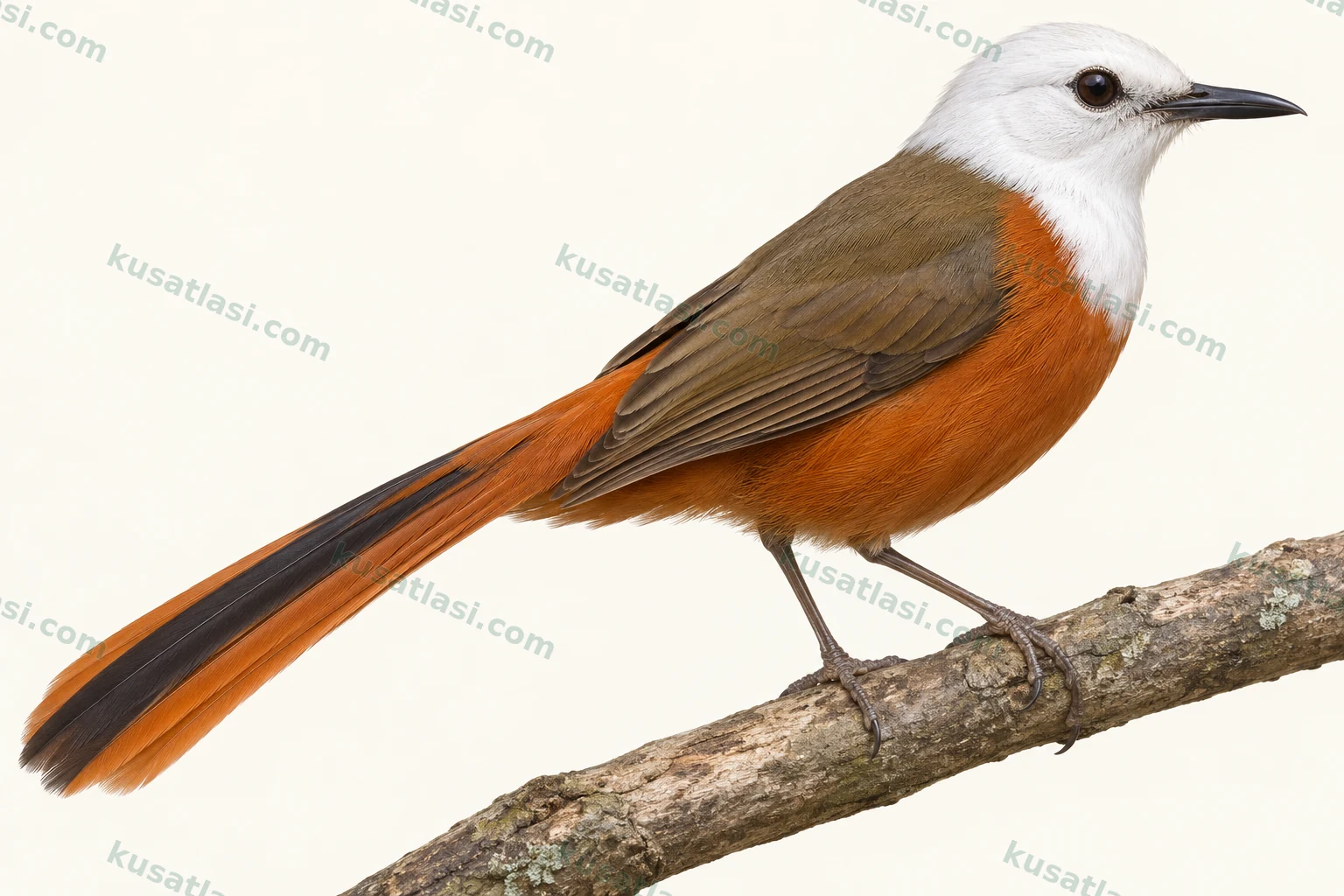
A songbird of streamside forests in northern Angola and adjoining western Congo, with a white head, orange underparts and a very long tail with a dark centre and orange sides.
Biometrics
Length
Male22–23 cm
Female22–23 cm
Shared species value
Wing length
Male12 cm
Female11–11.7 cm
Weight
Male61–69 g
Female56 g
White-headed Robin-Chat
Northern Angola and the adjoining western Democratic Republic of the CongoObservation guide in its natural range
Look for three features together
Do not rely on a single featureExtensive white on the head, orange underparts and a dark brown back.
Very long, with a dark centre and broad orange sides.
The same phrase may grow louder as it is repeated in a sequence. Pitch alone does not identify it.
Compare male and female
 FemaleMale
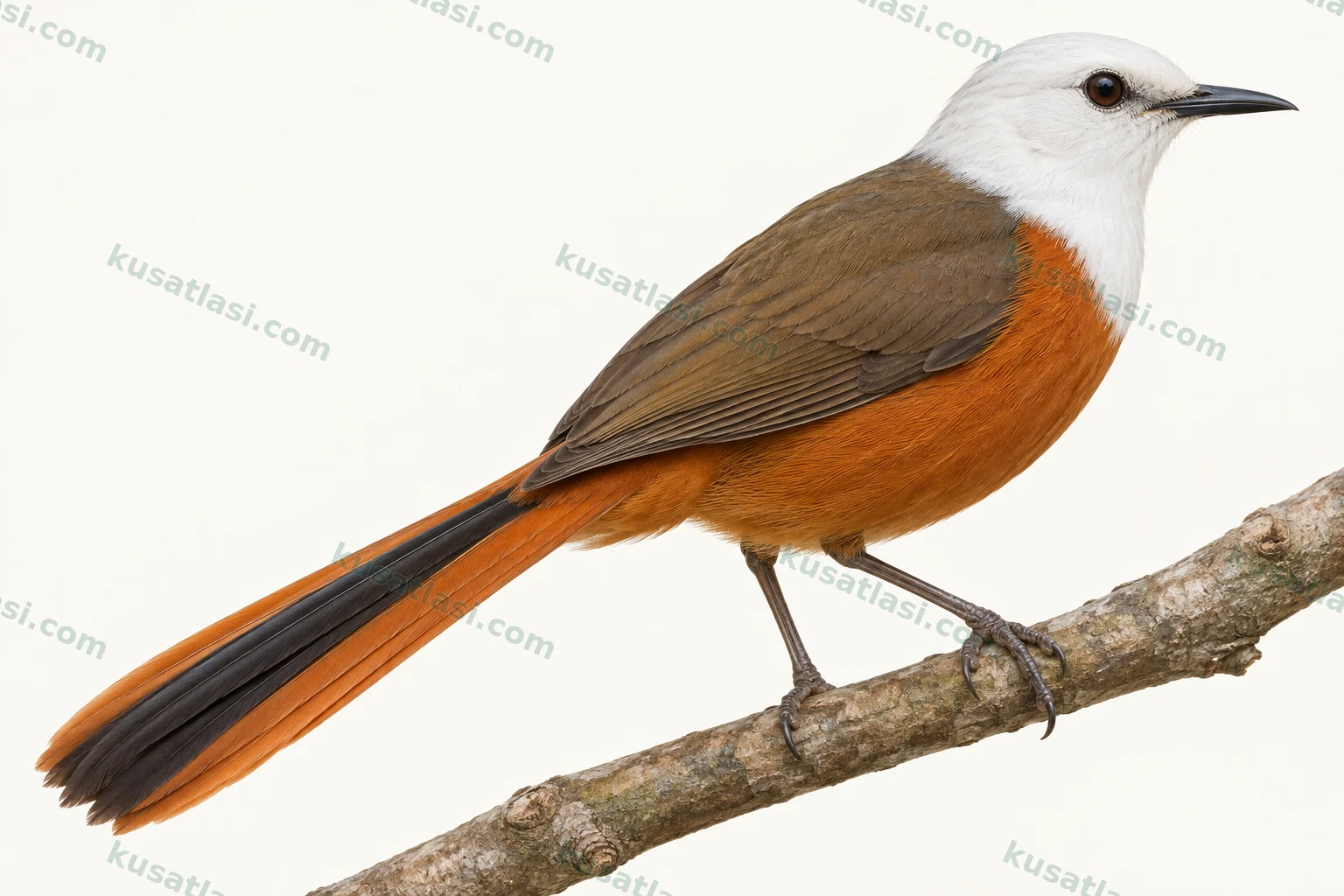
The adult is identified by its white head, orange underparts and dark back. The sources examined did not provide reliable external sex characters, and the detailed juvenile appearance was not verified.
Where to look in its natural range?
Dense undergrowth in streamside forest. Feeding high in trees has also been documented.
The general period reported for northern Angola in the specialist account does not indicate a nest inspected directly in every month.
January
Regular long-distance migration has not been verified. Local feeding movements do not establish a migration route. The specialist account gives a general breeding season for northern Angola. Nest and egg details were not verified.
February
Regular long-distance migration has not been verified. Local feeding movements do not establish a migration route. The specialist account gives a general breeding season for northern Angola. Nest and egg details were not verified.
March
Regular long-distance migration has not been verified. Local feeding movements do not establish a migration route. The specialist account gives a general breeding season for northern Angola. Nest and egg details were not verified.
April
Regular long-distance migration has not been verified. Local feeding movements do not establish a migration route. No verified regional date was given for this month. This does not imply local absence.
May
Regular long-distance migration has not been verified. Local feeding movements do not establish a migration route. No verified regional date was given for this month. This does not imply local absence.
June
Regular long-distance migration has not been verified. Local feeding movements do not establish a migration route. No verified regional date was given for this month. This does not imply local absence.
July
Regular long-distance migration has not been verified. Local feeding movements do not establish a migration route. No verified regional date was given for this month. This does not imply local absence.
August
Regular long-distance migration has not been verified. Local feeding movements do not establish a migration route. No verified regional date was given for this month. This does not imply local absence.
September
Regular long-distance migration has not been verified. Local feeding movements do not establish a migration route. The specialist account gives a general breeding season for northern Angola. Nest and egg details were not verified.
October
Regular long-distance migration has not been verified. Local feeding movements do not establish a migration route. The specialist account gives a general breeding season for northern Angola. Nest and egg details were not verified.
November
Regular long-distance migration has not been verified. Local feeding movements do not establish a migration route. The specialist account gives a general breeding season for northern Angola. Nest and egg details were not verified.
December
Regular long-distance migration has not been verified. Local feeding movements do not establish a migration route. The specialist account gives a general breeding season for northern Angola. Nest and egg details were not verified.
Nest, egg and incubation
The specialist account gives a September–March breeding season. Nest structure, clutch size, incubation duration and the time to nest departure were not verified.
A clear whistled phrase may be repeated and grow louder within the same sequence. A short rising whistle has also been recorded.
Do not play recordings to attract birds; observe quietly, especially near nests.
Species information
Quick identification
The White-headed Robin-Chat Cossypha heinrichi is a large songbird of dense forest cover in northern Angola and the adjacent western Democratic Republic of the Congo. The white head, warm orange underparts and dark brown back form a distinctive combination. The very long tail has a dark centre and broad orange sides. The white extends beyond a thin eyebrow or a small cap and covers much of the adult head.
The bird often stays among leaves and branches, where only the long tail or part of the head may be visible. Look for the head, body and tail pattern on the same bird instead of relying on a single pale spot. The species should not be described as common in every East African montane forest. Geography matters for identification. A white-headed bird outside northern Angola cannot be assigned to this species solely on the basis of similar colours.
General appearance and posture
The head and the breast and belly form distinct blocks of colour. The head is white, the underparts orange and the upperparts dark brown. The tail projects conspicuously behind the body, with orange outer feathers adjoining the dark centre. These areas are easier to see when the tail is spread. The back may look very dark in shade, and the orange underparts may look redder or paler depending on the light.
Original field observations around Kalandula describe resting birds briefly opening and closing the tail and slowly moving it up and down. This movement is a useful clue, but does not identify the species on its own. Check that the head is truly white and that the orange underparts are on the same bird. An elongated tail silhouette alone can lead to confusion with a flycatcher.
Males, females and young birds
The modern specialist accounts examined describe the adult combination of a white head, orange underparts and dark back. They do not provide a reliable way to determine sex by appearance. A white-headed bird is therefore not automatically male. Seeing two birds together as a pair does not by itself reveal which is female.
The detailed appearance of young birds at different ages could not be verified adequately from the original sources accessible for this account. A restricted view of the adult's white colouring would be misleading as direct evidence of youth, since branches and lighting can give the same impression. When a bird is thought to be young, direct care behaviour and dated observations should be considered along with head colour. Juvenile patterns from related robin-chats are not transferred to this species.
Appearance in flight
The long tail is conspicuous during a short flight between two patches of cover, but the head and underparts may be visible only for a moment. The 2005 field note records a bird flying past a trail by a stream and other individuals subsequently watched inside the forest. Such a short crossing is distinct from long-distance seasonal migration. Recording the direction of a flight and establishing a migration route require different levels of evidence.
The same study reported a bird flying from a perch high in a tree towards an insect. Its feeding is therefore not assumed to be confined to the ground. The excited flights seen in response to a recording should be distinguished from spontaneous, routine hunting. Playback to bring the bird into the open is discouraged. Its spontaneous movements can be watched from a quiet spot.
Voice and behaviour
The song consists of clear, musical whistles. In Mills's 2009 analysis, four song sequences recorded north of Kalandula lasted 35–70 seconds. The same phrase was faint at first and grew louder as it was repeated within a sequence. These figures apply to those four recordings and are not a fixed duration for every call from every bird. A short rising whistle was also reported as a separate call.
An earlier account suggested that the song was higher in pitch than that of the White-browed Robin-Chat. Later sound measurements did not support that impression, since the recorded frequencies overlapped substantially. A more useful distinction is that the White-headed Robin-Chat keeps repeating the same phrase within a sequence, whereas the other species may use more varied phrases. Pitch alone does not establish the species. Consider the bird giving the sound and its habitat as well.
Similar species
The White-browed Robin-Chat Cossypha heuglini may look similar at a distance because of its orange underparts and prominent song. Its broad white eyebrows separate the dark face from the dark crown, leaving much of the head dark. On the White-headed Robin-Chat, look at the extent of the white on the head together with the dark centre and orange sides of the tail. The loudness or pitch of the song cannot substitute for the head pattern.
Use the same approach with other small songbirds from the Angolan region that have dark upperparts and pale head markings. Distinguish a narrow eyebrow from an extensively white head. If only an orange section of tail was seen and the head stayed hidden, the identification can remain open. The colour pattern is distinctive in a well-seen adult, while a short, partial glimpse carries less certainty.
World distribution
The accepted natural range covers northwestern and north-central Angola and the adjacent western Democratic Republic of the Congo, especially its far southwest. Well-documented Angolan sites include streamside forests in the Malanje region. Kenya, Ethiopia and the entire Congo Basin should not be substituted for this restricted distribution. Presence in a country does not indicate equal use of its whole territory.
Status within its natural range
The bird may be easy to find locally in suitable forest strips, although its overall range is narrow and fragmented. The 2005 study found more than one bird along a short stretch of stream north of Kalandula. That finding does not give a population density for all Angola. The study also recorded the bird in streamside forest disturbed by nearby villages and agriculture. This single local finding does not establish that habitat loss is harmless.
Older publications used the Vulnerable category. The current taxonomic list gives the conservation category as Least Concern. The category in the old book should not be presented as current. The current category does not establish that all local forests are protected or that a new nationwide population census has been carried out.
Migration
The sources establish no regular long-distance seasonal migration route. Resident use of the natural range is distinguished from feeding movements along a stream. Following an ant colony is a local movement. The map may show cells with example observations, but those records cannot establish unknown departure and arrival countries or a shared migration route.
Breeding habitat
Forest strips with dense undergrowth along streams and rivers are its principal documented habitat. Occurrence near open woodland or savanna does not make the entire open landscape suitable for breeding. The position of the forest strip and the way its surroundings are used are considered together. A national boundary alone is insufficient for drawing a breeding area.
Nest site
Mills's specialist account reports a breeding season from September to March and explicitly says that the nest has not been described. Nest material, nest height, usual clutch size, incubation duration and the time young remain in the nest could not be verified in this review. Cup nests or egg counts from related species should not be copied here. The broad breeding period does not represent direct egg counts in every month.
Daily habitat use
The bird moves under dense cover. It may follow trails of ants and may also feed high in trees. Treating the stream edge only as a place for drinking overlooks the value of the surrounding vegetation. Avoid cutting branches or repeatedly playing recordings to bring the bird into view. When care behaviour is visible, move away rather than trying to find the unknown nest.
What does it eat?
The specialist account reports mainly ants and other insects. Following ant colonies and directly identifying prey are separate observations. An observer may not see what the bird takes in its bill every time it follows an ant trail. Insects that could not be seen in the field are left unidentified. The sources examined give no detailed prey percentages covering the whole year and every region.
How does it forage?
It may search for food in dense cover and near ant trails, and its feeding is not confined to the ground. The original 2005 record north of Kalandula describes a bird flying from a high perch in a tree towards an airborne insect. This shows that it can forage in different positions. One observation does not establish that it hunts in the canopy continuously or takes all its food in flight.
If prey is indistinct at the end of a short flight from a perch, record the movement alone. Flights in response to playback are distinguished from spontaneous feeding. Forcing the bird into view through the foliage changes the observation conditions and makes natural behaviour harder to interpret.
A new record does not establish a return
The brief 2005 survey in northern Angola documented the White-headed Robin-Chat again after a long gap in reported records. The researchers also described how years of war had affected the availability of field data. A long gap in records does not establish that the species vanished from the whole region and later returned. Access to research and the actual presence of the bird are separate questions.
Measuring sound can change a first impression
The first field note suggested that the song had a higher pitch than that of the related species. Later analysis found that the frequencies overlapped substantially. Repetition of the same phrase within a sequence was a more useful distinction. Detailed measurements in ornithology can test even an experienced observer's first impression. An earlier explanation is open to revision when new evidence emerges.
Birds that stay in cover can also fly up into trees
Direct observations also recorded this bird foraging high in a tree despite its habit of staying hidden in the streamside undergrowth. The excited response produced by playback differs from spontaneous daily behaviour. How the observation was made matters when interpreting it. Repeatedly playing sound to see the bird does not yield the same information as observing natural behaviour.
Breeding information needs care when the nest is unknown
The specialist book reports a breeding season without describing the nest. These two findings can coexist because a season may be established by evidence different from detailed examination of nests and eggs. Missing clutch sizes and development periods are left open rather than filled with data from relatives. A verified future nest study could extend this knowledge. Carrying food to young, obtaining a complete egg count and following development from hatching would each be a separate record. Finding one does not establish the others.