

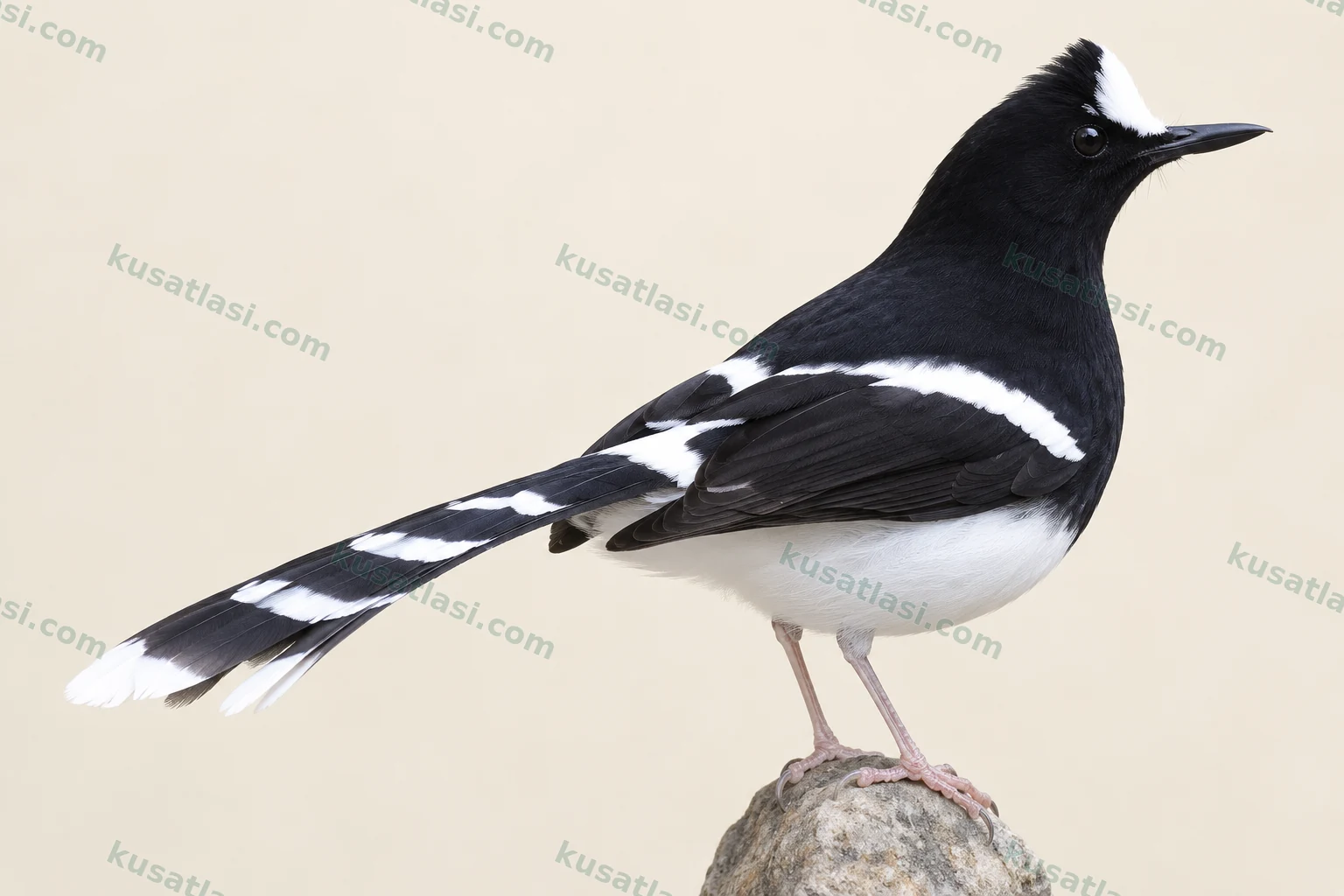
World Birds IUCN statusAccording to source taxonGlobal IUCN. BirdLife v10 (2025); taxon matching AviList 2026 / IOC 15.2; checked: 29.10.2026. The list year is not the species’ assessment date. Source and method OrderPasseriformesPasserines FamilyMuscicapidaeMuscicapidae
White-crowned Forktail
Enicurus leschenaulti
A bird of shaded Asian streams with white forehead, unspotted black back and long forked tail; Borneo’s mountain taxon is a separate species.
Biometrics
Length
Male25–28 cm
Female25–28 cm
Shared species value
Wing length
Male9.8–11.4 cm
Female9.8–11.4 cm
Shared species value
Weight
MaleData unavailable
Female53.5 g
White-crowned Forktail
Forested streams of the eastern Himalayan foothills, Southeast Asia and the Sunda IslandsObservation guide in its natural range
Look for three features together
Do not rely on a single featureWhite forehead and forecrown; the white does not extend behind the eye like a broad eyebrow.
Unspotted black in adults; rump and uppertail are white.
Long, forked and broken into a black-and-white pattern.
Compare male and female
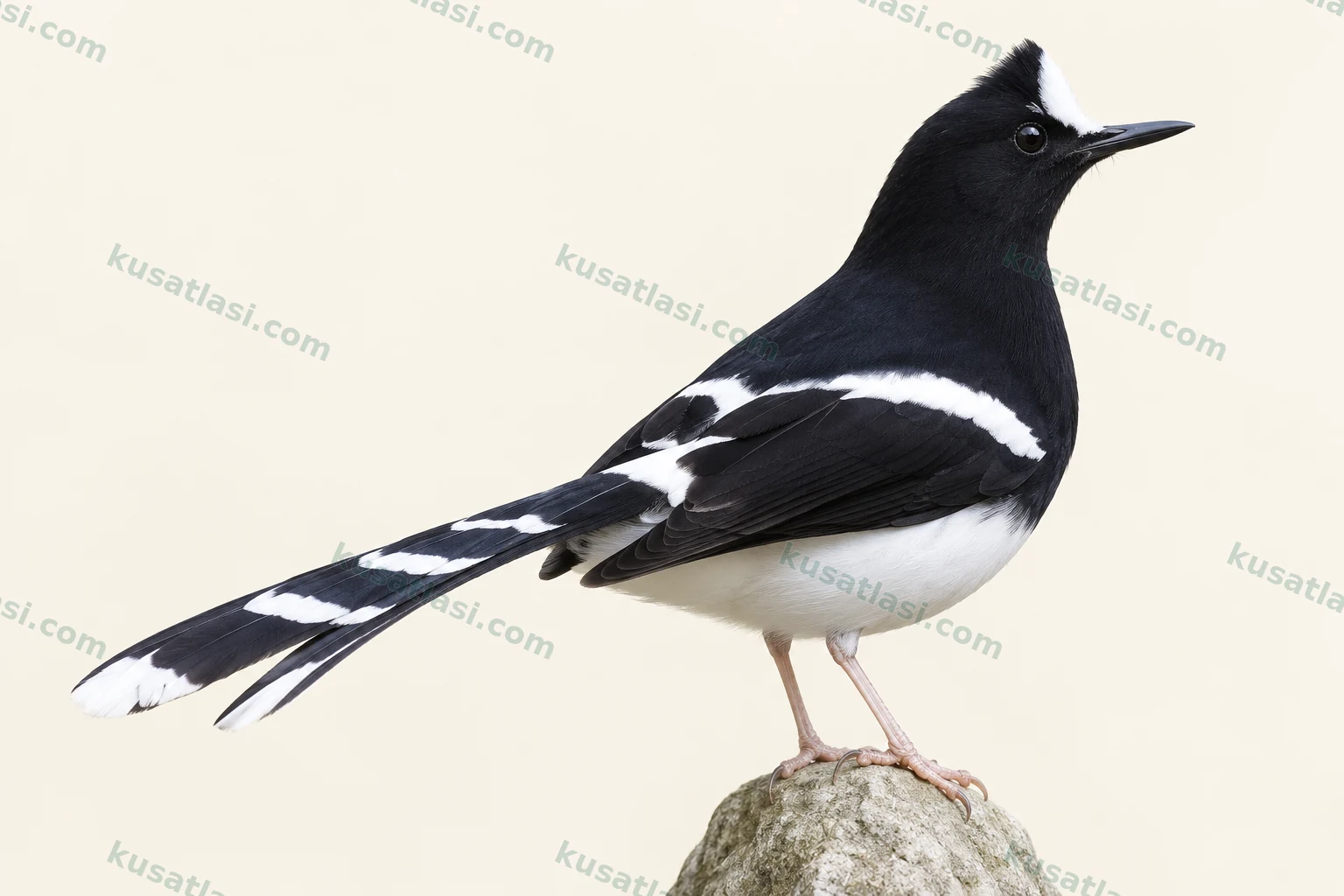 FemaleMale
Male and female are similar. Young birds are browner, with streaked or spotted underparts; a white forehead may not yet be present.
Where to look in its natural range?
On rocks and low branches overhanging shaded fast streams. Bornean lowland records belonged to the old broad concept; AviList v2026 separates them as Enicurus frontalis.
Regional breeding information is shown, not one season for the whole range.
January
Mostly resident; possible seasonal movement to lower ground in the north is mentioned. Sangi, Sumatra — 2006: an active nest with two eggs was documented directly. Java — specialist species account: a regional breeding period, not applicable to all Asia.
February
Mostly resident; possible seasonal movement to lower ground in the north is mentioned. Java — specialist species account: a regional breeding period, not applicable to all Asia.
March
Mostly resident; possible seasonal movement to lower ground in the north is mentioned. Java — specialist species account: a regional breeding period, not applicable to all Asia.
April
Mostly resident; possible seasonal movement to lower ground in the north is mentioned. Himalaya — specialist species account: a regional nesting period. Java — specialist species account: a regional breeding period, not applicable to all Asia.
May
Mostly resident; possible seasonal movement to lower ground in the north is mentioned. Himalaya — specialist species account: a regional nesting period. Java — specialist species account: a regional breeding period, not applicable to all Asia.
June
Mostly resident; possible seasonal movement to lower ground in the north is mentioned. Himalaya — specialist species account: a regional nesting period.
July
Mostly resident; possible seasonal movement to lower ground in the north is mentioned. No verified regional date specific to this month was given; this does not mean local absence.
August
Mostly resident; possible seasonal movement to lower ground in the north is mentioned. No verified regional date specific to this month was given; this does not mean local absence.
September
Mostly resident; possible seasonal movement to lower ground in the north is mentioned. No verified regional date specific to this month was given; this does not mean local absence.
October
Mostly resident; possible seasonal movement to lower ground in the north is mentioned. Java — specialist species account: a regional breeding period, not applicable to all Asia.
November
Mostly resident; possible seasonal movement to lower ground in the north is mentioned. Java — specialist species account: a regional breeding period, not applicable to all Asia.
December
Mostly resident; possible seasonal movement to lower ground in the north is mentioned. Java — specialist species account: a regional breeding period, not applicable to all Asia.
Nest, egg and incubation
The nest beside a stream uses moss and plant fibres; two eggs were directly recorded on Sumatra. A scientific comparison cites 16 days of incubation and 15 days of nest development for Thailand, versus 17–19 and 16–17 days for China; these are regional results.
A harsh buzzy whistle and thin metallic whistles; match them to a visible bird against the stream’s sound.
Do not play recordings to attract birds; observe quietly, especially near nests.
Species information
Quick identification
This account describes the former broad species concept of White-crowned Forktail. AviList v2026 separates the group into Enicurus leschenaulti of Java (Javan Forktail), Enicurus frontalis (Malayan Forktail) and Enicurus sinensis (Northern Forktail). The broad geography and regional studies below must be read within that older group concept; they do not all concern the restricted Javan species. White-crowned Forktail Enicurus leschenaulti is a long-tailed black-and-white passerine of shaded Asian forest streams. Its white forehead and forecrown stand out above the dark face and breast. The back is black and appears unspotted in adults. The two sides of the long tail separate; its black and white feather sections can appear as differently sized patches during movement. White forehead, unspotted black back and long forked tail are assessed together.
The bird is most often seen on rocks in a stream or low branches overhanging the water. Standing on a rock, then moving briefly to another, offers a useful clue when looking along a watercourse. Black-and-white colour and a long tail alone are insufficient, however. The white head area should not be interpreted as a broad eyebrow extending behind the eye; this detail matters in comparison with similar forktails.
General appearance and posture
The adult has a white forehead and front of the crown, with black face and breast. The dark back contrasts sharply with white on the shoulders and wing. Rump and uppertail are white; belly and undertail also look pale. The bill is black. Feet are pale pinkish or flesh-toned, although stream shade can make them look darker. Head, back, wing and underpart patterns are checked separately.
Outer and inner tail feathers are not equally long. White outer areas and white tips on black feathers create a broken tail pattern rather than one regular transverse line. White patches widen and narrow as the tail opens and closes. Tail length and the white head area also vary between geographical forms. Photographs from two different regions are therefore not expected to show exactly the same proportion of white.
Males, females and young birds
Male and female plumage patterns are similar. A slightly broader-looking adult white forehead or more glossy black breast is not a certain sex character. Light, head angle and geographical form can alter their appearance. Instead of assigning different colour schemes to the sexes, assess whether the bird is adult and consider the head-and-back pattern as a whole.
The young bird has brown or dark brown in areas that are black in adults. Its throat may be paler, breast streaked and belly spotted brown. The historical description of indicus states that young birds do not yet have a white forehead. A brown young bird lacking white on the forehead therefore cannot be excluded solely on that basis. Adults on the same stream may provide useful context, but every nearby young bird is not automatically their offspring.
The old broad White-crowned Forktail account compared birds of Java, the Malay Peninsula, Sumatra, Bornean lowlands and mainland Asia as different forms. In AviList v2026, frontalis and sinensis are no longer subspecies of Enicurus leschenaulti. Geographical plumage differences cannot serve as male–female differences within one current species. Enicurus borneensis of the Bornean mountains is also a separate species.
Appearance in flight
Short flights along streams can reveal black-and-white wing areas and the pale tips of the long tail. Flying between rocks allows the bird to reach another perch over the fast current. One wing angle may not show the true extent of the white. On landing, check the white head boundary and unspotted black back again; one pale flash in flight is not a complete identification.
The specialist description compares the flight movement to that of a wagtail. This does not place the bird in the wagtail family or imply identical migration habits. Flying from a stream into scrub is not evidence of seasonal migration either. Since the long tail is held differently at rest and in flight, its terminal markings are compared over several views.
Voice and behaviour
Cornell’s specialist description emphasises a harsh buzzy whistle and thin metallic whistles. Against the constant sound of a stream, these calls may help locate the bird before it is seen. Observe which individual actually produces the sound. Other forktails and whistling thrushes can use the same stream; one harsh call alone does not establish species identity.
Birds can forage alone or in pairs. They hop between stones, searching for small prey along banks and wet rock surfaces. They generally do not feed in the manner of dippers, submerging the whole body. This distinguishes living beside water from regularly walking and hunting underwater. When disturbed, a bird may retreat into dense bankside vegetation.
A nest documented on Sumatra on 30 January 2006 was beside a small stream shaded by tall rubber and fruit trees. The incubating bird left the nest when approached closely. This direct observation shows the importance of withdrawing when a nest is found. Rather than exposing its entrance for a photograph or repeatedly flushing the bird, watch normal feeding among rocks and bankside plants from a distance.
Similar species
Black-backed Forktail Enicurus immaculatus warrants comparison because of its similar black-and-white appearance. Cornell’s comparison describes its white head area as extending behind the eye, unlike the absence of such a broad extension in White-crowned Forktail. Current, rocks and a long tail alone do not separate them; the side of the head must be seen clearly.
Adult Slaty-backed Forktail Enicurus schistaceus differs in having a slate-grey rather than black back. Spotted Forktail Enicurus maculatus differs through pale spots on the back. The adult White-crowned Forktail back is unspotted black. Brown and spotted juvenile appearance can complicate this simple adult comparison; age is not ignored.
Enicurus borneensis of the Bornean mountains is a close relative treated as a subspecies in older sources. Its current separation is not assumed to be resolvable from one long-tail photograph; geography, elevation, voice and a reliable taxonomic record matter together. The name leschenaulti in a paper’s title is not sufficient reason to transfer every breeding value of the borneensis birds studied there to this page.
World distribution
The range covered by the old broad account extends from the Himalayan foothills of northeastern India through Myanmar, northern Thailand and Indochina, and into western and southern China and Hainan. To the south it includes the Thai–Malay Peninsula, Sumatra and Nias, Bornean lowlands, Java and Bali. The form chaseni is recognised on Tanahmasa in the Batu Islands off western Sumatra. This broad geography does not mean continuous presence in every forest or watercourse.
Lowland Bornean frontalis belonged to the older broad concept underlying this page. AviList v2026 places it in the separate species Enicurus frontalis; Enicurus borneensis of the mountains is separate too. Bornean records are not added to the Javan range of restricted current Enicurus leschenaulti.
Status within its natural range
The Least Concern assessment published for the older broad Enicurus leschenaulti cannot automatically be applied to every restricted species separated by AviList v2026. Where an assessment does not exactly match the taxonomic scope of this page, no verified category for that species is displayed. Failure to verify a separate category does not mean that the species was officially assigned NE either.
The 2006 Sumatran nest record was published under the then-broad name Enicurus leschenaulti. AviList v2026 treats Sumatran birds within Enicurus frontalis. This is not breeding evidence for restricted Javan Enicurus leschenaulti, nor proof of nesting in every rubber plantation on Sumatra.
Movements
It is resident through much of the range. Specialist sources mention possible winter movements to lower elevations in some northern mountain populations; this is not the whole group migrating along one long route. Daily movement between stream rocks and local space use are distinguished from seasonal movement. No migration line linking countries is supplied without verified individual tracking.
Breeding habitat
The principal habitat comprises shaded forest streams with rocky beds and fast-flowing small watercourses. Dense evergreen forest cover is particularly important. Northern habitats and those of the Sunda Islands are not all at the same elevation. The direct Sumatran nest record came from 450 metres, among rubber trees mixed with fruit trees and native forest trees. These particular conditions differ from wholly open, treeless production land.
Nest site
The nest uses moss, lichen, leaves, grass and fine fibres and may be placed in sheltered locations such as rock ledges, gaps between stones or around roots. Two eggs were observed in a deep cavity inside the bank immediately beside a small Sumatran stream. They were pale pinkish white with small dark spots. The count in this single nest is not an invariant clutch size for every geographical form.
A scientific comparison published in 2022 cites 16 days of incubation and 15 days of development in the nest in a Thai study, versus 17–19 and 16–17 days respectively for China. These are regional research results. Values directly measured in that paper for Bornean mountain birds concern a separate taxon and are not used here. Do not obstruct the bird’s entrance route while watching a nest or clear vegetation in a way that exposes it to predators.
Daily habitat use
During foraging, the bird uses stream rocks, damp banks and low branches near water. Shaded areas immediately beside the water offer perches and concealment. Specialist accounts also mention shaded gullies where water becomes very scarce. This does not make the bird a general inhabitant of dry open land. Waiting at a quiet point beside the stream is more suitable than continually driving it ahead between rocks.
What does it eat?
Insects and other small invertebrates are the principal foods. The foreign specialist account lists beetles, small jumping invertebrates and caterpillars. This is not a stomach analysis demonstrating that one prey species is eaten in an identical proportion all year. Small prey in the stream and along damp banks matter; dietary percentages of a close relative are not used as this bird’s measured diet.
How does it forage?
The bird searches for prey with short steps over stones and bankside surfaces and may hop while moving. Although feeding beside water, it generally does not submerge the whole body. Collecting small prey with its pointed bill differs from constantly chasing flying insects over broad open spaces.
Tree shade and damp stream surfaces form parts of this feeding environment. Briefly perching on a dry rock does not establish that all prey is collected from dry ground. Feeding locations are watched together with water level and bank structure. Blocking the current, lifting stones or clearing bankside plants to obtain a close view can alter the natural foraging habitat.
One old name may include two different species
Lowland and highland Bornean forktails were formerly described within one broad species. Current AviList treats mountain borneensis as separate. The title of the detailed breeding study published in 2022 retains older nomenclature, while its methods explicitly identify which form was measured. Before using a number, check not only the scientific name but also the population actually studied.
A breeding record came from tree-covered production land
Iqbal’s record, published in 2011, describes a two-egg nest found on Sumatra on 30 January 2006. The site is not a flat field containing rubber trees alone; it is a mixed wooded area with tall fruit and native forest trees and a small stream. Finding a nest there contradicts the idea that the bird can enter no human-used land. It does not show that every production system provides habitat equivalent to a forest stream.
Incubation duration must retain its regional context
The incubation and nest-stay periods cited from Thailand and China in the scientific comparison are close but not identical. The studies concern different climates and populations. Time in the nest is not the age at which adult dimensions or every aspect of independent life are attained. Feather development and food-begging may not end when a young bird leaves its nest; values are interpreted alongside the events actually measured.
Not every stream bird feeds like a dipper
White-crowned Forktail lives very close to water, but most feeding movements occur on rocks and damp banks. It is not expected regularly to show the distinctive underwater foraging of dippers. Similar habitats do not necessarily mean identical relationships or hunting methods. Watching how a bird moves between rocks, water and bank is more informative than merely noting its presence in a stream.