

World Birds IUCN statusAccording to the source taxonGlobal IUCN. BirdLife v10 (2025); taxon matching AviList 2026 / IOC 15.2; checked: 29.10.2026. The list year is not the species’ assessment date. Source and method OrderPasseriformesPasserines FamilyMuscicapidaeMuscicapidae
African Stonechat
Saxicola torquatus
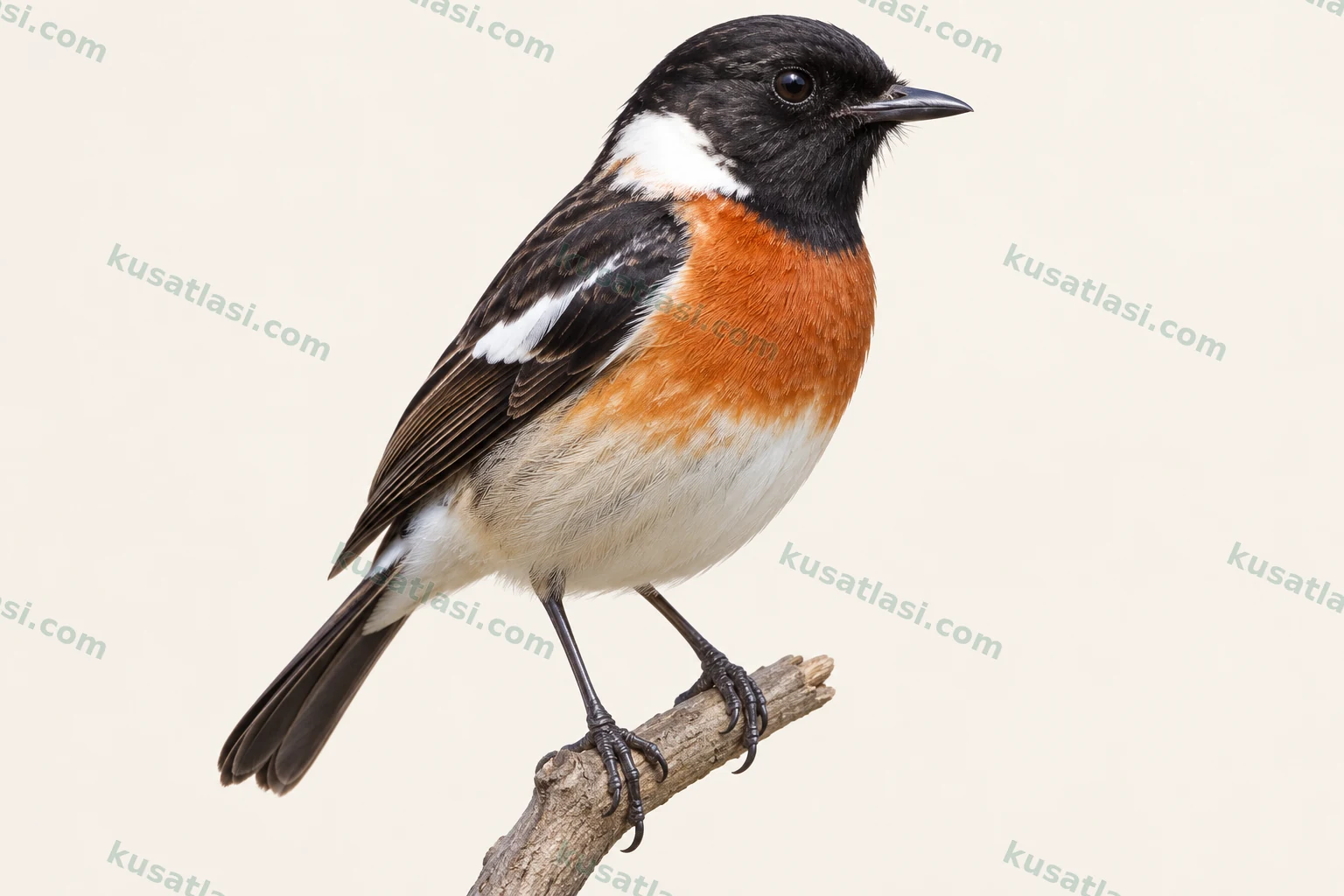
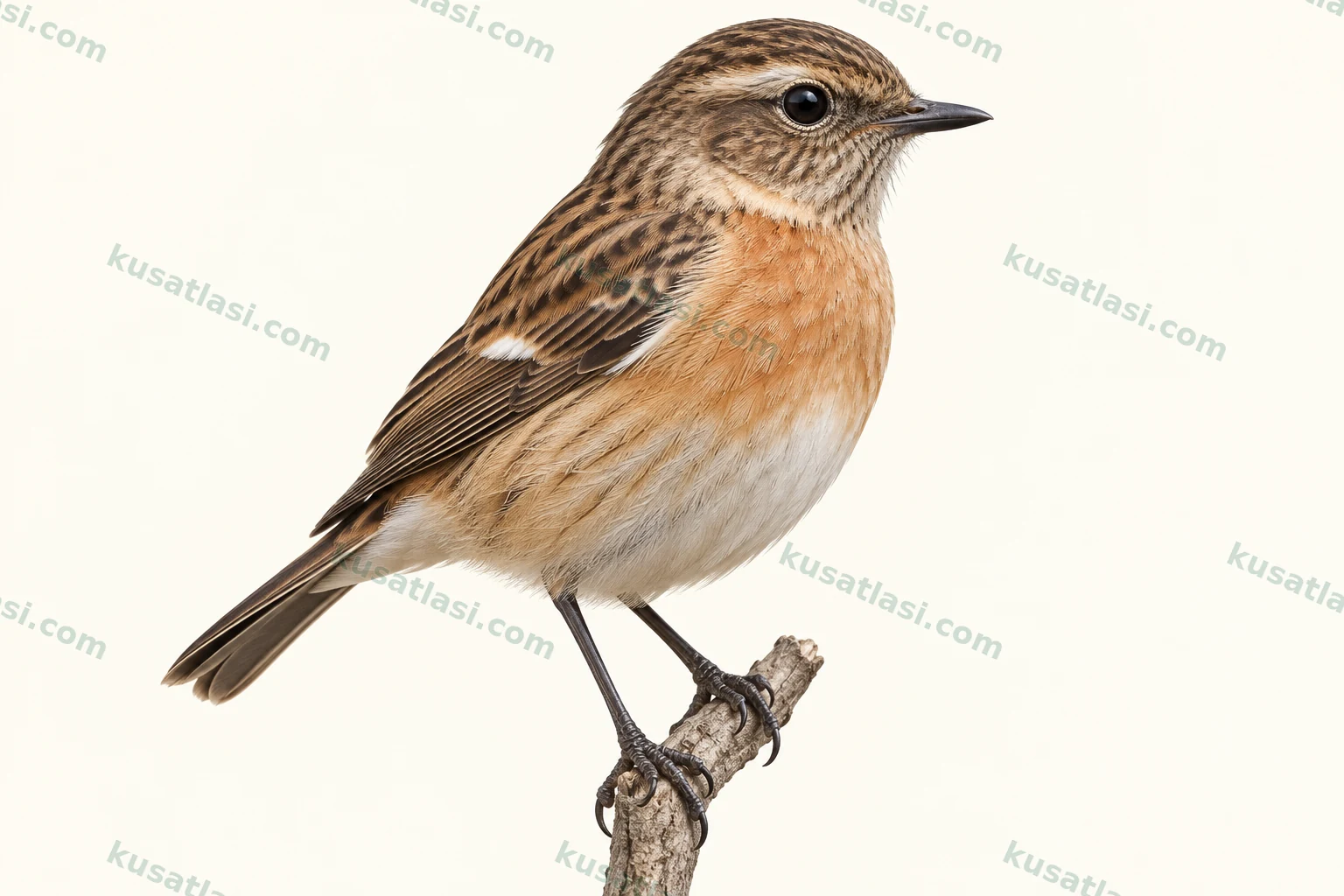
A typical southern male has a black head and throat, white neck sides and a rufous breast; females are brown and juveniles spotted. It hunts from perches in moist open habitats.
Biometrics
Length
Male12 cm
Female12 cm
Shared species value
Wing length
Male7.2 cm
Female7.2 cm
Shared species value
Weight
Male13.3–17.4 g
Female14–18.1 g
African Stonechat
Suitable open habitats of sub-Saharan Africa and MadagascarObservation guide in its natural range
Look for three features together
Do not rely on a single featureSee the typical male’s black head together with the white neck sides.
Do not apply the adult male key to pale or spotted birds.
Do not equate the African species with the former European–Asian stonechat group.
Compare male and female
 FemaleMale
The typical southern male has a black head and rufous breast; the female is browner and the young pale-and-dark spotted. Geographical forms may differ.
Where to look in its natural range?
Watch exposed perches along moist grassland and shrub edges.
Spring–summer breeding and an October concentration reported in South Africa are regional examples, not a shared monthly sequence for the whole taxon.
January
Residency or local altitudinal movements vary regionally; continuous presence in the same small area is not assumed. No verified regional date specific to this month was given; this does not mean local absence.
February
Residency or local altitudinal movements vary regionally; continuous presence in the same small area is not assumed. No verified regional date specific to this month was given; this does not mean local absence.
March
Residency or local altitudinal movements vary regionally; continuous presence in the same small area is not assumed. No verified regional date specific to this month was given; this does not mean local absence.
April
Residency or local altitudinal movements vary regionally; continuous presence in the same small area is not assumed. No verified regional date specific to this month was given; this does not mean local absence.
May
Residency or local altitudinal movements vary regionally; continuous presence in the same small area is not assumed. No verified regional date specific to this month was given; this does not mean local absence.
June
Residency or local altitudinal movements vary regionally; continuous presence in the same small area is not assumed. No verified regional date specific to this month was given; this does not mean local absence.
July
Residency or local altitudinal movements vary regionally; continuous presence in the same small area is not assumed. No verified regional date specific to this month was given; this does not mean local absence.
August
Residency or local altitudinal movements vary regionally; continuous presence in the same small area is not assumed. No verified regional date specific to this month was given; this does not mean local absence.
September
Residency or local altitudinal movements vary regionally; continuous presence in the same small area is not assumed. No verified regional date specific to this month was given; this does not mean local absence.
October
Residency or local altitudinal movements vary regionally; continuous presence in the same small area is not assumed. South Africa, regional specialist account: breeding records concentrate in this month in many areas. Some high-altitude belts in the southern African atlas: this is a regional example of a later concentration of breeding records.
November
Residency or local altitudinal movements vary regionally; continuous presence in the same small area is not assumed. Some high-altitude belts in the southern African atlas: this is a regional example of a later concentration of breeding records.
December
Residency or local altitudinal movements vary regionally; continuous presence in the same small area is not assumed. Some high-altitude belts in the southern African atlas: this is a regional example of a later concentration of breeding records.
Nest, egg and incubation
A deep cup concealed at the base of grass is built by the female, who incubates the eggs for 14–15 days. The regional account gives 2–5 eggs; both parents feed the young. Nest development of up to about 16 days and subsequent care are separate stages.
Short calls and song are matched to the bird being seen and the observation context.
Do not play recordings to attract birds; observe quietly, especially near nests.
Species information
Quick identification
African Stonechat Saxicola torquatus is a small passerine of suitable open, often moist habitats. A typical adult male in South Africa draws attention with a black head and throat, white patches on both sides of the neck, a rufous-chestnut breast and a white patch on the dark wing. The female is browner and the juvenile spotted. Geographical forms differ, so one region’s colour tone is not applied as an unchanging rule throughout the range.
Standing upright on a thin plant stem, bush top or wire and watching its surroundings is familiar behaviour. On detecting prey, it may drop to the ground and return to a perch. Other stonechats and small predatory passerines do this too; the behaviour alone does not identify the species. Head pattern, neck patch, wing and rump should be seen together. White areas hidden behind a leaf or wire are not guessed from the photograph.
General appearance and posture
The South African male has a black head and throat. The back is also dark, but brownish feather tips can alter its appearance. Breast and flanks are warm rufous-chestnut, becoming paler on the belly and undertail. There is a white wing area and a pale rump. Bill, legs and feet are dark. The eyes are reported as dark brown; the border between eye and surrounding black feathers may be difficult to distinguish in an image.
Edges of fresh or worn feathers alter the visible extent of black. Posture and wind can also affect the size of the white neck patch. Do not interpret a broad pale neck patch in a photograph like a ruler measurement. As the bird turns its head, check both neck sides and whether the pale wing area really consists of feathers. A breast faded by light is insufficient for a certain age, sex or subspecies name.
Males, females and young birds
The South African female’s head, back and folded wing are dark-streaked on a lighter brown background. The area before the eye and ear region may be dark; breast and flanks have a paler warm colour than in the male. The adult male’s solid black head is not a necessary part of this appearance. Pale rump and wing patch may be visible depending on the view. Rather than basing female identification only on a pale breast, see the upperparts and head pattern together.
Juveniles may resemble females but have conspicuous pale spots on the upperparts and dark spotting on the breast. The throat may look greyer and the rump rufous-pale brown. Requiring every adult white patch to be equally vivid at this age is wrong. Age differences must be considered in streaked or spotted plumage; a young bird is not certainly female just because its head is not black.
A pair or family group can make different appearances easier to compare. Nevertheless, two birds together in the same area are not assumed to be paired. Direct transfer of food to young is stronger evidence of care. Birds near a nest may be more cautious; approaching to hold them on an exposed perch changes natural behaviour. Continuing care of a young bird that has left the nest shows that first flight and independence are not the same stage.
Appearance in flight
It can make low, short, lively flights between places; wing and tail movements briefly reveal pale patches. A white rump may become obvious in a turn and disappear in the next frame. Not seeing a patch does not always mean it is absent. The position of the pale wing area and colour of the tail base should be distinguished; motion blur can merge them into one white line.
Dropping from a perch to prey and moving to another nearby perch is daily hunting behaviour. This short directed flight is not evidence of altitudinal migration. South African mountain birds occurring lower in winter in some areas are assessed through broad dated observation patterns. A single coastal record does not reveal the mountain of origin or the route followed. A flight clue is not a one-step identification replacing head and body pattern.
Voice and behaviour
It communicates with short calls and song; waiting on an exposed perch makes it easier to observe. Wires, bush tips and tall grass stems are prey-watching points. Wing and tail flicking can draw attention but does not separate it certainly from every other small passerine. A listener should confirm that the sound comes from the bird on that perch. A few short calls do not alone give the number of pairs in the area.
It is usually seen in pairs or family groups. Adults may defend a territory and some pairs may use the same area all year. Regional movements linked to elevation and season are nevertheless reported. Calling the species entirely immobile or entirely migratory throughout its geography loses this difference. Occurrence beside irrigated farmland also does not show that it equals natural grassland in every function.
Similar species
1. Whinchat Saxicola rubetra is compared by its conspicuous pale eyebrow and white on the sides of the tail base. The typical adult male African Stonechat’s black head, white neck sides and rufous breast form a different combination. In females and juveniles, eyebrow and tail pattern must be seen separately; a rufous breast alone is insufficient. Whinchat can be an unusual visitor in South Africa.
2. European Stonechat Saxicola rubicola and Siberian Stonechat Saxicola maurus may appear together in names and records of the former broad stonechat group. The current African taxon does not have the same record scope. Age, season and geographical form matter in photographic comparisons; a black-headed adult male appearance is insufficient to unite the whole group as one species. If the view or locality is inadequate, species-level uncertainty is left explicit.
World distribution
The current African Stonechat scope includes sub-Saharan African populations and Madagascar forms. Distribution is more interrupted in West Africa and more extensive along suitable open habitats in the east and south. Older sources also described European and Asian stonechats under the same scientific name; their countries are not added to this species’ natural range. Checking which taxonomic boundary a source uses is as necessary as reading its species name.
Status within the natural range
It is widespread in moist South African grasslands, mountain slopes and suitable coastal habitats; very arid parts of Namibia and broad dry surfaces of the Kalahari and Karoo are not used in the same way. Irrigated or moist small habitat patches in dry regions can be considered separately. Okavango records are also associated with permanent water and damp floodplain areas. A broad regional name is therefore not equated with the habitat actually used.
AviList v2025b gives the assessment field for the current taxonomic scope as Not Evaluated. Least Concern labels on some specialist pages may relate to another assessment or older scope. The status card follows the current taxonomic list; Not Evaluated proves neither an absence of threats nor high threat.
Movements and migration
Populations south of the equator show residency alongside local altitudinal movements. Decreasing winter records in some South African highlands and increases lower down are consistent with regional movements; no single route is applied across the continent. Daily perch changes, juvenile dispersal and altitudinal movements are separate events. The coloured map model is not a definite nesting area; observation cells alone do not show the mountain of origin or a route taken. No unverified monthly route is drawn.
Breeding habitat
It uses open settings with tall grasses, scattered shrubs and perches for watching prey. Mountain grasslands, moist slopes, marsh edges, fynbos and suitable farmland surroundings are southern African examples. Not all open areas are equivalent; very short vegetation or intensive grazing can change nest concealment and the food environment. Coastal occurrence also prevents describing it as exclusively a high-mountain bird.
Nest site
The female builds a deep cup of dry grasses, fine roots and other plant materials; she may line it with finer softer material. The nest is concealed on the ground or a low bank, supported by grass roots or similar vegetation. The regional specialist account reports 2–5 eggs, 14–15 days of female incubation and a nest-development period of up to about 16 days (southern African information for African Stonechat). Both parents bring food; two–three weeks of care after nest departure are not the same as the time to first flight.
Daily use of space
A tall grass stem, shrub or wire serves as a prey-watching point; the bird may drop to the ground and return to the same or a nearby perch. A nest need not be beside that perch. Frequent descents do not mean it enters a nest every time. Food carrying and direct feeding of young should be recorded separately. Rather than entering the hidden nest’s surroundings and alarming the birds, watch from a distance at regular intervals; notice whether their behaviour returns to normal when you move away.
What does it eat?
Small and medium-sized arthropods are the main foods. Flies, grasshoppers, insect larvae and other insects are reported, along with spiders and some other small invertebrates. Specialist food lists may include less frequent small vertebrates, fruits and seeds; these are not described as eaten as often as the main foods. Carrying a grasshopper in one photograph does not show a year-round grasshopper-only diet.
How does it hunt?
It watches from a perch and drops to the ground for visible prey. Sometimes it catches flying prey or briefly hovers before descending. Not every landing is successful; prey visible in the bill or being swallowed provides direct evidence. Perch height, viewing angle and grass cover can affect hunting at the same site; one short observation does not yield a daily food quantity.
Food carried during chick care is recorded separately from the adult’s own consumption. Even if a bird repeatedly hunts from one perch, it is not assumed that every other individual uses it in the same way. Baiting it to one point is unnecessary for observing feeding; follow the perch it chooses and visible descents. Cutting surrounding grass can change nest concealment and the prey environment together.
The scope of an old name can change
A stonechat entry in an old atlas may describe a broad group from Europe to Africa. Current Saxicola torquatus has an African scope; the same written name does not mean the same species boundary at every date. Regional South African observations can be used without importing European migration from an older paper. Establishing taxonomic boundaries at the start of reading preserves consistency of appearance and maps.
Winter differences in elevation
Fewer highland records and more lowland records are consistent with local altitudinal movement in some southern African regions. It cannot be said that every individual does this on the same day or over the same distance. A single bird on the coast does not show which mountain it came from. Observation patterns inform movement; an individual route needs more direct tracking.
Visibility and function of white areas
The male’s pale wing and rump patches may become more conspicuous with posture and display. Their apparent sizes in photographs depend on the bird’s angle. Before treating a difference between two images as a new subspecies or sex mark, check how the feather surface opens. A visible colour patch and its measured size are different kinds of information.
First flight does not end care
Young leaving the nest may need parental feeding for a while. Adding nest duration to later care does not create an exact independence date absent from the source. If the starting date is unknown, a young bird’s age in days is not calculated. Direct food transfer and the youngster catching its own prey are separate developmental signs; following both explains family life better than one photograph.