

World Birds IUCN statusLC · Least ConcernGlobal IUCN category. BirdLife v10 (2025); taxon matching: AviList 2026 / IOC 15.2; checked: 29.10.2026. The list year is not the species assessment date. Source and method · BirdLife OrderPasseriformesPasserines FamilyMuscicapidaeMuscicapidae
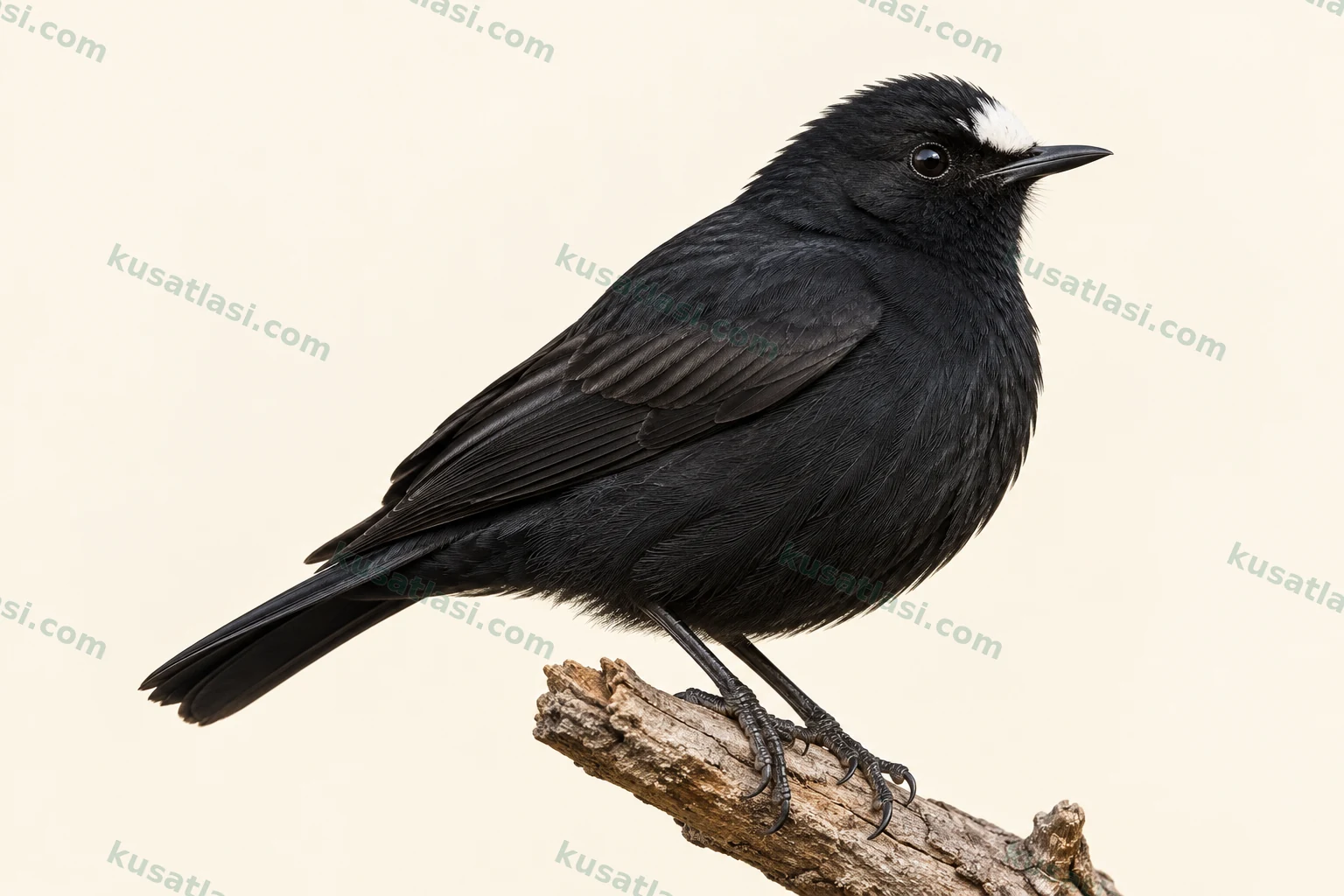
White-fronted Black Chat
Oenanthe albifrons
A small dark chat of open wooded and rocky savannas south of the Sahara; the male has a white forehead, while female and shoulder markings vary geographically.
Biometrics
Length
Male15–16 cm
Female15–16 cm
Shared species value
Wing length
Male7.7 cm
Female7.7 cm
Shared species value
Weight
Male19.5–24.9 g
Female18.5–20 g
White-fronted Black Chat
Savanna belt from Senegambia to central and northeastern AfricaObservation guide in its natural range
Look for three features together
Do not rely on a single featureWhite in the male; its extent varies regionally.
A small slender dark chat; the female’s throat varies.
It moves from a low perch towards open ground.
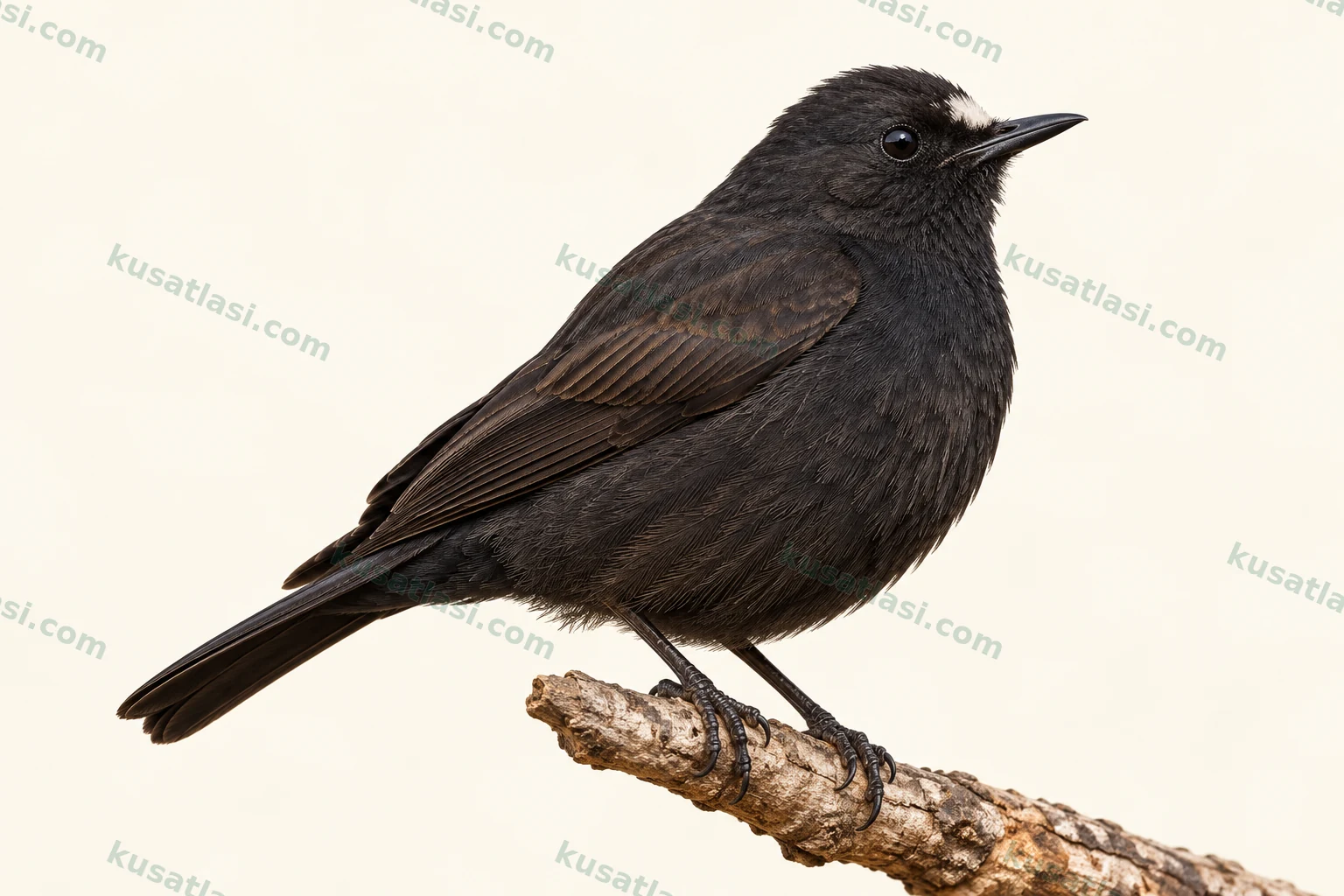
Compare male and female
 FemaleMale
The male is dark with a white forehead; a white forehead is not required in the female. Throat and shoulder appearance vary geographically; young birds have pale rufous-buff spots.
Where to look in its natural range?
Look on stones, shrubs and stumps in open wooded savanna; viewing the front of the head from several angles is helpful.
Regional breeding examples from the specialist account; these do not form a shared continental calendar.
January
It is resident in most regions; short-distance movements are reported for Mauritania. Mali: the breeding period given in the specialist account. Nigeria: the breeding period given in the specialist account. Ghana: a regional breeding record. Northeastern Democratic Republic of the Congo: a breeding example given in the specialist account.
February
It is resident in most regions; short-distance movements are reported for Mauritania. Mali: the breeding period given in the specialist account. Nigeria: the breeding period given in the specialist account. Northeastern Democratic Republic of the Congo: a breeding example given in the specialist account.
March
It is resident in most regions; short-distance movements are reported for Mauritania. Nigeria: the breeding period given in the specialist account.
April
It is resident in most regions; short-distance movements are reported for Mauritania. Nigeria: the breeding period given in the specialist account. Ethiopia: a breeding example for eastern populations.
May
It is resident in most regions; short-distance movements are reported for Mauritania. No verified regional date specific to this month was given; this does not mean local absence.
June
It is resident in most regions; short-distance movements are reported for Mauritania. No verified regional date specific to this month was given; this does not mean local absence.
July
It is resident in most regions; short-distance movements are reported for Mauritania. No verified regional date specific to this month was given; this does not mean local absence.
August
It is resident in most regions; short-distance movements are reported for Mauritania. No verified regional date specific to this month was given; this does not mean local absence.
September
It is resident in most regions; short-distance movements are reported for Mauritania. No verified regional date specific to this month was given; this does not mean local absence.
October
It is resident in most regions; short-distance movements are reported for Mauritania. No verified regional date specific to this month was given; this does not mean local absence.
November
It is resident in most regions; short-distance movements are reported for Mauritania. Mali: the breeding period given in the specialist account.
December
It is resident in most regions; short-distance movements are reported for Mauritania. Mali: the breeding period given in the specialist account. Nigeria: the breeding period given in the specialist account.
Nest, egg and incubation
The cup nest of grass and fine plant material is near the ground in a rock crevice or hollow stump; typically 2–3 eggs. Incubation duration and time to first flight could not be verified.
A varied melodic song from a shrub or treetop, with short whistled phrases and sometimes sounds resembling other species.
Do not play recordings to attract birds; observe quietly, especially near nests.
Species information
Quick identification
White-fronted Black Chat Oenanthe albifrons is a small dark passerine of open woodland and rocky ground south of the Sahara. The adult male’s white forehead is its main distinguishing mark; most of the body is black. The name does not mean the whole head or throat is white. The female may be duller and is not expected to have the same forehead pattern as the male.
Geographic variation is important. Male forehead white is a small patch in some regions and extends over much of the crown in others. White on the shoulder also differs between populations. Forehead position, overall dark body, sex and observation region are used together. Before separating a male with extensive head white as another species, check the appearance expected in that region.
General appearance and posture
It is a slender, short-necked, relatively small chat. It may watch its surroundings from a low branch, stone, stump or bush top. Such a perch allows the head to be seen without its being lowered and lets the observer follow hunting movements towards the ground. A single bird is often seen; membership of a large persistent flock is not its principal expected behaviour.
In the nominate subspecies of Eritrea and northern Ethiopia, the male is slightly glossy black, with dark bill and feet. Flight feathers seen from below may look silvery grey. This pale surface is not interpreted as a white belly or large white wing-coverts. The boundary between sunlight on black feathers and a true white patch is checked again as the bird changes angle.
Open wooded savanna and bare or sparsely grassy rocky ground help locate the species. A dark bird can be overlooked on blackened burned ground; the forehead is easier to see when it reaches a low perch. Habitat supports identification, but not every dark chat in a burned area belongs to this species. Separate views of the front of the head and the shoulder are useful in photographs.
Males, females and young birds
The female’s appearance differs from the male and between regions. In the nominate eastern form, the upperparts are browner and the chin and throat greyish white with fine dark spots. Females of the western frontalis may look more uniformly sooty dark. The male’s bright white forehead is not required when looking for a female. Some females may show a grey forehead or throat; a single pale-throat mark does not establish species identity.
Young birds have pale rufous-buff spotting on upperparts and underparts. They may initially look browner and irregularly patterned. An adult male and a recently fledged young bird are not presented with the same strongly contrasting black-and-white pattern. No detailed species-wide calendar showing the exact month of appearance changes with age was found; a date alone is insufficient for ageing.
In males of pachyrhyncha from southwestern Ethiopia, the white may extend farther onto the crown. Accounts of Central African limbata and clericalis also describe white around the shoulder. These differences do not require combining every subspecies’ marks on one bird. If geography is known, the regional appearance is assessed; a photograph of unknown origin is not assigned a definite subspecies from patch size alone.
Appearance in flight
A short movement from a low perch to the ground followed by a return to a viewpoint is useful for following the hunt. As the head turns forwards and down in flight, the small forehead patch may briefly disappear. A momentary failure to see it does not prove its absence. Wait for the landed bird to turn its head again; compare flight and perched frames of the same individual.
Head, shoulder and underwing are visible at different angles. The pale reflection of the flight feathers may support identification of the nominate form; the same pale lower surface is not expected on a bird viewed from above. No exact size comparison with other species is made from the apparent dimensions of open wings in one frame.
Voice and behaviour
Song may be long, varied, conversational and melodious. The specialist account separates short whistled phrases given from a tree or bush top from other calls. Some songs may include passages resembling other birds. Resemblance to a nearby species does not mean that species must be the caller; where possible, confirm identity by seeing the singing individual.
A bird watching from a low perch drops towards prey on open ground. Seeing it on the ground for a while does not show that it hunts only by walking all day. Following its next perch and prey approach makes the feeding method clearer. An observer can wait for natural movements rather than repeatedly attracting the bird with sound; rock crevices where nests may occur are not opened.
Similar species
Sooty Chat Myrmecocichla nigra is a larger dark chat. A well-seen white forehead supports identification of an adult male White-fronted Black Chat. Females and young are less straightforward; apparent body size, head and throat appearance and behaviour are assessed together. Size seen by eye can mislead when two distant birds are at different distances.
Northern Anteater Chat Myrmecocichla aethiops is another larger dark bird. Look for the small male White-fronted Black Chat’s white forehead and hunting from perch to ground. A black bird whose head front is hidden is not named with certainty from general colour alone. Comparisons with white-headed species such as White-crowned Wheatear Oenanthe leucopyga require the extent of pale head, remaining body and tail pattern and natural geography together.
World distribution
The natural range is a broad but fragmented savanna belt south of the Sahara in Africa. Western populations extend from Senegal and The Gambia east towards northern Cameroon and Chad. Populations in the Central African Republic, South Sudan, northeastern Democratic Republic of the Congo and Uganda, and those in Eritrea and Ethiopia, occupy different parts of the same continental belt. Entire country maps are not suitable habitat; open woodland and rocky ground leave gaps between occupied areas.
Status within its natural range
The current conservation category is Least Concern. Wide distribution does not make the bird abundant and easy to see everywhere. Specialist accounts mention sparse areas as well as places of higher local occurrence. Because plumage varies between the Eritrea–Ethiopia form and West African forms, photographs from different countries are not judged against identical colour boundaries.
Open habitats around Murchison Falls in Uganda are mentioned in specialist sources. Elevation in northeastern Africa may differ from coastal savanna; records are given to about 2000 metres in Ethiopia and into higher wooded areas in Uganda. These do not establish identical lower and upper limits in every country.
Migration and movements
It is considered resident over much of its range. The specialist account nevertheless notes short-distance movements in Mauritania, and the data compilation also uses a partial-movement category. A judgement of no movement for all populations is therefore not made. No verified intercontinental route or shared wintering area for the entire species was found. Local hunting transitions are not transferred to a map as migration lines.
Breeding habitat
Open wooded savannas, bushy clearings and stony ground are important. Areas with small erosion gullies, rocks and low perches can be searched. Specialist sources also mention recently burned surfaces and some agricultural surroundings. This does not make burning land beneficial for finding birds or nests; use of the existing ground is assessed through natural observations.
Nest site
The nest is a small cup of grass, thin twigs and other plant stems, lined with finer materials such as rootlets and spider web. It may be placed near the ground in a protected crevice under a rock or inside a hollow stump. The specialist account generally gives 2–3 pale greenish or bluish eggs with dark spots. Incubation duration and age at first flight could not be verified.
Daily use of space
Proximity between a low perch and an open prey surface matters for daily space use. Dry-season breeding examples are reported over different month ranges in Mali and Nigeria, and in April in Ethiopia. These are country-specific examples; combining them does not show that one pair lays throughout the year. Arrivals and departures can be watched from afar without putting a hand into a nest crevice or breaking apart a stump.
What does it eat?
It eats insects and other small invertebrates. The specialist species account describes an insect-eating bird, and the broad data compilation also places it among invertebrate predators. Prey percentages covering the entire range and all seasons were not found. Even if its name or former genus suggests ants, this does not mean it eats only ants; prey type must be seen directly.
How does it hunt?
It watches open ground from a low bush, branch or stump and heads down when prey is seen. This feeding pattern should not be restricted to the impression of a bird walking only on the ground for hours. An observer can record the capture point and the perches used before and after it together. If the small captured prey cannot be identified from afar, guessing an insect group to add detail is unnecessary.
Head movements can be followed on rocky, sparsely covered ground. Ground searching, short flight and returning to a perch may belong to the same feeding sequence. Presence at a field edge does not prove that the crop or fruit is the main food; habitat and food records remain separate.
The white forehead is not equally extensive everywhere
The forehead mark named in this chat is real identification support, but its extent varies geographically even among adult males. A small front patch and white extending farther onto the crown can occur in different populations of the same species. Female throat appearance cannot be reduced to one pattern either. Keeping the country and, where possible, locality with photographs helps interpret plumage correctly.
A nesting calendar belongs to its country
The specialist account separately gives breeding examples for November–February in Mali, December–April in Nigeria and April in Ethiopia. Environmental conditions differ between regions. Combining these months into a continuous breeding season for the whole species would incorrectly broaden regional information. A possible July record for Togo is not at the same evidence level as definite dates and is kept apart from verified examples.
A nest does not contain a fraction of an egg
Large life-history compilations may show decimal summaries for egg number. They are statistical expressions of different records, not the actual number of eggs in one nest. The specialist account’s typical 2–3 eggs describes a group that can be counted in the field. Keeping summary data distinct from a direct nest record makes breeding information understandable and accurate.
An old scientific name can refer to the same taxon
Older publications may use Myrmecocichla albifrons or Pentholaea albifrons. The accepted name in the current taxon list is Oenanthe albifrons. An old record is not a separate species merely because its genus differs; its date, geography and the taxon to which the name was applied are checked together.