

World Birds IUCN statusLC · Least ConcernGlobal IUCN. BirdLife v10 (2025); taxon matching AviList 2026 / IOC 15.2; checked: 29.10.2026. The list year is not the species’ assessment date. Source and method · BirdLife OrderPasseriformesPasserines FamilyPloceidaePloceidae
White-billed Buffalo-Weaver
Bubalornis albirostris
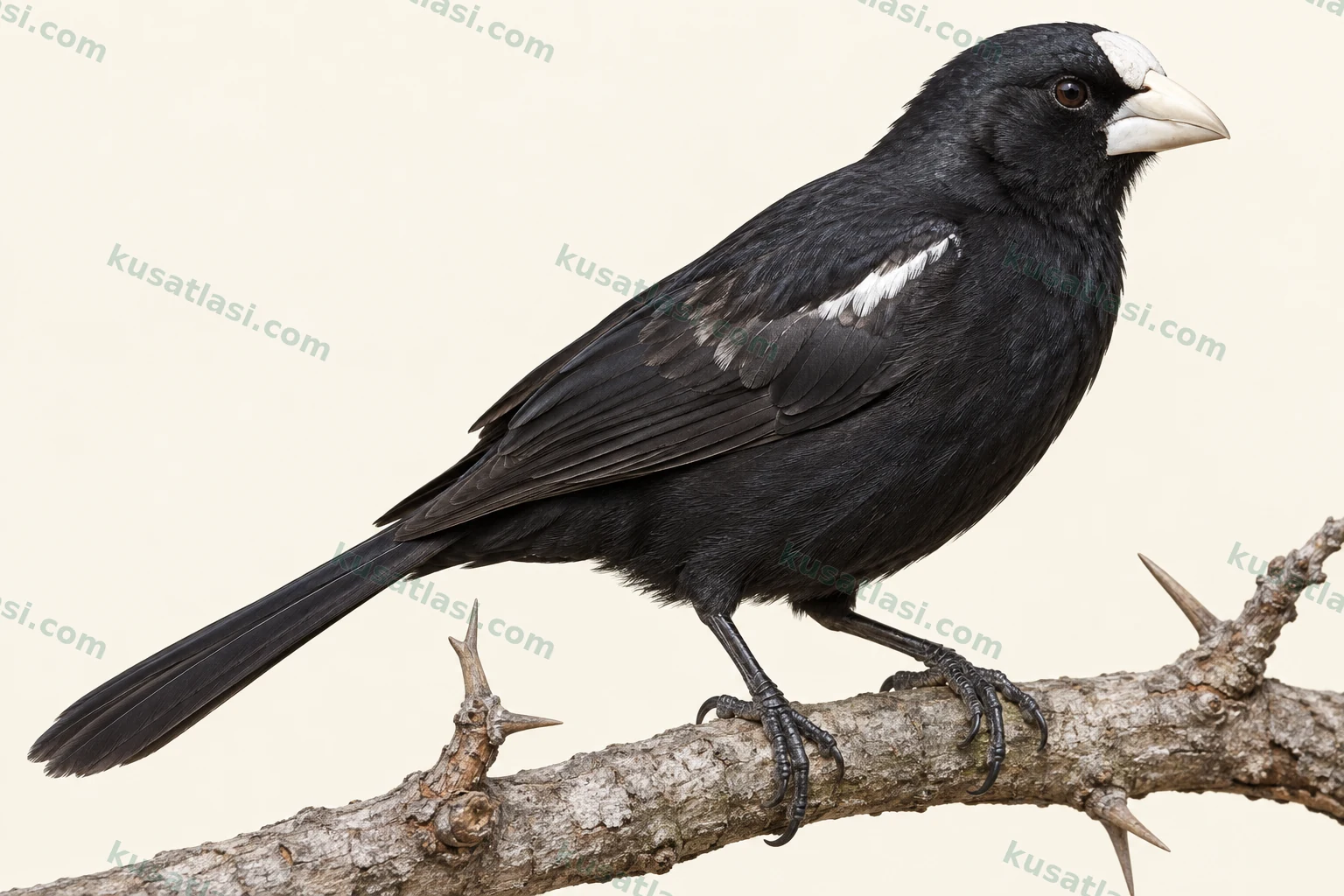
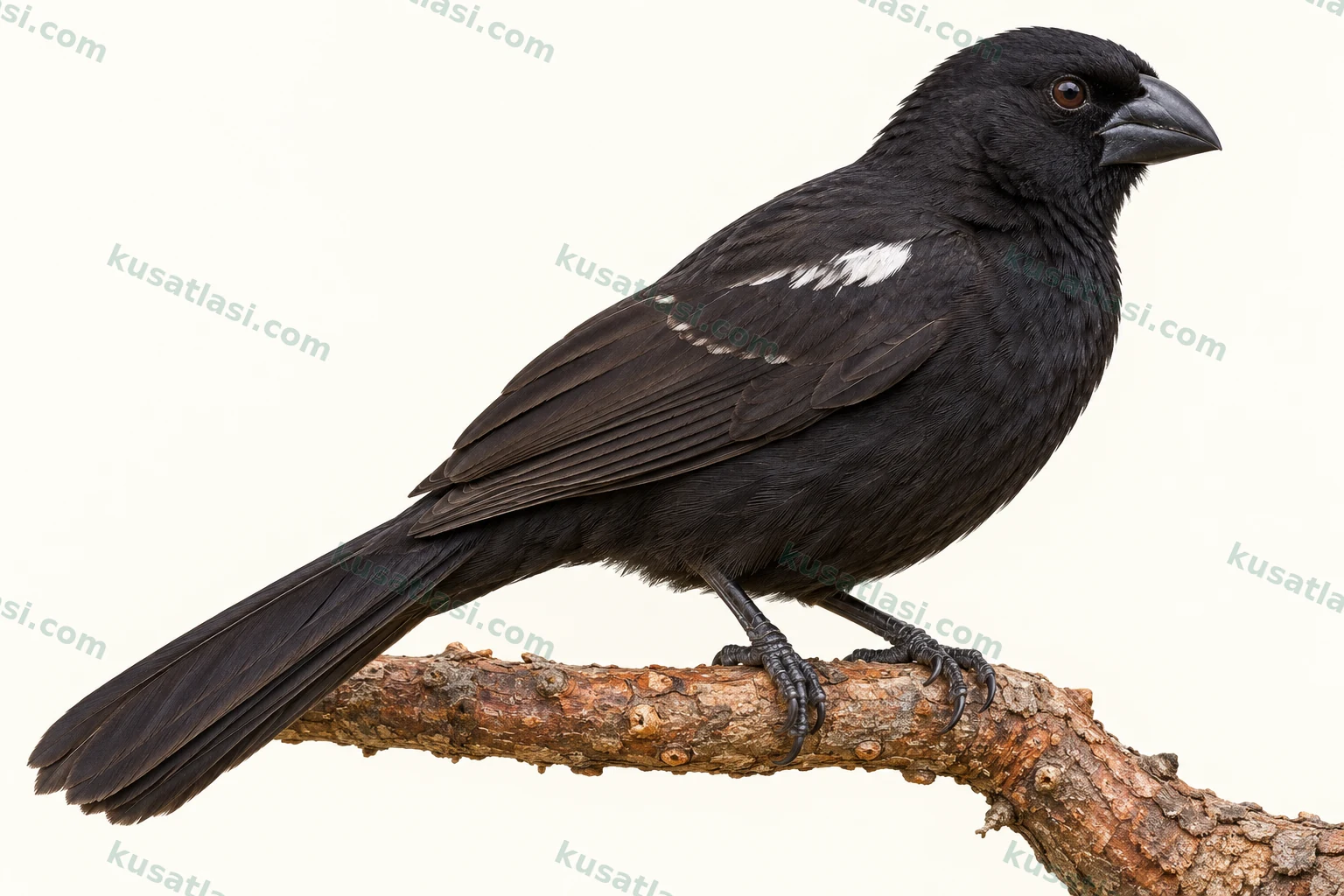
Large, long-tailed dark weaver; adult bill pale or dark according to sex, with white at the shoulder front.
Biometrics
Length
Male23 cm
Female23 cm
Shared species value
Wing length
Male11.42 cm
Female11.42 cm
Shared species value
Weight
Male56–80 g
FemaleData unavailable
White-billed Buffalo-Weaver
Africa: northern savanna belt south of the SaharaObservation guide in its natural range
Look for three features together
Do not rely on a single featureBulky body, large bill and long tail together.
Pale in male, dark in female. A red bill is not expected.
White at the shoulder front and the pale wing area visible in flight matter.
Compare male and female
 FemaleMale
The adult account gives a pale male bill and dark female bill. Immatures are dark brown with strongly streaked underparts.
Where to look in its natural range?
Dry savanna, woodland and thorn scrub. Look at the birds using large communal nests.
Resident; common exact breeding months for the full range were not verified. Local flock movements are not a distant migration route.
All months: Data unavailable
January
February
March
April
May
June
July
August
September
October
November
December
Nest, egg and incubation
Large communal stick nests. Reliable typical egg number, incubation and young period were not verified in this review.
Harsh short calls may be given successively by the group. Check the calling bird’s appearance too.
Do not play recordings to attract birds; observe quietly, especially near nests.
Species information
Quick identification
The White-billed Buffalo-Weaver Bubalornis albirostris is a large, bulky, long-tailed dark weaver of African dry savanna and woodland. Males have pale bills and females dark bills. White at the front edge of the shoulder and a pale wing area visible in flight contrast with the body.
Compare each flock member's bill with its own plumage. Pale- and dark-billed birds together do not alone mean two species. The closest comparison is the Red-billed Buffalo-Weaver Bubalornis niger. A red bill is not expected in the White-billed Buffalo-Weaver.
General appearance and posture
The bulky body, large bill and long tail differ from small slender weavers. The white shoulder-front patch does not make the whole back white. The pale wing area can be partly hidden when closed and more visible in flight.
In open savanna, plumage and shadow may merge into one dark mass. Natural turns clarify tail proportions and the bill's actual boundary. Several views of one bird are more reliable than merging different flock members' marks into one.
Males, females and young birds
Cornell's adult account distinguishes a white male bill from a black female bill. Without the whole appearance, a dark bill alone does not settle age and breeding status together. Bill colour, plumage and relationships to other birds are recorded jointly.
Immatures are described as dark brown with strongly streaked underparts. This differs from adult black plumage and helps assess age, without assigning an exact number of days or months. Pale feather edges can be clearer as the bird turns.
Compare full views of both sexes and young under similar light. Distinguishing a young bird from an adult female should not rely on one small feather area.
Appearance in flight
The pale wing area may become conspicuous in flight. Together with the dark body and long tail, it gives more than a silhouette alone. One pale flash does not establish the species: other dark birds also have pale feathers.
This review did not verify a separate upperwing–underwing angle key sufficient for certain identification. Do not add marks to an unseen surface. One flock member's spread wing and another's bill colour are not combined as the same individual.
Voice and behaviour
It can occur in flocks in dry savanna and woodland. Cornell describes harsh short calls given successively by many group members. They help locate birds, but written imitations alone do not establish the species.
Large communal stick nests in trees are conspicuous. The mass is not treated as one pair's small cup. Entry does not necessarily mean eggs inside; maintenance is observed separately. Reviews record other large birds nesting above weaver structures. Association does not automatically prove mutual benefit.
Similar species
The Red-billed Buffalo-Weaver Bubalornis niger is directly comparable in dark body and large-weaver build. Its red bill differs from pale or dark bills here. Older literature sometimes combined the taxa more broadly, so check the scientific-name scope.
Against other dark savanna weavers, combine long tail, bulky body and white shoulder. Yellow-male weaver patterns are not expected. A large nest alone does not establish identity. See the bird using it.
Global range
The accepted taxon's natural range occupies the northern belt south of the Sahara. AviList gives southern Mauritania and Guinea east to southern Sudan, western Ethiopia and northern Eritrea, south to southeastern South Sudan, northeastern Uganda and northwestern Kenya. This is not all sub-Saharan Africa filled by one species. Do not confuse its scope with the red-billed southern relative.
Status within its natural range
The global-list snapshot gives Least Concern. Flocks and communal nests may make local observations easier, but one colony is not the regional population. Dry woodland, scrub and local food resources are assessed together. An old Chad vulture–weaver nesting association is neither an ordinary range-wide proportion nor a current colony total.
Movements and migration
The specialist dataset treats it as resident. Daily flock movements around food and nests are not regular distant migration routes. Common arrival and departure months throughout the range were not verified. Records carry their own dates and places, not a group's tracked year-long journey. The actual savanna or woodland strengthens interpretation of local records.
Breeding habitat
Dry savanna, woodland and thorn scrub are the main settings. Nest trees and surrounding feeding areas matter together. An opening with a nest does not make adjacent woodland unimportant. Historical Chad associations show that one tree and structure can be used by several species.
Nest site
It builds large communal stick structures. The 2016 review recounts vultures nesting above White-billed Buffalo-Weaver nests in Chad; one vulture identification is disputed. Reliable usual egg number, incubation and young period were not separately verified for this work. Decimal egg summaries in a database are not egg counts in one real nest.
Daily habitat use
Flocks may move between nest trees and surrounding open feeding areas. Entry, rest and actual chick feeding are separate behaviours. Do not lift nest branches or lure birds out to examine entrances. Watch from an existing opening at a natural distance.
What does it eat?
A recent morphology and ecology compilation classifies it as omnivorous. This is a broad framework combining plant and animal foods, not a percentage of local intake. A detailed verified list for the whole range was not completed in this review. Flock members are not assumed to eat identical food amounts.
How does it forage?
Record searching with the actual taking of an object from ground or vegetation. An object in the bill is not immediately identifiable as seed, animal prey or nest material. If identity is unclear, describe only the seen movement. Do not scatter food around a colony. Quietly watch natural searching and taking in the existing habitat. One local record does not establish a fixed species-wide menu.
Communal nests can matter to other birds
The 2016 vulture–weaver review includes Chad vulture nests above White-billed Buffalo-Weaver structures. These particular historical records show possible support for other birds, not the same relationship in every colony or guaranteed protection for weavers. Proposed benefit and observation remain distinct. A disputed Chad vulture identity does not establish a certain species' behaviour.
A species name does not colour every bill alike
Adult male pale and female dark bills differ. A dark-billed flock member does not mean the white-billed species is absent. Dark brown, streaked immatures also differ from generally black adults. Bill, plumage and age context together reduce mismatches.
Another mark can appear in flight
A partly hidden pale wing area can become clearer when spread. It is anatomically different from white at the shoulder's leading edge. Link flight with a voluntary return to a perch. Do not gather different flock members' marks into one bird.
Old broad taxa require care
Older papers sometimes treated white- and red-billed weavers in a broader classification. Matching the current scientific name is needed to assign a breeding date or measurement to the right bird. A relative's detailed incubation record cannot fill a missing number here. Check country and taxonomic scope together.