

World Birds IUCN statusLC · Least ConcernGlobal IUCN category. BirdLife v10 (2025); taxon matching: AviList 2026 / IOC 15.2; checked: 29.10.2026. The list year is not the species assessment date. Source and method · BirdLife OrderPasseriformesPasserines FamilyEstrildidaeEstrildidae
African Silverbill
Euodice cantans
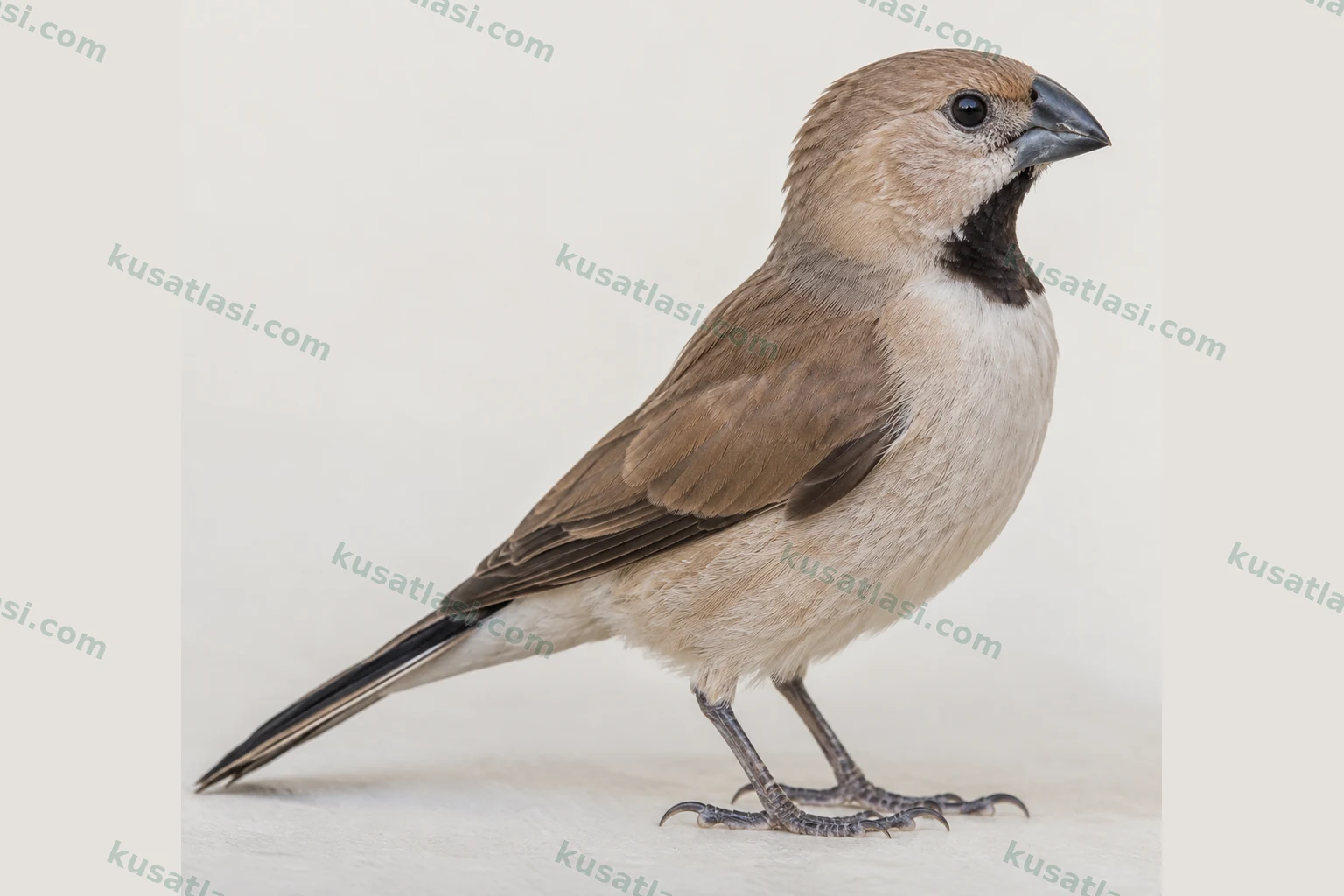
A thick silver-grey bill, pale body, black rump and long dark tail. Adults of both sexes are similar; bill colour alone does not separate it from Indian Silverbill.
Biometrics
Length
Male11 cm
Female11 cm
Shared species value
Wing length
Male5.36 cm
Female5.36 cm
Shared species value
Weight
Male10–14 g
Female10–14 g
Shared species value
African Silverbill
Suitable dry areas in northern sub-Saharan and eastern Africa; southern Arabia and southern OmanObservation guide in its natural range
Look for three features together
Do not rely on a single featureAssess the silver-grey bill together with the whole body and tail.
Do not infer a rump hidden by the wings from the tail tip alone.
Look for it together with the pale belly and dark wings; watch seed-foraging flocks from outside the group.
Compare male and female
 FemaleMale
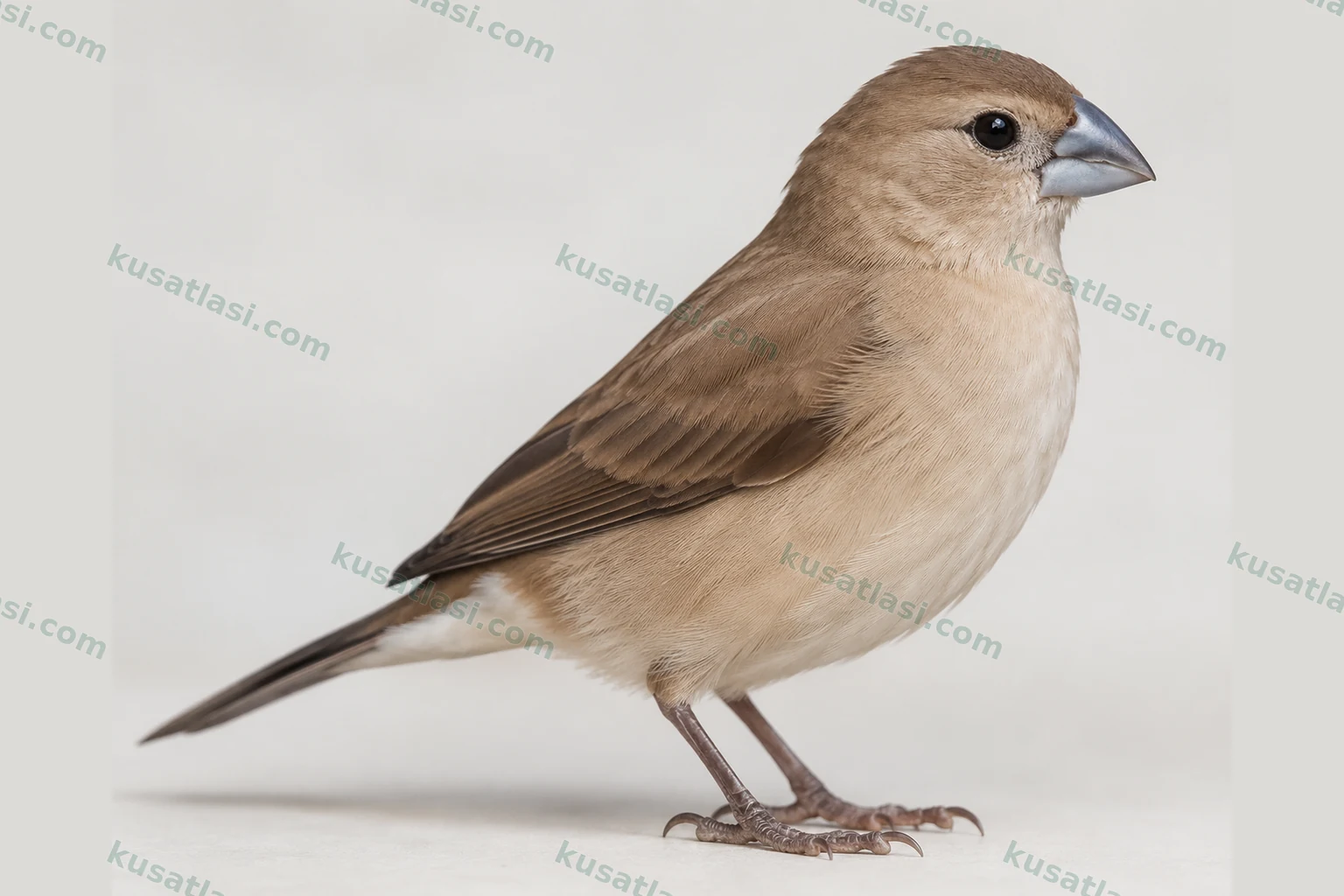
Adult males and females have similar plumage. Small differences in shade or the tail tip alone are not reliable keys to sex or age.
Where to look in its natural range?
Watch flocks feeding in seed-bearing grasslands and along thorny scrub edges. Hawaiian records represent introduced populations; do not confuse them with the natural Arabian range.
It is primarily resident and social. Because no verified breeding months are shared by all its natural African and Arabian areas, neither monthly breeding probabilities nor absence are inferred.
All months: Primarily resident; assess breeding dates using local records. No verified regional date specific to this month was supplied; this does not mean local absence.
January
February
March
April
May
June
July
August
September
October
November
December
Nest, egg and incubation
It builds a closed grass nest with a side entrance; old weaver and sparrow nests may also be used. The Cornell synthesis reports three to six eggs,11–13 days of incubation and a nestling period of about 21 days. Nearby pairs do not prove shared care of young.
The calls are thin and metallic, and the song ends with rapid notes; the expert account mentions the female’s two-note call. Do not determine sex without seeing the individual making the sound.
Do not play recordings to attract birds; observe quietly, especially near nests.
Species information
Quick identification
African Silverbill Euodice cantans is a small bird recognised by its thick silver-grey bill, sandy-brown upperparts, pale belly and long dark tail. Dark wings and a black rump contrast with the pale body. When a flock feeds among grasses, only the pale bill may stand out; seeing rump and body together helps complete identification. A silvery bill also occurs in the related Indian Silverbill and is not a conclusive mark alone.
The accepted scientific name is Euodice cantans and the English name African Silverbill. Older publications use Lonchura cantans. This is the former genus placement of the same taxon. Its natural range is not limited to Africa: native populations of southwestern Arabia and southern Oman are considered separately from populations introduced by people to Hawaii. The bird’s name does not by itself describe every boundary of its natural range.
General appearance and posture
The head and back are sandy with a light brown tinge. Feathers may have fine dark centres and pale edges, producing a lightly spotted head and finely streaked upperparts. Some western populations are described as paler and less streaked than birds of eastern Africa and Arabia. This geographical difference is not turned directly into a sex difference. A bird looking very different in shade and sun is also considered when interpreting colour.
Breast and flanks have pale warm tones, and the belly is more whitish. The wings are darker than the body, and the tail is long and dark. The black rump helps separate similar silverbills; failure to see black where wings cover the area does not mean it is absent. It may show better when the bird bends or during a short flight. There is no need to flush the flock for that view; waiting for natural movement is enough.
The bill is short and strong, looking silver-grey or bluish-grey. Glare can make its particularly dark upper surface appear lighter than it is. The whole bill is examined for colour; a bright lower surface alone can hide another detail. The eye is dark and its narrow pale surround may show in suitable light. Comparing bill shape and body-and-tail proportions together is more reliable than measuring a small bird’s bill from a photograph.
The central feathers of the long tail are longer and may create a slightly pointed shape. Those proportions are easier to see with the tail closed; spreading or wear can change the silhouette. A long tail alone does not identify a plain little bird as African Silverbill. Thick pale bill, dark rump, pale belly and the overall body appearance are needed together. In an incomplete view behind grass, the marks seen are noted instead of a certain species identification.
Males, females and young birds
Adult males and females look very similar in plumage. The 2022 publication summarising field research also states that there is no marked sexual plumage difference. Sex should not be selected just because a body is paler or darker. Fine tail-tip differences are not a reliable single everyday field key because of wear and viewing angle. The male and female plates are not interpreted as implying a large colour difference absent from the sources.
The specialist account describes sex-related differences in vocalisation, but using them requires seeing the calling individual. Several birds in a flock may call simultaneously. A voice heard beside a bird is not automatically that bird’s voice. Nor is it correct to apply the same sex rule to a singing bird and a bird carrying food near a nest solely from their positions in an image.
Age and sex are separated when assessing young birds. Because not all verified juvenile details were found equally clearly for this work, a slightly dull bill or pale body is not used to give a certain age. Begging from an adult may help interpret age but does not show sex. A bird needing care for a while after leaving the nest and completing adult plumage are different processes.
Appearance in flight
During short flock flights, long dark tail, dark wings and pale body may attract attention together. Details are quickly hidden again when birds land in grasses or bushes. A flock’s take-off direction alone does not establish seasonal migration. The same flock may move daily between food and water; that short movement is not a route describing the species’ entire natural range.
If the rump was seen in flight but head and bill could not be resolved, identification is recorded with that limited view; unseen marks are not filled in.
Voice and behaviour
Birds may feed and rest socially; flocks may be larger outside breeding. This social appearance does not mean that every flock is a family or that all individuals jointly care for one nest. Cornell’s account distinguishes nesting in pairs from close settlements formed by some old nests. Nearby nests are not presented as one shared nest system.
Calls are described as thin and metallic, and the male’s song as a sequence ending in rapid notes. The specialist description also includes the female’s double-note call. Written imitations do not convey the rhythm and tone of a real recording fully; the source must be seen. This section is a written description of the natural voice.
Similar species
Indian Silverbill Euodice malabarica also has a thick pale bill and plain body. African Silverbill’s black rump is compared with Indian Silverbill’s pale rump. A rump covered by wings cannot adequately be inferred just from the tail tip. The two species’ distributions in Arabia provide useful geographical context; location does not directly replace a colour mark.
Bronze Mannikin Spermestes cucullata is compared by its darker head and breast pattern. African Silverbill’s pale head, pale underparts and long dark tail are checked together. In young or poorly lit small seed-eaters, the adult’s obvious patterns may not show as clearly. A pale bill or feeding in a flock alone therefore does not reliably distinguish the two species.
Global distribution
African Silverbill’s natural range extends from the northern sub-Saharan belt of Africa through eastern Africa to southwestern Arabia. Specialist sources and the field publication include Dhofar in southern Oman among its natural breeding areas. The Oman Bird Rarities Committee’s current list also describes it as a common resident breeder in southern Oman. This cannot be interpreted as meaning that every Arabian record is of birds introduced by people.
Status within its natural range
Haddad and Afoutni’s 2022 field publication recorded birds at three new sites in southern Algeria in December 2021. New record sites helped refine knowledge of the range. A place reported for the first time is not assumed to be a place reached by the bird for the first time that year; previous observation coverage may have differed. The whole of Algeria is not marked as a continuous breeding area.
The specialist institutional account gives global Least Concern. An imprecisely known total population and a wide distribution are different facts. Introduced Hawaiian populations are not shown as an additional native area alongside the natural African and Arabian range. Modelled area and licensed observation samples on the map do not replace verified resident breeding boundaries.
Migration
It is regarded as primarily resident. Short movements linked to food and local conditions do not imply a regular long-distance migration route. No route is drawn because the source does not provide a verified monthly journey sequence covering all native regions. A flock moving away on one day is not evidence of seasonal migration either. The calendar reports residency; no shared breeding months are invented for all Africa and Arabia.
Breeding habitat
Dry savanna, thorn scrub and open acacia woodland are the main environments. Agricultural edges may also be used; the specialist institutional account particularly notes places near water in dry surroundings. Seeing it in a field or garden does not mean every form of intensive agriculture is equally suitable. Seed supply, cover and nest site are considered together. Natural habitat and habitat used by introduced populations are kept separate.
Nest site
It builds an enclosed side-entrance nest of grasses and fine twigs; bushes and thorn-tree branches may be used. The specialist account also reports occupation of old weaver or sparrow nests. A typical clutch contains three to six eggs, incubation lasts 11–13 days and young leave the nest at about 21 days (Cornell’s specialist synthesis for African Silverbill, not fixed durations for every individual). Using an old nest does not mean leaving chick care to another bird.
Daily space use
Flocks collecting seeds on the ground may move between open ground and shrub cover. Plants need not be opened or the nest entrance turned to see birds that have gone into grass. Watching the feeding flock from outside is sufficient. A bird carrying nest material is a breeding-behaviour record; if only material carrying was seen, egg number and chick age are not added from that. One small local observation does not mean that the entire breeding cycle was followed.
What does it eat?
Seeds of grasses and other small herbaceous plants form the basis of the diet. Cornell’s account says small insects can also be eaten; the completely plant-based diet stated in some older specialist descriptions is not used here to exclude other food categorically. AVONET’s seed-eater classification summarises the main food group. That category does not mean that nothing else is eaten at any stage of life.
How does it feed?
The bird mainly collects seeds on the ground in flocks and can also use accessible seed heads. It is therefore worth watching movements on the grasses as well as individuals standing on the ground. The thick bill and seed gathering together form the feeding appearance. The apparent strength of the bill does not reveal which seed species the bird chooses or the proportions of different foods it takes.
A flock on farmland does not show that the bird eats only the cultivated crop; wild plant seeds may be present in the same surroundings. A food record requires seeing the object actually taken. Instead of scattering food to bring the flock close, the observer should watch natural feeding. A young bird begging beside a seed-eating adult does not explain the complete chick diet; age and behavioural context are included in the record.
Native in Arabia, introduced in Hawaii
The name African Silverbill does not mean all native populations are in Africa. Native breeding in southern Arabia and southern Oman is verified by specialist sources in foreign languages. Hawaii instead has introduced populations. Treating every point on the map as the same class of native occurrence confuses those two origins. Being resident somewhere does not necessarily make that place native range.
A new record is not a new arrival date
Haddad and Afoutni’s 2022 publication documented the December 2021 observations in southern Algeria. Adults and young were seen together in some populations.
Reusing a nest differs from brood parasitism
The species can occupy old weaver and sparrow nests. Such structures provide a ready nest site; it does not mean that African Silverbill leaves its eggs and chicks in another bird’s care. Nearby pairs in several old nests do not show that the entire flock has one shared breeding system either. Nest structure, nest owner and the bird providing chick care are different pieces of information.