

World Birds IUCN statusLC · Least ConcernGlobal IUCN category. BirdLife v10 (2025); taxon matching: AviList 2026 / IOC 15.2; checked: 29.10.2026. The list year is not the species assessment date. Source and method · BirdLife OrderPasseriformesPerching birds FamilyEstrildidaeEstrildidae
White-capped Munia
Lonchura ferruginosa
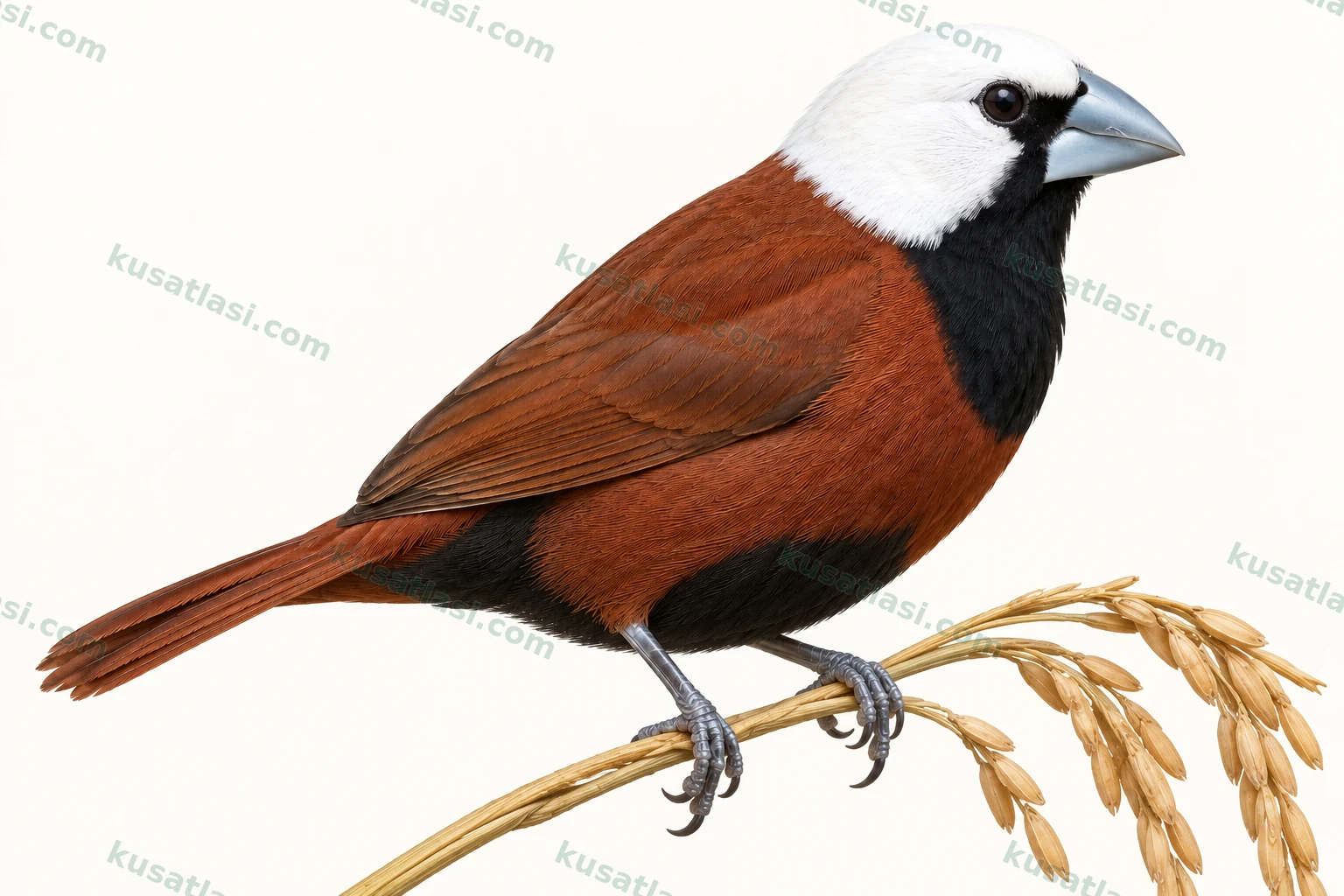
A small munia with a white head, black throat and dark chestnut body, centred on Java and Bali. Records from southern Sumatra have also been documented.
Biometrics
Length
Male11–12 cm
Female11–12 cm
Shared species value
Wing length
Male5.21 cm
Female5.21 cm
Shared species value
Weight
Male13 g
FemaleData unavailable
White-capped Munia
Java and Bali, with additional records from southern SumatraObservation guide in its natural range
Look for three features together
Do not rely on a single featureA distinct black throat below the white head.
Dark chestnut body and short, thick silvery-blue bill.
A plain head or an incomplete view of it does not establish age or sex.
Compare male and female
 FemaleMale
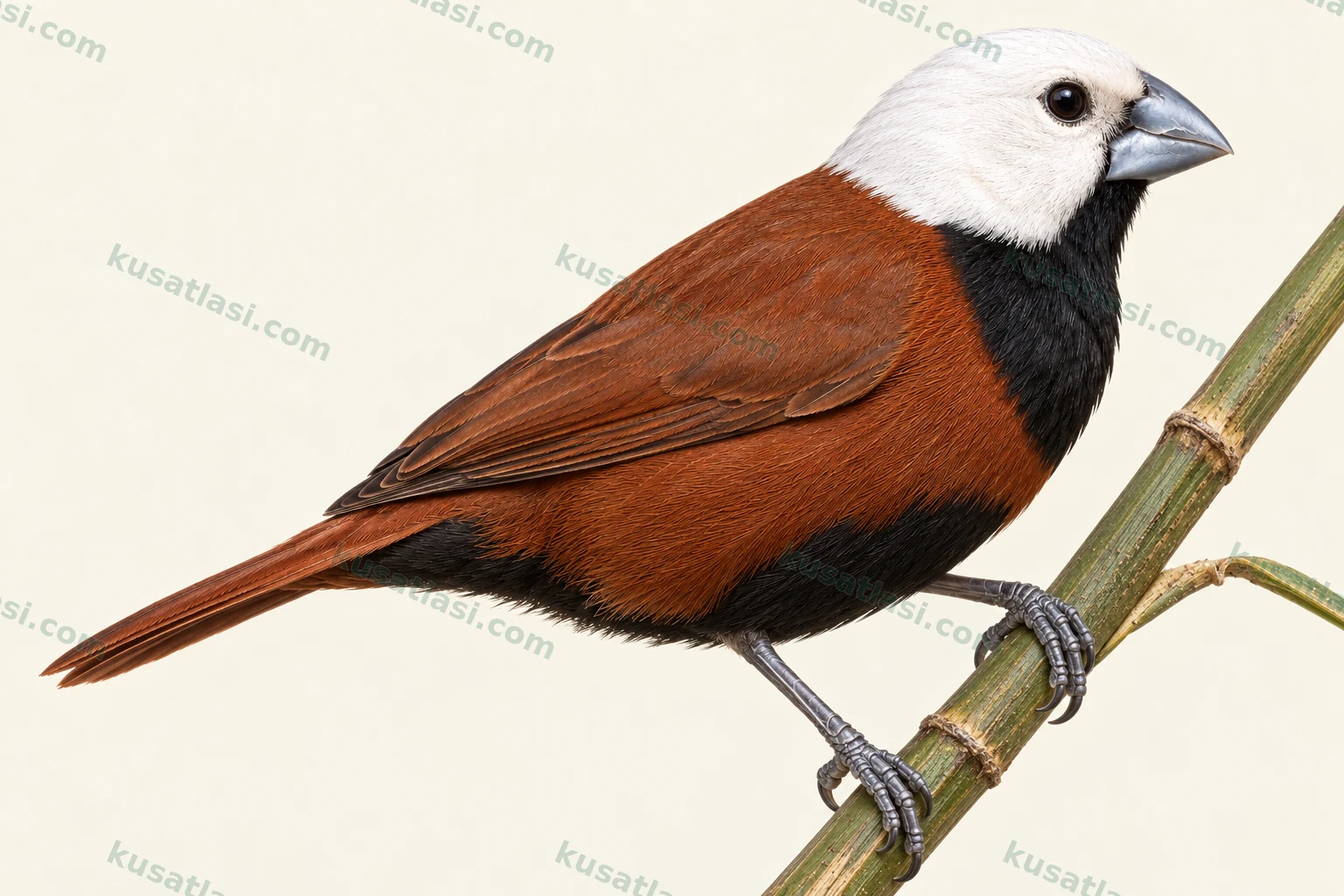
The white head and black throat of adults are important for identification. No reliable separate colour key for sex or age was verified in the sources examined.
Where to look in its natural range?
Rice fields, grassland and marsh edges, with agricultural transition areas linked to vegetation.
The months with clutches in the West Java collection and the date of a single southern Sumatra observation are shown separately. The latter is not a breeding record.
January
Resident. Its local use of fields and grassland can vary. West Java, historical museum collection. Clutches with eggs were recorded. This is not a shared breeding season across the island.
February
Resident. Its local use of fields and grassland can vary. No verified regional date was given for this month. This does not imply local absence.
March
Resident. Its local use of fields and grassland can vary. West Java, historical museum collection. Clutches with eggs were recorded. This is not a shared breeding season across the island.
April
Resident. Its local use of fields and grassland can vary. No verified regional date was given for this month. This does not imply local absence.
May
Resident. Its local use of fields and grassland can vary. No verified regional date was given for this month. This does not imply local absence.
June
Resident. Its local use of fields and grassland can vary. No verified regional date was given for this month. This does not imply local absence.
July
Resident. Its local use of fields and grassland can vary. No verified regional date was given for this month. This does not imply local absence.
August
Resident. Its local use of fields and grassland can vary. Belitang, southern Sumatra, 2007. Two free-living birds were observed on a ripe rice plant. This is not a nest record.
September
Resident. Its local use of fields and grassland can vary. No verified regional date was given for this month. This does not imply local absence.
October
Resident. Its local use of fields and grassland can vary. No verified regional date was given for this month. This does not imply local absence.
November
Resident. Its local use of fields and grassland can vary. No verified regional date was given for this month. This does not imply local absence.
December
Resident. Its local use of fields and grassland can vary. No verified regional date was given for this month. This does not imply local absence.
Nest, egg and incubation
Seven clutches in the West Java collection held 2–6 white eggs, with clutches of five the most frequent. Incubation duration and time to flight from the nest were not verified. Old jagori records may refer to a different taxon. Do not expose the nest site.
A short series of paired whistles. In a mixed flock, match the call to a bird you can see.
Do not play recordings to attract birds; observe quietly, especially near nests.
Species information
Quick identification
White-capped Munia Lonchura ferruginosa is a small seed-eating bird with a dark chestnut body and a clear boundary between the white head and black throat. The thick silvery-blue bill stands out in that pattern. For identification, consider the darkness of the throat and breast, the warm chestnut body and the region together with the white head. Munias joining the same flock in a rice field need not all be the same species.
The current English name is White-capped Munia. Older publications may use Munia ferruginosa, Black-throated Munia or a subspecies name under a broader species. Read those names with their publication dates. In particular, old Lonchura ferruginosa jagori records are not automatically equivalent to today's Java–Bali taxon. Check the full scientific name, locality and current taxon limits before using nest information from another island.
General appearance and posture
The white crown and head sides form a pale cap above the dark throat. The black throat extends onto the front of the neck. The back, wing coverts and flanks show dark chestnut tones. Dark areas in the centre of the breast, on the belly and under the tail keep the body from looking uniformly light brown. Sharpe's museum account emphasises the deeper chestnut and black throat in comparison with White-headed Munia. Warm colours can look almost black in shade, so a single colour name should not be applied to the whole body.
The short, strong bill differs from a long, slender insect-catching bill. On a bird perched on a seed head, the thickness of the bill and white head can be seen together. Both signs in one view are more useful than a pale spot at a distance. When the bird lowers its head, breast feathers can hide the lower throat. Wait for it to raise the bill for a clearer view of the front of the neck. The dark eye appears as a small spot on the white face.
Males, females and young birds
The white head, black throat and chestnut body in the species account form the basis of adult identification. The sources examined did not give separate colour cues for males and females reliable enough for the field. A whiter-looking head is not assigned to a male and a more shaded head to a female. Brightness can vary with the direction of light, feather posture and photographic exposure. An apparently thick bill is not taken as a sex difference without measurements.
The detailed age-related sequence of juvenile plumage was not adequately verified in this review. Plain brown young birds of other munias do not establish that every plain individual is a young bird of this species. If the white cap cannot be seen clearly, record visible and hidden features separately. Standing near an adult does not by itself prove that the bird is a juvenile of the same species. Mixed feeding flocks can include several species.
During moult, pale and dark areas may be present on the head of the same bird. A brief view need not match the entire adult pattern. When evidence of age or sex is weak, leaving both open avoids giving a false sense of certainty to the species identification. A distinction requiring scientific capture or molecular methods is not advice for a casual observer to catch the bird.
Appearance in flight
Birds taking off from a field may look like small, dark-bodied silhouettes. An angle showing the white head supports the identification, but White-headed Munia in the same region is also pale-headed. Check the head and breast when the bird perches again instead of assuming a throat pattern not visible in flight. Dark shadow under a wing is not evidence that the chestnut body is black.
Voice and behaviour
Cornell's specialist description gives the most frequent call as whistles delivered in pairs. A faint or distant sound alone cannot establish which munia called. If several species are in the same field, match the call to a visible bird when possible. A quiet individual may still be present. A feeding flock can easily disappear behind seed heads and grasses.
It can form large groups with other munias in rice fields, at marsh edges and in grassland. Group size describes the birds counted at a given moment, not the total population of Java or Bali. A crowded flock in one field and fewer birds nearby are considered alongside food and cover. A large flock is not necessarily a family group tied to a nest.
Similar species
1. White-headed Munia Lonchura maja is similar in its pale head, but its throat and transition to the breast differ from the distinctly black front of the neck of White-capped Munia. Its body looks paler cinnamon-brown. Both have a white head and thick bill, so first check whether the throat is actually pale or black. If the colour is unclear in shade, leave the identification open.
2. Chestnut Munia Lonchura atricapilla has a chestnut body and thick pale bill, but the adult's whole head is black. The white crown and sides of the head are important on White-capped Munia. The plain brown juvenile of Chestnut Munia is not substituted for a verified juvenile description of White-capped Munia. Regional occurrence and the bird's age also inform the comparison.
World distribution
The current taxonomic list gives lowland grasslands of Java and Bali as the core natural range. That does not extend the species to all Indonesian islands. Old, more broadly named munia records from Sulawesi or the Philippines do not automatically refer to this taxon. The map retains the core islands and distinguishes modelled cells from examples of verified observations.
The original 2011 Kukila paper reports two birds observed around Belitang in southern Sumatra in 2007 and other later records. The author discusses this as a westward extension of the known range. First publication of a historical record does not prove that the birds arrived on the island for the first time that year. Direct observations of free-living birds, photographs and a seller's description of locality are different kinds of evidence. The whole of Sumatra is not shaded as regular, confirmed breeding range.
Status within its natural range
The global category is Least Concern. The species can be scarce in some places. A biology thesis on Rawa Ngombol in Purworejo counted marsh–rice field and mangrove–rice field transitions separately. Local changes in the February–April counts do not mean the population throughout Java declined at the same rate. A density figure for the first month is given differently in the results and the abstract, so it is not used here as general population information.
Movements
The species data consulted classify it as resident. Feeding movements between rice fields or grassland differ from regular seasonal migration between islands. The sources examined give no annual route confirmed by individual tracking and applicable across the species. The date of one Sumatran record is also insufficient to draw the same journey every August. Consider local visibility together with field conditions and the time spent observing.
Breeding habitat
Grasslands, rice fields, marsh edges and suitable agricultural transition zones are the main settings. Open feeding areas and protective vegetation are both important. The Rawa Ngombol thesis distinguishes plants used for food, rest and shelter. A seed head used for feeding is not necessarily a nest support. Seeing birds in one field does not show that nests occur throughout it.
Nest site
A 1967 publication examining a museum egg collection from West Java records seven clutches for this taxon. One had two eggs, two had four eggs each, three had five each and one had six. The eggs were described as white and matt. These are 31 eggs rather than 31 nests. The original sources examined did not adequately verify total incubation or time to flight from the nest. Durations from another munia or old jagori nest records from the Philippines are not applied to this species.
Daily use of space
Sheltering in a clump of grass and eating its seeds are different uses. Seeing what the bird actually takes with its bill improves a record of plant use. A bird merely standing on a banana leaf does not establish that it eats banana fruit. Do not expose sensitive sites in vegetation or part the grass or move a branch to check for a nest. Field chemicals and removal of cover are also part of the conditions at a site.
What it eats
AVONET and referenced species data classify this bird among seed-eaters. Rice field and grassland use is consistent with that food group. The Rawa Ngombol thesis identifies rice and some local grasses as food plants. Use of a plant does not establish a fixed percentage of the daily diet. No quantitative study of dietary proportions across the whole range was verified, so proportions and a mandatory seasonal food list are left open.
How it obtains food
The thick bill and feeding on seed heads are important to how it obtains seeds. Iqbal's Belitang observation describes two birds perched on ripe rice plants. Seeing the seed taken in the bill is stronger evidence of feeding than a flight over the field. Check the head and throat pattern of each munia sharing a seed head.
Resting on a flowering or leafy plant does not mean the bird eats every part of it. Recording food collection and shelter separately helps describe both habitat and diet. Scattering food in a field or attracting a group by sound is unnecessary. Watching from a distance to see which plants the undisturbed group approaches gives better evidence of its natural behaviour.
The difference below the white cap
Both White-capped and White-headed Munias have a pale head. Seeing the front of the neck can change the identification, because the black throat is conspicuous on White-capped Munia. Using a shared pale marking alone can miss the distinguishing feature between close relatives. Even a brief view showing head, throat and body is more informative than a photograph showing only a very bright head.
Egg counts and nest counts are different
The historical West Java collection contains seven clutches and 31 eggs. Clutches of five were the most frequent, but that does not make five universal. Two, four and six eggs also occurred in the small sample. Eggshell masses in the collection are not adult bird masses. Keeping track of what each number measures prevents different biological measurements from being confused.
A large flock does not represent the entire population
Birds congregating in one field can be easy to see when nearby seed heads offer food. On another day, scattered birds in cover can be hard to count. A count at one spot is therefore misleading if read as the whole island population. The Rawa Ngombol study's separate transition zones help explain where the local data were collected. Comparisons are more meaningful when date, season, method and habitat are recorded together.