

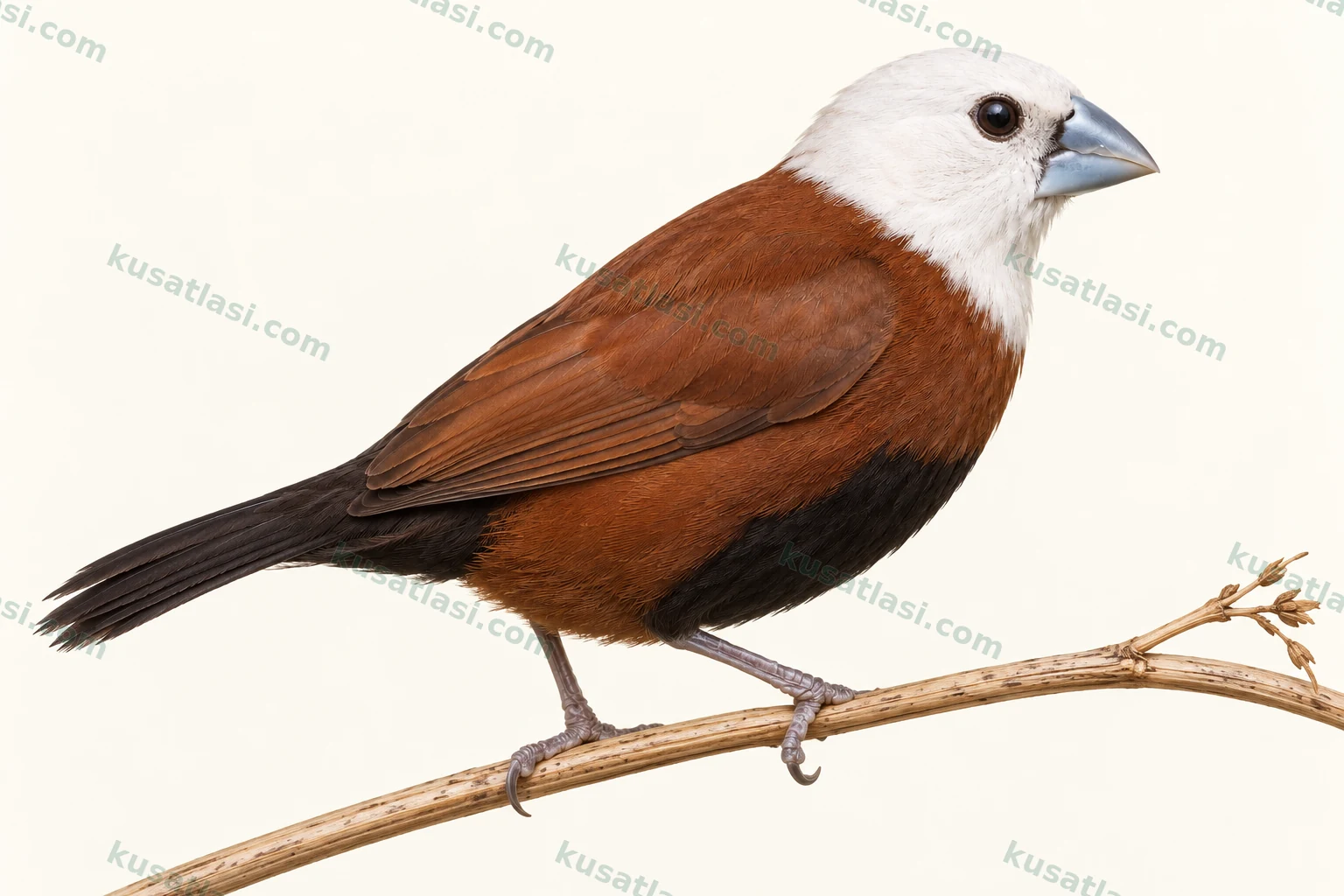
World Birds IUCN statusLC · Least ConcernGlobal IUCN category. BirdLife v10 (2025); taxon matching: AviList 2026 / IOC 15.2; checked: 29.10.2026. The list year is not the species assessment date. Source and method · BirdLife OrderPasseriformesPasserines FamilyEstrildidaeEstrildidae
White-headed Munia
Lonchura maja
A small munia recognised by its pale head, chestnut body and thick silver-grey bill. It often feeds in groups in rice fields and grasslands.
Biometrics
Length
Male11 cm
Female11 cm
Shared species value
Wing length
Male5.36 cm
Female5.36 cm
Shared species value
Weight
Male10.5–14.7 g
Female10.5–14.7 g
Shared species value
White-headed Munia
Thai-Malay Peninsula, Sumatra, Java, Bali and southern VietnamObservation guide in its natural range
Look for three features together
Do not rely on a single featureThe head and throat are whitish to cream, the body is chestnut and the centre of the underparts is dark.
The bill is large, short and conical, and is silver-grey or blue-grey.
The head is brown and lacks the adult’s white. Young birds may be confused with other munias.
Compare male and female
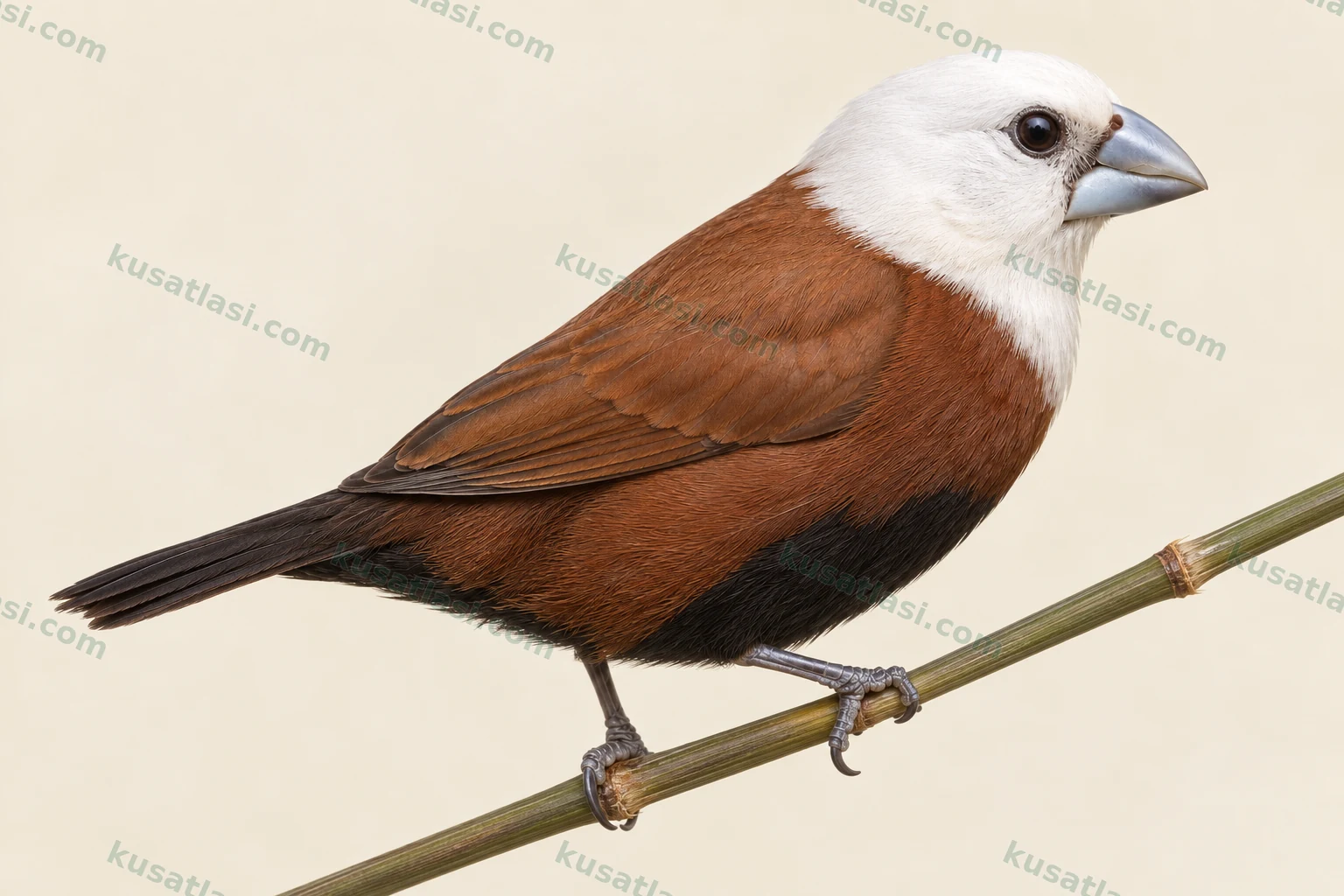 FemaleMale
Males and females look alike. The degree of white on the head is not a reliable way to tell their sex. Young birds have brown heads.
Where to look in its natural range?
Rice fields, grasslands, reedbeds and edges of cultivated areas.
Historical West Java egg records. These months do not form a single breeding calendar for the entire natural range.
January
The species is resident. Movements between sources of seed are not migration routes. West Java: The original museum study records dated clutches.
February
The species is resident. Movements between sources of seed are not migration routes. West Java: The original museum study records dated clutches.
March
The species is resident. Movements between sources of seed are not migration routes. No verified regional date is given for this month. This does not imply local absence.
April
The species is resident. Movements between sources of seed are not migration routes. West Java: The original museum study records dated clutches.
May
The species is resident. Movements between sources of seed are not migration routes. No verified regional date is given for this month. This does not imply local absence.
June
The species is resident. Movements between sources of seed are not migration routes. No verified regional date is given for this month. This does not imply local absence.
July
The species is resident. Movements between sources of seed are not migration routes. Ipoh, Malaysia: On 13 July 2020 young birds that had left the nest were fed seeds. This is not an egg-laying date.
August
The species is resident. Movements between sources of seed are not migration routes. No verified regional date is given for this month. This does not imply local absence.
September
The species is resident. Movements between sources of seed are not migration routes. No verified regional date is given for this month. This does not imply local absence.
October
The species is resident. Movements between sources of seed are not migration routes. No verified regional date is given for this month. This does not imply local absence.
November
The species is resident. Movements between sources of seed are not migration routes. West Java: The original museum study records dated clutches.
December
The species is resident. Movements between sources of seed are not migration routes. West Java: The original museum study records dated clutches.
Nest, egg and incubation
The enclosed nest has a side entrance and is set in grassy cover. The specialist synthesis reports 3–7 white eggs, 12–13 days of incubation and first flight at about 21 days. Most clutches in the historical West Java sample contained 5 eggs.
The calls are thin and short. The young beg for food in a different context from the adult’s usual calls.
Do not play recordings to attract birds; observe quietly, especially near nests.
Species information
Quick identification
The White-headed Munia Lonchura maja is a small, stocky seed-eater found in grasslands and rice fields in Southeast Asia. The adult can be identified by the combination of a whitish head, warm chestnut-brown body and thick silver-grey bill. The centre of the underparts and the area under the tail are darker, sometimes nearly black. Look for the whole pattern on one bird, since separate glimpses of a pale head and brown wings are insufficient.
The name refers to the pale head, which need not look snow-white in every individual. Cream or pale yellowish tones may be present, and shade or feather wear can make the head appear darker. Young birds lack the adult’s pale head pattern. A brown juvenile in a flock with white-headed adults cannot be assigned to the species with certainty on that basis alone.
General appearance and posture
The short neck and full body are paired with a large conical bill. The head, face and throat are pale, while the back and folded wings are chestnut-brown. The lower nape and upper breast may form a transition between the white head and darker body. The dark central underparts help distinguish it from some other munias with white bellies. If the central area is hidden by the viewing angle, do not assume the whole belly is either white or black.
The original Singapore museum guide from 1927 described a white head, neck and throat, chestnut upperparts and black in the centre of the underparts in both sexes. It also described the rump and tail as a brighter chestnut than the rest of the back. This historical colour pattern agrees with the pale head, cinnamon-brown body and silvery bill of the current specialist description. The old book’s range limits do not replace the current checklist.
The eye is brown, and the bill and feet range from grey to blue-grey. The bill is short but has a broad, prominent base. Bright sunlight can make the light head and shiny bill seem to merge, but the bill is separate from the head markings. When the bird leans forward to feed, the edge of the white head and the dark underparts appear differently. Comparing several postures helps with identification.
Males, females and young birds
Adult males and females look very similar, as noted by the current Cornell account and the original museum guide. A female may sometimes look duller or have a creamier head, but this is not a reliable way to sex every individual. Worn male feathers can look similar. Do not automatically classify the whiter bird as male and the yellower one as female.
Young birds have brown upperparts and lighter brown or pale yellowish underparts. They lack the adult’s distinctive white head. The old museum account emphasises how similar young White-headed and Chestnut Munias can look in the field. This similarity prevents a confident identification of every pale brown bird. Bill shape may help, but on its own it may be insufficient to distinguish similar young birds.
Seeing an adult directly feed a juvenile shows a closer association than seeing two birds on the same grass stem. Even so, a feeding observation cannot establish exact age, hatching date or whether the entire group came from the same nest. A flock may contain more than one munia species, which matters when counting both adults and juveniles. Young birds that cannot be identified can be recorded separately as uncertain observations.
Appearance in flight
During short flights the bird shows its small, stocky body and brown wings. The pale adult head may appear briefly as a bright patch. The original Singapore guide describes direct flight in groups that take off from grassland. However, one pale head cannot identify every member of a flock. Other munias feeding with them may take flight at the same time.
Moving from a grass stem to the ground or nearby cover is different from regular intercontinental migration. On the map, the documented natural range and areas of human introduction are interpreted separately. A bird observed in Taiwan or another distant place does not demonstrate that it arrives there each year by natural migration. The direction of flight and the date can be recorded without drawing unknown departure and arrival points.
Voice and behaviour
It gives thin, short sounds. The old field guide noted the faint, high-pitched calls of birds taking off as a group. The sources examined here do not provide detailed sound analysis that would let each call identify the species with certainty. If the calling bird in a mixed flock was not seen, check the pattern of the head and underparts as well. The begging calls of young birds and the usual calls of adults are different behaviours.
The species generally feeds in groups and can join other munias. It gathers seeds on the ground and climbs grass stems, using the same seed source at different levels. A dated field note from Malaysia describes young birds following an adult to beg for food and calling more as the adult approached. The behaviour of this small group does not establish a fixed group size for the whole population or show that only females provide care.
Similar species
The Chestnut Munia Lonchura atricapilla resembles it in its chestnut body, but the adult has a black head instead of a pale one. Young birds of both species can look very similar, with brown upperparts and pale underparts. Treating the lack of white on a juvenile’s head as proof of Chestnut Munia would overlook young White-headed Munias.
Adult Scaly-breasted Munias Lonchura punctulata have a distinct light-and-dark scaled pattern on the underparts. In adult White-headed Munias, look instead for a pale head, a more evenly chestnut body and a dark centre to the underparts. Seeing one scaled bird in a mixed flock does not identify the rest of the flock.
With the White-capped Munia Lonchura ferruginosa, compare the extent of the pale area on the head and pay particular attention to the dark throat. In adult White-headed Munias, the throat forms part of the pale head pattern. Seeing the top of the head without the throat is insufficient to choose between the two similar species. Wait for the bird to give an unobstructed view again.
Global range
The accepted native range includes the Thai-Malay Peninsula, Sumatra, Java and southern Vietnam. A modern regional specialist account also includes Bali. It would be equally misleading to consider the species endemic to Indonesia or to assume that it occurs on every island in Southeast Asia. The islands and mainland regions are identified individually. Munia observations in Borneo and Sulawesi cannot all be attributed to this species.
Status in its natural range
The species is listed as Least Concern in the current checklist. It can occur in rice fields and grasslands near settlements. The use of such habitats is distinct from the presence of populations introduced by humans elsewhere. Taiwan and Hong Kong are listed as introduced areas in the accepted taxonomic record. Current specialist sources also report introduced presence in Singapore and parts of Japan. The regional Singapore account includes both resident and introduced status, so records should not all be assumed to have a single origin.
The old Singapore guide’s reports of widespread flocks do not provide a census of today’s urban population. Use of urban areas and the frequency of records may change over time. A large flock in one field cannot stand in for the population size or the amount of crop damage in an entire country.
Movements and migration
Specialist sources describe resident populations without regular long-distance migration. Daily movements between grasslands where seeds ripen are not drawn as migration routes. Records resulting from introductions in distant countries do not extend the natural range shown on the map. The date of a sighting shows that the bird was present at that site. It does not establish that the whole population was breeding on that date.
Breeding habitat
Grasslands, reedbeds, wetland margins and cultivated ground are its main habitats. It may also use rice field edges, tall uncut grass and garden boundaries. Seed-bearing plants and cover matter alongside proximity to water. Finding the bird in a rice field does not mean it lives permanently on open water or feeds underwater.
Nest site
The specialist account describes a round, enclosed nest made of grass and pieces of leaves, with a side entrance. The original Singapore guide also reports nests in reeds and tall grass. Of seven clutches in the historical West Java egg collection, five had five eggs, one had four eggs and one had six eggs. Five eggs predominated in this small sample. This fits within the wider range of 3–7 eggs given in the general specialist account.
The specialist synthesis reports incubation lasting 12–13 days and the first flight from the nest at about 21 days. These figures do not come from new nest monitoring conducted here. A first flight does not imply full independence in feeding. Adults have been observed carrying seeds to young that had left the nest.
Daily use of habitat
Birds may search for seeds in groups on the ground and climb stems to reach seed heads. The grassy patch where a flock feeds may be separate from the cover used for nesting. Seeing birds during grass cutting does not justify approaching a nest. Do not open the entrance to count eggs. In a known breeding area, observing from a distance helps preserve existing cover and allows the birds to behave naturally.
What does it eat?
It feeds mainly on grass and cereal seeds. Although it is seen around rice fields, it eats more than rice. The original Singapore guide lists rice and other seeds, and the modern local specialist account confirms that it uses seeds both on the ground and on stems. These sources do not establish year-round proportions in the diet or a list of plants used in every region.
How does it find food?
The bird collects seeds while taking short steps and hops on the ground. It can also climb grass stems and take seeds directly from the seed heads. Its thick conical bill stands out when it is feeding, but it may be impossible to identify what it takes at every peck. In mixed flocks, keep observations of the White-headed Munia’s feeding separate from those of other munias.
On 13 July 2020 at Ipoh, three young birds were fed grass seeds. One of the plants reported was Cynodon dactylon. The observer stated that no animal prey was seen during that feeding. This single local observation does not prove that the species never eats invertebrates in its lifetime. The same note records one adult collecting several seeds and giving them to more than one juvenile. It did not establish that only the female feeds all the young.
Seven egg clutches do not make a global average
In the historical Java museum study, five of seven clutches contained five eggs, and the other two contained four and six eggs. The study’s methods explain the notation used to indicate, for example, a clutch containing five eggs. The records are direct evidence of egg numbers, but do not establish a fixed average for every region. Eggshell weights from the collection are distinct from adult body weights.
Three young birds do not mean three eggs
The dated feeding note from Malaysia recorded three adults and three young together. This group size does not show that a nest originally held three eggs or that every juvenile was the offspring of one pair. An egg clutch and a social group of birds that have left the nest are different units of observation. Keeping them separate helps avoid drawing overly strong conclusions about breeding success from a conspicuous flock.
A white head does not establish sex
Adult males and females share a similar pale head pattern. Treating a cream-coloured head as certain evidence of a female may misclassify a male with worn plumage. The browner head of a young bird is a separate question of age. Species, age and sex cannot all be determined at once from a single colour clue. The extent of each visible pattern needs to be considered separately.
Old names do not establish new species
The Singapore book of 1927 calls this bird Munia maja, and the Java egg study uses the spelling Lonchura maja leucocephala. The accepted current species identity is Lonchura maja. The old names help explain the history of the source records, but do not by themselves establish a new global range or a separate species in current classifications. The current identification should preserve the link with the bird represented by the historical specimen.