

World Birds IUCN statusLC · Least ConcernGlobal IUCN category. BirdLife v10 (2025); taxon matching: AviList 2026 / IOC 15.2; checked: 29.10.2026. The list year is not the species assessment date. Source and method · BirdLife OrderPasseriformesPasserines FamilyEstrildidaeEstrildidae
African Firefinch
Lagonosticta rubricata
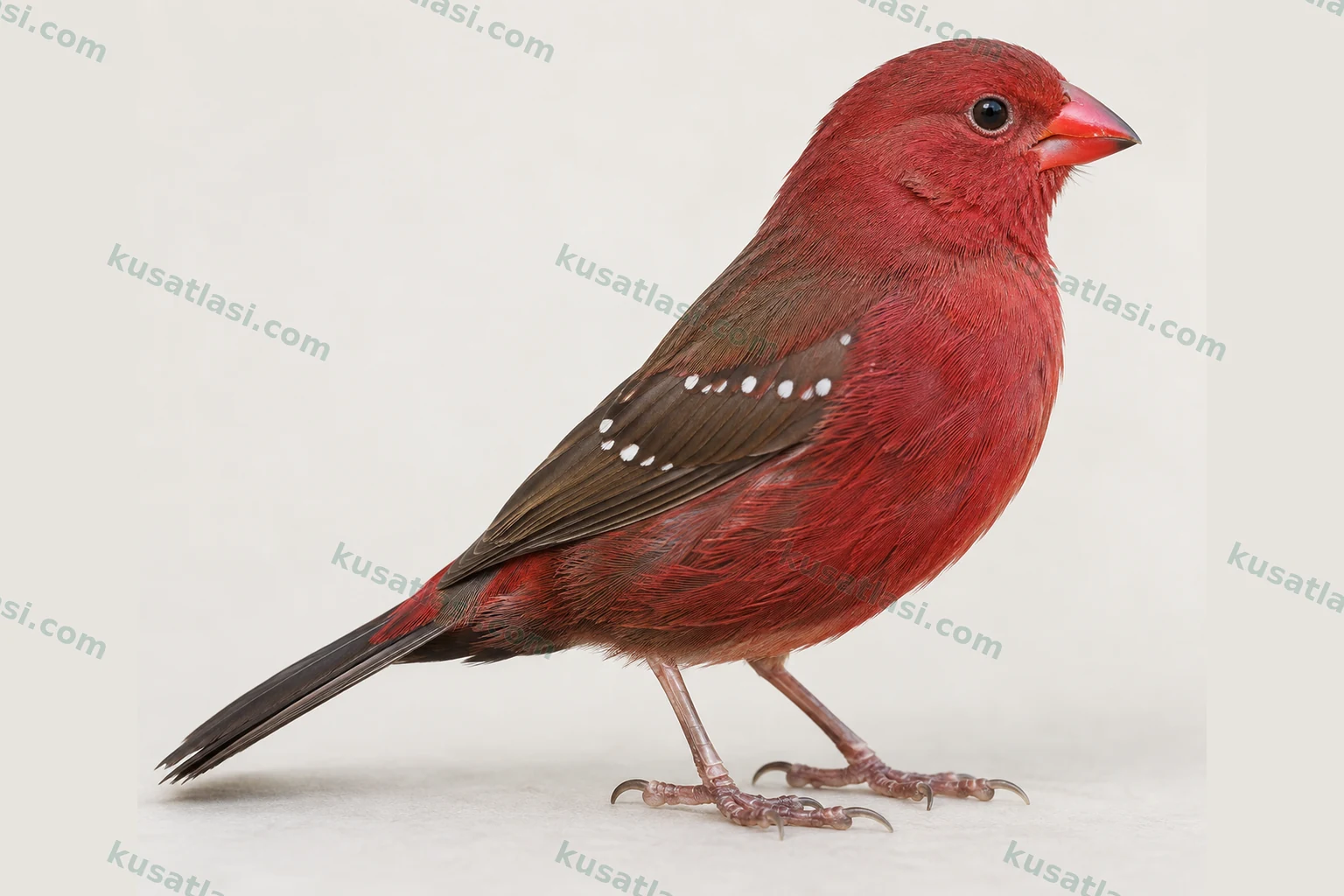
Dark bill, red underparts and rump, brown upperparts; male with dark lower belly. Head colour varies geographically.
Biometrics
Length
Male10–11 cm
Female10–11 cm
Shared species value
Wing length
Male4.81 cm
Female4.81 cm
Shared species value
Weight
Male9.5–10 g
FemaleData unavailable
African Firefinch
Patchy moist scrub and forest edges in sub-Saharan AfricaObservation guide in its natural range
Look for three features together
Do not rely on a single featureBluish-black or dark grey; red plumage alone is insufficient.
Compare the red area with the dark brown back.
A grey crown is not required in every regional population.
Compare male and female
 FemaleMale
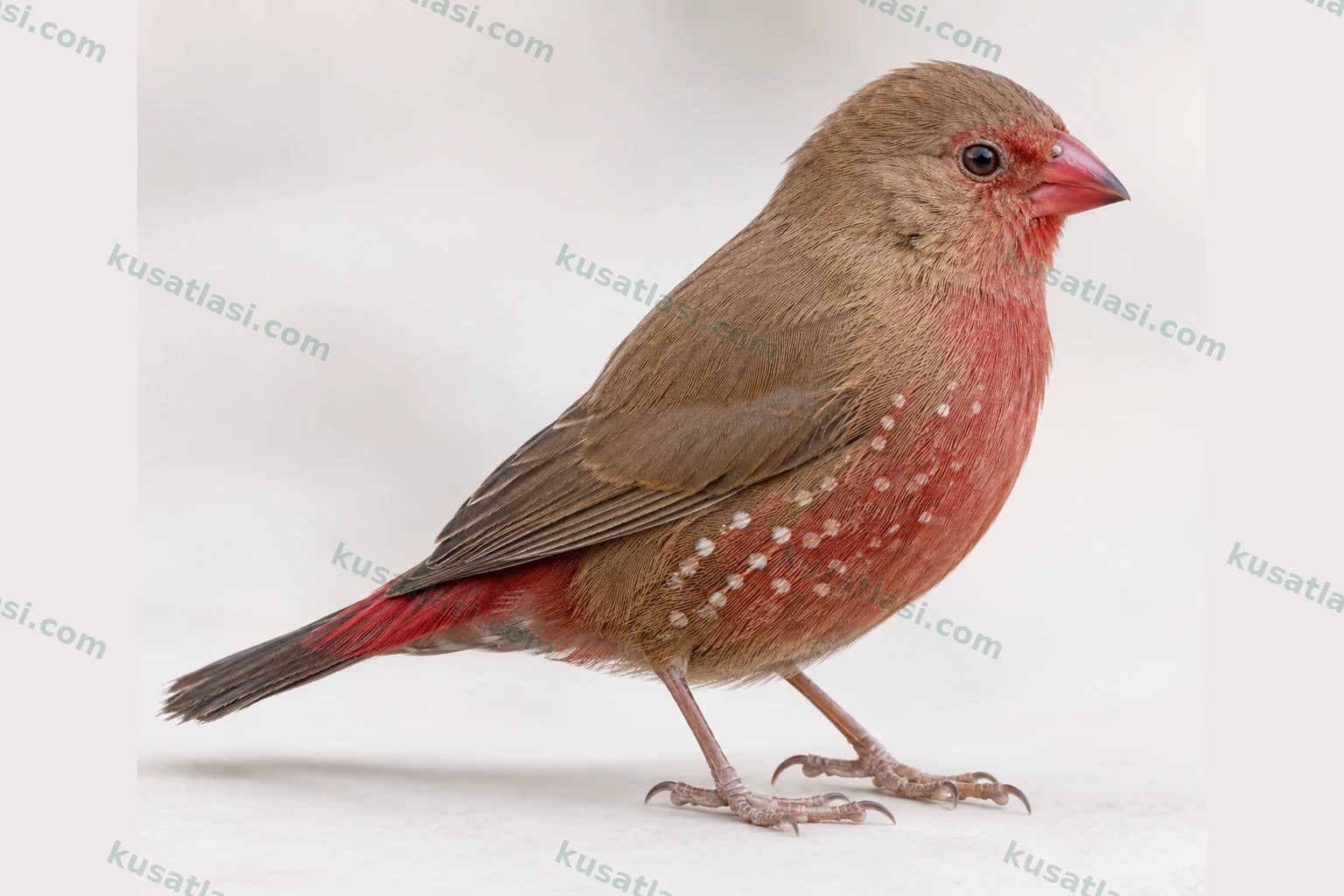
The female is usually paler; head and face vary regionally. Young birds lack developed adult red underparts.
Where to look in its natural range?
Near dense grass and moist scrub, watch the dark bill, contrast between back and underparts, and area around the tail together.
The species is essentially resident, and breeding time varies by region. The months below are examples only from the named regional study or expert account.
January
The species is essentially resident, and breeding time varies by region. South Africa, Roberts regional account: Laying period; January–April peak.
February
The species is essentially resident, and breeding time varies by region. South Africa, Roberts regional account: Laying period; January–April peak.
March
The species is essentially resident, and breeding time varies by region. South Africa, Roberts regional account: Laying period; January–April peak.
April
The species is essentially resident, and breeding time varies by region. South Africa, Roberts regional account: Laying period; January–April peak.
May
The species is essentially resident, and breeding time varies by region. South Africa, Roberts regional account: Laying period; January–April peak.
June
The species is essentially resident, and breeding time varies by region. South Africa, Roberts regional account: Laying period; January–April peak.
July
The species is essentially resident, and breeding time varies by region. No verified regional date specific to this month was given; this does not mean local absence.
August
The species is essentially resident, and breeding time varies by region. No verified regional date specific to this month was given; this does not mean local absence.
September
The species is essentially resident, and breeding time varies by region. No verified regional date specific to this month was given; this does not mean local absence.
October
The species is essentially resident, and breeding time varies by region. No verified regional date specific to this month was given; this does not mean local absence.
November
The species is essentially resident, and breeding time varies by region. South Africa, Roberts regional account: Laying period; January–April peak.
December
The species is essentially resident, and breeding time varies by region. South Africa, Roberts regional account: Laying period; January–April peak.
Nest, egg and incubation
The male builds a closed grass nest with a side entrance. The South African account gives two–five eggs; both parents incubate for 11–12 days, and the young leave the nest at 14–19 days, with care continuing afterwards.
It gives tinkling, trembling calls with repeated notes and clipped alarm sounds. Match the sound to the bird seen.
Do not play recordings to attract birds; observe quietly, especially near nests.
Species information
Quick identification
The African Firefinch Lagonosticta rubricata is a small finch with a short, thick bill, living close to dense grass and scrub cover. In an adult male, assess the dark red underparts, browner upperparts, red rump, dark bill and dark lower belly together. Small white spots may be present on the flanks.
On a live bird the bill appears bluish-black or dark grey, and may look entirely black in shade. Red feathers alone are insufficient because other firefinches also have red plumage. The bill, head, contrast between back and underparts, and darkness beneath the tail need to be seen together. This page concerns Lagonosticta rubricata, matched to the English name African Firefinch. Red-billed Firefinch and other Lagonosticta species with similar names are not the same taxon.
General appearance and posture
The short, strong-looking conical bill gives the bird the appearance of a small seed-eating finch. The red face, throat and breast of the adult male contrast with the brown wings and back. The rump is dark red and the tail darker. The lower belly, particularly the undertail region, can approach black. Small white flank spots are more or less visible according to posture and overlapping feathers. Failure to see spots should not be treated as definite absence without checking whether the entire flank was actually visible.
Look for pairs or small groups near scrub and dense grasses. Despite its red body, the bird can be difficult to notice once it enters thick cover. While feeding close to the ground, it may raise its head to look around and then return to the grass bases, providing brief identification opportunities. Seeing the whole bird is important, rather than identifying one red fragment among plants. Weak sunlight, deep shade and worn feathers alter the appearance; photographic colour saturation is not a fixed standard for the species.
Males, females and young birds
Adult males generally have more intense and extensive red areas. Females may look paler, with browner-grey upperparts and less intense red or warm pink underparts. The extent of flank spotting and colours of head and face must be considered alongside regional variation. Museum comparisons and field guides support the basic similarities, but one shade or spot count does not establish sex with certainty for birds throughout Africa. It is especially important to know which geographical population a particular head pattern represents.
Young birds have not yet developed the full red underparts of adults, and the lower belly may appear brown. A dark bill is useful when comparing them with their red-billed relative. Yet a small juvenile hidden in scrub should not be identified from a shadow on the bill alone. Head, back, underparts and the area around the tail must be seen together. Females and young of other firefinches are also dull-coloured. Being close to an adult may help, but each bird in a mixed feeding group must have its identity checked separately.
Appearance in flight
In a short flight, the red rump can contrast with the darker, brown upperparts. The Kenya Bird Map identification guide considers this contrast useful when comparing the species with Red-billed Firefinch. African Firefinch often lands in concealed vegetation after flight. However, a red rump is not unique to this species: the flying bird should be matched with its bill, head and underparts when it lands again. A momentary flash of red is not enough for a definite species name.
The head and small white flank spots may not be distinguishable on a bird with open wings. Identification features visible when perched do not necessarily show equally clearly in flight. No new, unverified single-feature rule for the upperwing or underwing is offered here. A flight of a few metres to a bush is part of daily space use and does not establish a migration direction or seasonal route. If possible, a voice heard from its hiding place should also be directly matched with the bird seen before flight.
Voice and behaviour
Newman’s guide describes ringing, quivering calls with repeated notes, along with abrupt alarm sounds. This small bird’s voice can sometimes reveal its location before it is seen. But nearby dark-billed finches should not all be given the same name without knowing which individual produced the sound. Voices of Vidua species associated with firefinch nests can further complicate assessment. A written description of a sound does not by itself provide reliable identification of sex or species.
Pairs and small groups occur in dense scrub, forest edges and tangles of grass. Southern African guides emphasise a preference for damper, shadier sites than Jameson’s Firefinch. The Kenyan expert account also stresses moist highland scrub. These descriptions do not establish identical altitude limits in every region. Brief appearance beside a path does not mean that the bird spends its whole day on open ground; its feeding site and hiding cover must be considered together.
Species that may be confused
1. Lagonosticta senegala, Red-billed Firefinch: the adult bill includes red, whereas African Firefinch has a dark grey or bluish-black bill. Also compare the male’s contrast between back and red underparts, lower belly and undertail region. Do not apply only the adult bill pattern to young birds; age and the complete pattern must be considered.
2. Lagonosticta rhodopareia, Jameson’s Firefinch: a pinker appearance and habitat preference may help. A pink head in Zimbabwe populations of African Firefinch need not, by itself, indicate this relative. Along with the head, check the brown back and wings, dark lower belly and undertail region.
3. Other female and young Lagonosticta: a dark bill or white flank spots alone do not distinguish every species in the genus. Consider locally possible species, head and breast pattern, the whole underside and age together. Record an uncertain bird from several angles without assigning a definite name.
World distribution
African Firefinch has a patchy distribution in sub-Saharan Africa, extending from the Senegal region in the west to Ethiopia and East Africa in the east, and farther south into suitable areas of central and southeastern Africa. Southern populations in Mozambique, Zimbabwe and eastern South Africa are important. Zimbabwe’s eastern highlands and neighbouring parts of Mozambique are treated within the same broad species framework as populations extending along South Africa’s east coast and inland. Appearance and density are not uniform throughout the range.
Status within its natural range
Because the bird is associated with dense grass and scrub, an individual in suitable cover can easily be missed on open ground just a few steps away. Habitat descriptions for eastern South Africa, Eswatini and southern Mozambique should not be transferred unchanged to West African populations. Geographical and colour differences between subspecies must be retained. Cornell’s 2022 taxonomy update included Lagonosticta landanae, previously treated separately, within L. rubricata; the taxonomic framework of older data therefore needs checking.
Migration
The South African expert guide describes the species as resident. This does not mean that it never uses different nearby sites according to food and cover conditions. No migration route with verified month-by-month boundaries and distances across the full range was found, so no such route is shown. Changes in rainfall, grass seeding or vocal activity may affect records; fewer sightings in a month alone do not prove migration. Observation samples and estimated coloured areas on the map are not direct evidence of resident breeding either.
Breeding habitat
Moist, dense scrub, forest edges, tall grasses and vegetated surroundings of waterways are the main places to look. The South African expert account also mentions ferns, dense grass cover, rural gardens and path margins. Nearby hiding cover matters more than an open, closely mown patch. This preference does not mean that the species lives only in high mountains throughout Africa; the habitats of regional populations must be considered separately.
Nest site
The male builds an enclosed, roughly rounded nest of dry grass with a side entrance. Softer grasses and flower heads, sometimes feathers, form the lining. The South African account reports nests about 0.5–2 m above ground in dense grass, ferns or vegetation around logs. Both parents incubate the two–five eggs for about 11–12 days. Nest departure is reported at 14–19 days, followed by about ten days of parental feeding; these are regional values from that expert account.
Daily habitat use
The bird may seek food at grass bases and scrub edges before retreating into dense cover. The South African account gives an egg-laying period of November–June, concentrated in January–April. The shorter breeding period reported by the historical atlas through the host-species relationship is not identical to this; its recording method and geographical context differ. The same continental breeding probability is not calculated for every month. Do not part grasses, trample ferns or open an entrance to find the enclosed nest. Watching adults come and go from a distance is enough to understand behaviour without damaging cover.
What does it eat?
It feeds mainly on small seeds and also eats insects. Its short, thick bill gives it the general appearance of a finch adapted to gathering small grass seeds. Bill shape cannot, however, identify a particular plant species or calculate a fixed year-round food ratio. The detailed grass-seed list in the Roberts-based southern African account is presented together with observations in captivity. That list must not therefore be reproduced as a definite wild diet list applying throughout the bird’s natural range.
How does it forage?
It gathers food on the ground and near grasses, and may use small openings at the edge of dense cover. Pairs or small groups being visible does not mean that every individual is eating the same thing at the same time. Seed gathering and insect catching represent different feeding opportunities. Name a small item seen in the bill only if it is sufficiently clear. A bird briefly entering an open path to feed may retreat into concealed vegetation when an observer approaches. Waiting at a distance near the edge of cover is more appropriate than driving it out for a photograph. In descriptions of natural habitat, feeding behaviour must be considered alongside moist scrub and grassland; one feeder observation does not replace the species’ usual behaviour.
One species, more than one head pattern
The grey crown in the South African guide is a useful African Firefinch feature. The same guide also states that Zimbabwe birds can have pink-red tones on the head and nape. It is therefore wrong to turn an illustration from one region into a fixed colour template for all of Africa. Identification uses the head together with bill, brown upperparts, red underparts and the dark area around the tail. Geographical variation does not mean that every unusual colour represents a separate species.
Museum colour and live-bird colour
The National Museum comparison explains that colours of live birds and long-stored museum specimens cannot be interpreted in the same way. The effect of preservation on bill colour is especially important when comparing sources. A museum specimen is valuable scientific material, but a faded preserved bill is not direct evidence that the same colour is normal in a live bird. Live identification follows the field guide’s dark grey or bluish-black bill description.
A host of brood parasitism
The southern African atlas and Newman’s guide record the brood-parasitic relationship between Vidua funerea and this firefinch. Another bird’s egg potentially occurring in the same nest is an additional consideration when describing the firefinch’s nest or young. The atlas’s emphasis on voice and host relationships for identifying Vidua species shows that feather colour alone is not sufficient in every group. Opening a nest to inspect the young is not an appropriate observation method for confirming that relationship.
Read old data carefully when taxonomy changes
Cornell’s 2022 update included Lagonosticta landanae, previously separated as Pale-billed Firefinch, within African Firefinch. Such a decision does not automatically give old measurements and maps the same scope. This is also why AVONET provides separate tables for different taxonomic lists. The species framework from which the measurement used here was taken is recorded; values from different tables are not combined to produce a new average. Encountering an old name is no justification for silently transferring another bird’s measurements.