Length
Male80 cm or more
Female80 cm or more
The shared adult figure published directly by Parks Australia; separate sex measurements are not supplied.

The global breeding population now nests only on Christmas Island in the Indian Ocean. Its tiny breeding range, historical forest loss and altered wind conditions around nest trees leave the species vulnerable.
The hero image and adult-male perched plate use the exact same file.
The shared adult figure published directly by Parks Australia; separate sex measurements are not supplied.
Parks Australia's shared approximate adult wingspan; it was not calculated from a range.
The shared species range published by Oiseaux.net/AVONET is repeated in both boxes; its endpoints are not assigned to the sexes.
Three useful ideas before opening the detailed account.
The long Christmas Island breeding cycle; pairs are not all at the same stage.
Late chicks and dependent juveniles may still require food from their parents.
Adults forage at sea, while established nest areas may remain part of the pair bond.
Nest repair and pre-laying behaviour become evident in some pairs.
Laying can begin; observers must remain well away from nest trees.
One of the main laying months; both parents share incubation.
Incubation and the first hatching attempts may overlap; one egg is normal.
Hatching continues and the naked chick is brooded on the adults' webbed feet.
The chick grows quickly but remains in the tree nest for many months.
Large white-downy chicks may be visible high in the canopy; sensitive locations are not shared.
Late pairs may hatch while older chicks begin sustained wing exercise.
Some young can fly but return to the nest area for food.
The long post-fledging dependence continues, and pairs are not all at the same stage.
Five clean working plates. Open the detailed image description below each plate for a non-visual equivalent.
The adult male is shown in right profile on a single branch. The head, neck and underparts are white, while the folded wings and pointed tail are dark. Irregular dark mottling across the lower back and rump breaks the boundary between the white body and dark wings. The male's long powerful bill is blue-grey with a faint pink wash and black tip; the eye is dark brown and the bare skin around it is dark bluish. This is an AI-generated scientific working plate, not a photograph of a real bird.
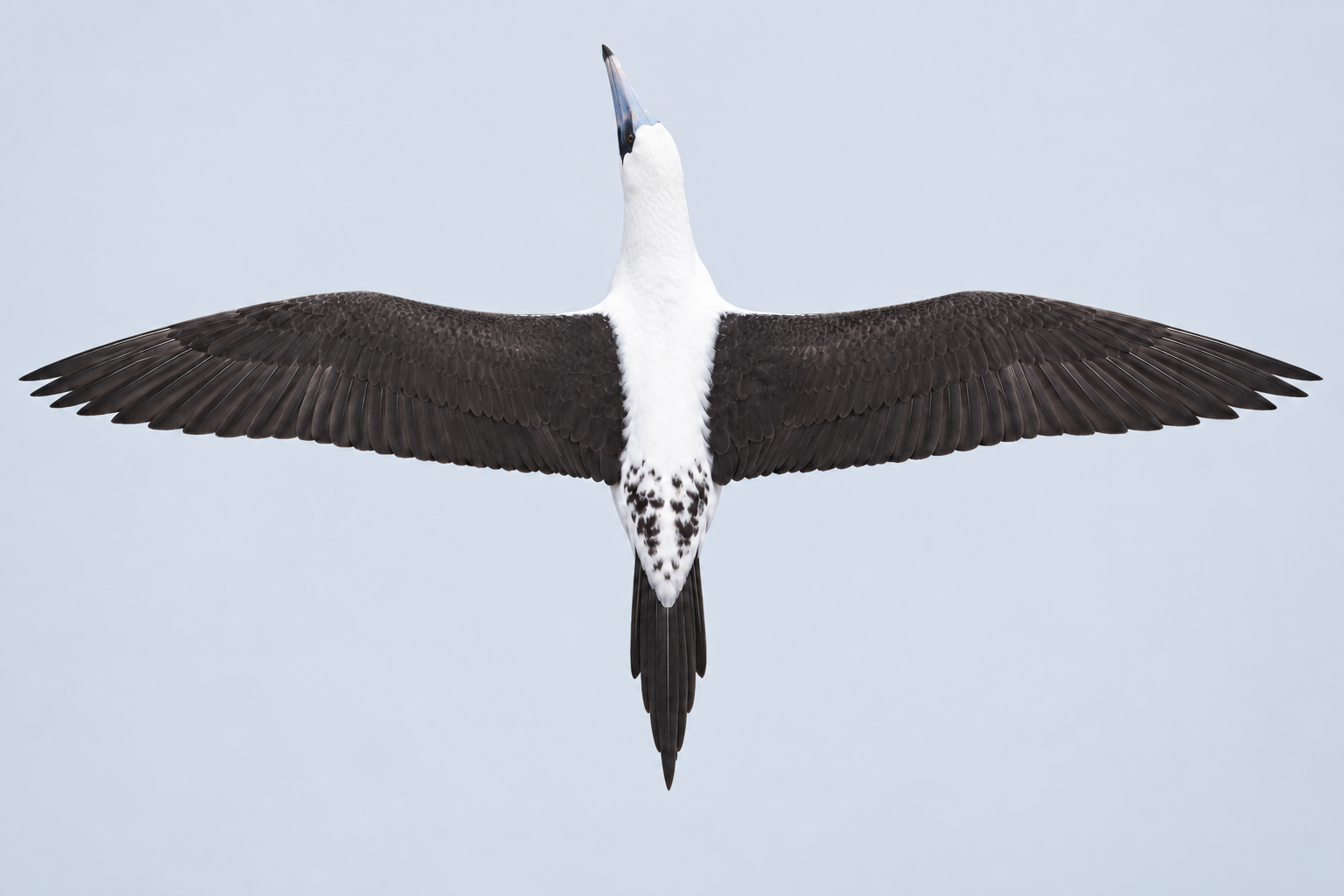
The bird is viewed directly from above with its long wings fully spread. The white head and body contrast sharply with almost black upperwings and a black tail; black-and-white mottling across the lower back and rump connects the two broad colour fields. The long wings appear narrow relative to the body. This view shows the species' large, long-winged structure, but a black-and-white pattern alone should not be treated as definitive identification.

From below, most of the body and underwing coverts are white. The long flight feathers form a broad black area along the outer and rear wing, and the pointed tail is also black. Small irregular dark marks may be visible on the lower flanks behind the legs. The underwing is not uniformly dark like the upperwing, an important distinction when reading the correct surface. The feet are held close to the body and are not a stand-alone field mark.

The right profile shows a large angular head and a very long, thick bill with a gently hooked tip. In the male the bill is blue-grey, locally pink-washed and distinctly black-tipped. Its fine serrated edge helps grip fish and should not be imagined as exaggerated teeth. The iris is dark brown; the eye ring and bare skin at the bill base are dark bluish black. The white head has no crest. This view is intended to combine bill colour and head structure with the body pattern, not to replace the whole-bird assessment.
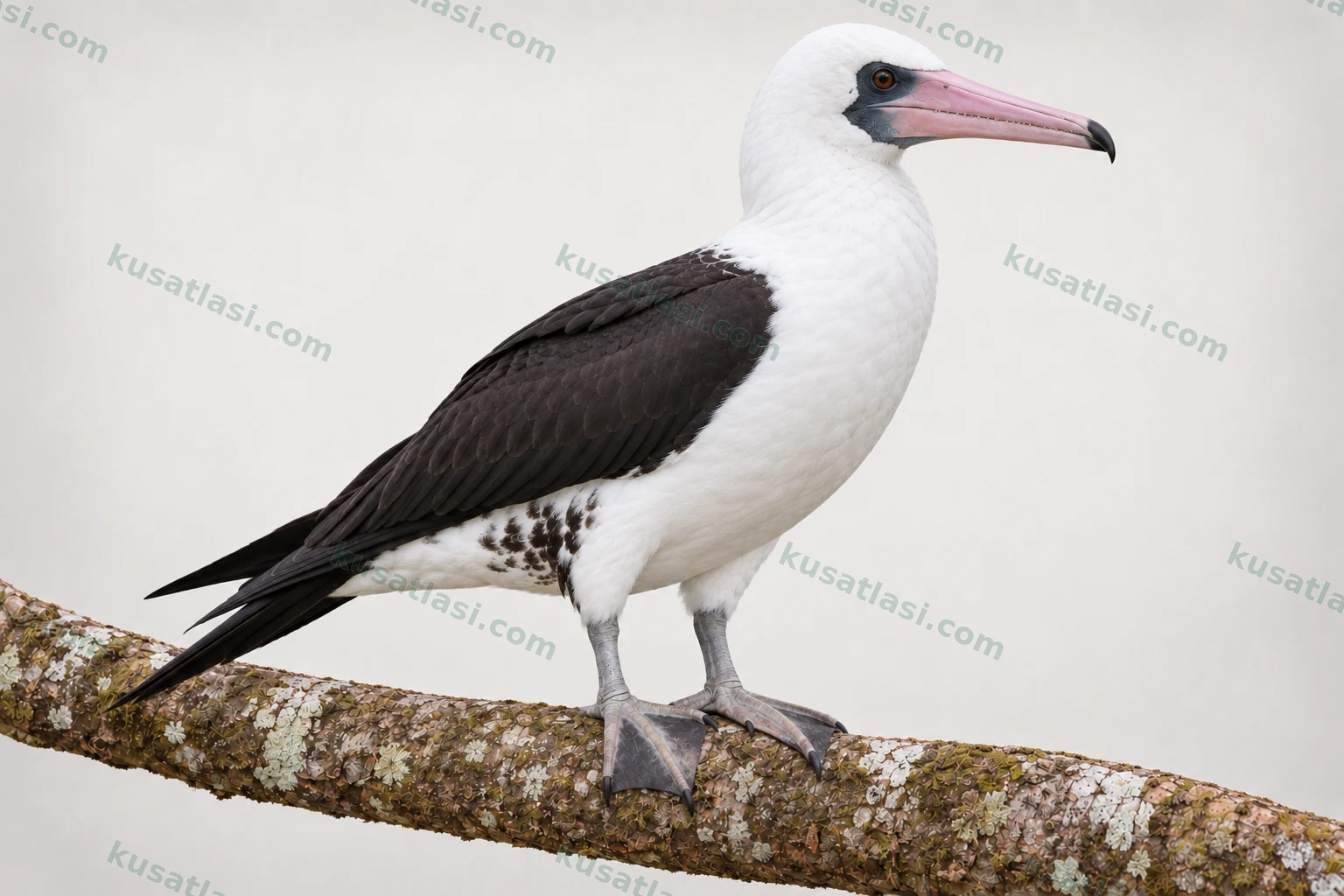
The adult female shares the male's white body, dark wings, black tail and mottled rump; no invented female plumage difference is shown. The reliable sex cue presented here is the long pink bill with a black tip. The eye is dark brown, the facial skin dark bluish and the legs grey. Distance, light and age can alter the apparent bill colour, so sexing from a single photograph should remain cautious.
It is generally quiet at sea. At the nest, adults give low, heavy calls likened to a bull's bellow, together with croaks, grunts and groans. These words describe only the quality and context of the voice; they do not replace a recording. Nothing plays automatically until an individual recording and its licence have been verified.
No licensed recording is attached; nothing plays automatically.The Turkish and English accounts cover the same evidence in natural language.
Abbott's Booby is a large-bodied tropical seabird with exceptionally long wings. At distance, the first pattern is a white head and body set against almost black wings and a black tail. The upperwing looks like a dark mantle, while irregular black-and-white mottling across the lower back and rump makes a broken transition between white body and dark wings. From below, most of the body and underwing coverts are white, with the long flight feathers forming a broad black edge. The head is large, the neck strong and the bill remarkably long and thick. Identification should not rest on a single white area or black wing; use the combined large structure, long bill, mottled rump, dark tail and contrast between the two wing surfaces.
When perched, the body looks long and heavy, the chest full and the head large for the body. The feet are fully webbed. Instead of wrapping slender toes around a branch like a songbird, it spreads broad webs across the branch. This shows how a bird built to swim and plunge into the sea balances in the top of a tall tree. Folded wings make a long dark panel toward the tail. The boundary between white neck and dark wing is clean, but mottling breaks it across the lower back. The tail is black, narrow and rather pointed. Legs and feet are grey, with the outer web sometimes darker.
Its proportions can look heavier and more large-headed than those of many other boobies. The long bill darkens to black at the tip and is gently hooked. Fine serrations along the cutting edge help hold slippery fish. A dark brown eye sits within narrow dark bluish bare facial skin. A resting bird may draw in its neck and look rounder; when alert, the neck lengthens and the bill projects. Such changes in posture should not be mistaken for real differences in size or age in a photograph.
Male and female share the same basic plumage: white head, neck and underparts; dark wings and tail; irregular mottling across the lower back and rump. The dependable visible sex distinction concerns bill colour rather than body plumage. An adult male has a blue-grey bill, sometimes washed pink, with a black tip. An adult female has a more distinctly pink bill, again black-tipped. Light, distance and camera colour balance can shift these tones, so a faded photograph alone should not be used for confident sexing.
A juvenile resembles an adult male but is duller and may have a greyer bill. Fresh plumage appears clean, while worn feather edges become less even. The large white-downy chick remains at the nest for months and continues to receive food after it learns to fly. A tree-top young bird approaching adult size is therefore not necessarily independent. Approaching juveniles or adults near a nest can disrupt an unusually long and energetically costly period of care.
In the air, exceptionally long and relatively narrow wings extend almost straight from either side of the heavy body. They may be held stiffly while gliding, with strong but measured beats during active flight. From above, the white body is sharply separated from the dark wings; the black tail and mottled rump complete the pattern. From below the bird is much paler: white coverts and body are bordered by the broad black band formed by the flight feathers. If only a silhouette is seen, record distance, light, wing proportions and which surface was visible rather than forcing certainty at species level.
The bird travels long distances over the ocean in search of fish and squid. A tracking study found that it tends to dive from lower heights and to shallower depths than several other boobies. This is a measured general tendency, not a rule that every dive must follow. Activity can peak during morning and afternoon. Longer trips in warmer, less productive conditions show behavioural flexibility in variable tropical seas, but that flexibility is not unlimited.
It is usually quiet away from land. At a nest tree, however, pairs may make deep, muffled sounds likened to a bull's bellow, along with short croaks, grunts and groans. Mutual wing waving is one ritual through which mates recognise one another and maintain the pair bond. Long wings require control on approach to the nest; landing in a tall open-crowned tree needs clear manoeuvring space.
At sea it finds prey visually and enters the water head first. Fish and squid are often taken near the surface. Visits by adults to a nest can be widely spaced, while the chick's slow growth helps it tolerate long gaps between meals. Failure to see a parent during a short watch does not prove that a nest has been abandoned. Non-research observers should not wait beneath a nest tree, publish its exact coordinates or block the birds' approach path.
Masked and Nazca Boobies can also combine a white adult body with dark wing areas. Abbott's Booby has more extensively dark upperwings, a conspicuously mottled lower-back and rump transition, a dark tail and a very long heavy bill. Adult Brown Boobies have a broadly brown head, neck and upper body, so the distinction is easier in good light. At long range, in an overexposed image or against the light, these colour boundaries may disappear.
Geography is a powerful aid but never the whole identification. Abbott's Booby now nests only on Christmas Island, yet birds range widely at sea and juveniles or non-breeders may travel farther. To document a record, look for bill colour and structure, rump pattern, tail colour, the difference between upperwing and underwing, and overall proportions on the same bird. A sequence of images, flight direction, approximate size and a behaviour note are much more useful than one blurred frame.
A large black-and-white booby on Christmas Island is a strong candidate, but it should not automatically be labelled Abbott's Booby. Whenever possible, document the wing surface, rump, tail and bill in separate frames. If a nest tree is known, follow conservation staff guidance rather than posting its location on an open map. Approaching a tall nest tree not only disturbs the birds but also exposes people to falling branches and difficult forest ground. A scientific record becomes stronger through an honest account of visible characters, not by moving closer.
The only confirmed breeding site of Abbott's Booby today is Christmas Island, an Australian territory in the eastern Indian Ocean. The species formerly nested across a wider chain of islands in the Indian and Pacific oceans, but those colonies disappeared. Breeding adults remain tied to nest sites in the island's elevated rainforest, while feeding trips can take them hundreds of kilometres out to sea. Satellite and location tracking show that the marine range is not one narrow line: direction and trip length change with water temperature and productivity.
Abbott's Booby is not a regular member of the Turkish avifauna. Türkiye's coasts do not lie within its known breeding, wintering or normal feeding range. This heading on a World Birds page provides geographic context; it does not imply that the species is native to Türkiye. Any extraordinary claim from Turkish waters would require multi-angle photographs, date, location, flight direction and independent expert review. Other black-and-white boobies and lighting effects would need to be excluded first.
Breeding adults generally use a broad marine area around Christmas Island and return to the island during nesting. Juveniles and non-breeders may disperse across a wider Indo-Pacific region. This is not a mass seasonal migration between two fixed points but marine dispersal shaped by age, breeding state, currents and food conditions. The page therefore avoids drawing one exact migration line. A satellite track represents the journey of an individual in a particular year, not an unchanging route used by the whole species.
The species breeds in mature tropical rainforest on the higher parts of Christmas Island. The most valuable nest trees are giants rising above the surrounding canopy, with open crowns and strong branches. Long-winged birds need clear airspace around the crown for a safe approach. Large clearings left by phosphate mining do more than remove trees; they can create turbulence and harsh airflow along forest edges, affecting nests that remain nearby.
The nest is usually a substantial bowl of sticks in a large fork 10–40 metres above the ground. The pair carries dry sticks and lines the interior with green leafy twigs. The same area may be used for years. A canopy nest can look small from the ground even though a chick remains there for roughly five months. Standing beneath it, touching the tree or using a drone for a closer image is inappropriate.
Breeding birds can spend much of day and night on ocean journeys, returning to the forest mainly for nest attendance, changeovers and chick feeding. Their marine habitat is the open tropical ocean. As prey distribution changes, so do the direction and length of trips. Forest and sea may appear to be separate habitats, but both are essential to one life cycle: breeding requires a safe emergent tree, while prolonged chick care requires sufficient food at sea.
Fish and squid form the core diet. Flying fish are among the recorded prey, although the menu can change with year, season and ocean conditions. A tracking study found shifts in diet and trip pattern in warmer, less productive water. This shows that the species is not tied to one fish, but a prey list from one study should not be treated as an unchanging menu for every year. A chick takes soft regurgitated food directly from a parent's mouth or throat.
The bird searches over the open sea for prey close to the surface. It enters the water head first and grips slippery fish with a long bill whose edge is finely serrated. A published comparative study found lower plunge heights and shallower dives than in several other boobies. Foraging activity can rise during morning and afternoon. When prey is sparse, trips and the area searched become larger. Its long bill, exceptionally long wings and tendency toward shallow diving describe a bird that scans broad ocean areas while taking much of its food near the surface.
Many boobies nest on the ground or rocky ledges, whereas Abbott's Booby uses giant rainforest trees. Broad webbed feet on a high branch look surprising, but the bird spreads its whole foot across the branch and distributes its weight over a wide surface. Clear airspace around the nest is vital for take-off and landing with a wingspan approaching two metres. Protecting only the nest tree is therefore insufficient; surrounding forest structure and wind conditions matter as well.
Incubation of the single egg lasts about 56 days, unusually long among boobies. The chick remains at the nest for a mean of 151 days and can continue receiving food for a further mean of 230 days after fledging. The complete cycle from laying to independence can reach roughly 486–504 days. This explains why most pairs can raise a young bird only every second year. The loss of one breeding attempt affects not just one season but long-term population renewal.
Historical phosphate mining created broad openings in the rainforest. Air behaves differently along a clearing edge than inside closed forest; turbulence and sudden downdrafts can make approach to a nest tree harder for a heavy long-winged bird. Research and rehabilitation programmes therefore consider more than planting trees: they also examine forest-edge shape and future wind conditions. The connection shows how invisible physical processes can matter as much as the number of trees in species conservation.
Abbott's Booby is the only living species placed in the genus Papasula. Its scientific name traces to Robert Ridgway's 1893 description, and older literature may call it Sula abbotti. That older combination records a historical classification; it does not denote a different species. This page matches the accepted Papasula abbotti with the established English name Abbott's Booby and the project's Turkish name Abbott Sümsüğü.
The most useful record is dated and photographed from more than one angle without approaching a nest. At sea, note flight direction, group size, feeding behaviour and approximate location. On land, record only general behaviour visible from authorised routes. Keeping sensitive nest sites off open maps directly supports conservation. Flying a drone, playing calls or flushing a bird does not improve scientific value; it may instead threaten an exceptionally long breeding cycle.
Pairs build a substantial stick nest 10–40 metres high in open-crowned emergent rainforest trees and line it with green leafy twigs. The female lays one thick-shelled white egg. Both parents warm it with their webbed feet for about 56 days. A chick fledges after a mean of 151 days and may remain dependent on its parents for a further mean of 230 days. The period from laying to independence therefore approaches 15–18 months, so most pairs cannot raise a chick every year. Approaching a nest, waiting beneath its tree or trying to flush a bird is dangerous and unethical.
Use several field marks together.
Adults are also white with black wings, but Abbott's combination of a mottled lower back and rump, longer powerful bill and tree-nesting ecology should be assessed together.
It shares a black-and-white design. Bill colour, tail and rump pattern and geographic context must be read together rather than relying on a white body alone.
The adult has a broadly brown head, neck and upper body. Abbott's Booby is mostly white-headed and white-bodied with distinctly dark wings.
Sources are maintained once in the central bibliography; they are not duplicated under species pages.
Open the central bibliography