

World Birds IUCN statusVU · VulnerableGlobal IUCN category. BirdLife v10 (2025); taxon matching: AviList 2026 / IOC 15.2; checked: 29.10.2026. The list year is not the species assessment date. Source and method · BirdLife OrderOtidiformesBustards FamilyOtididaeOtididae
Houbara Bustard
Chlamydotis undulata
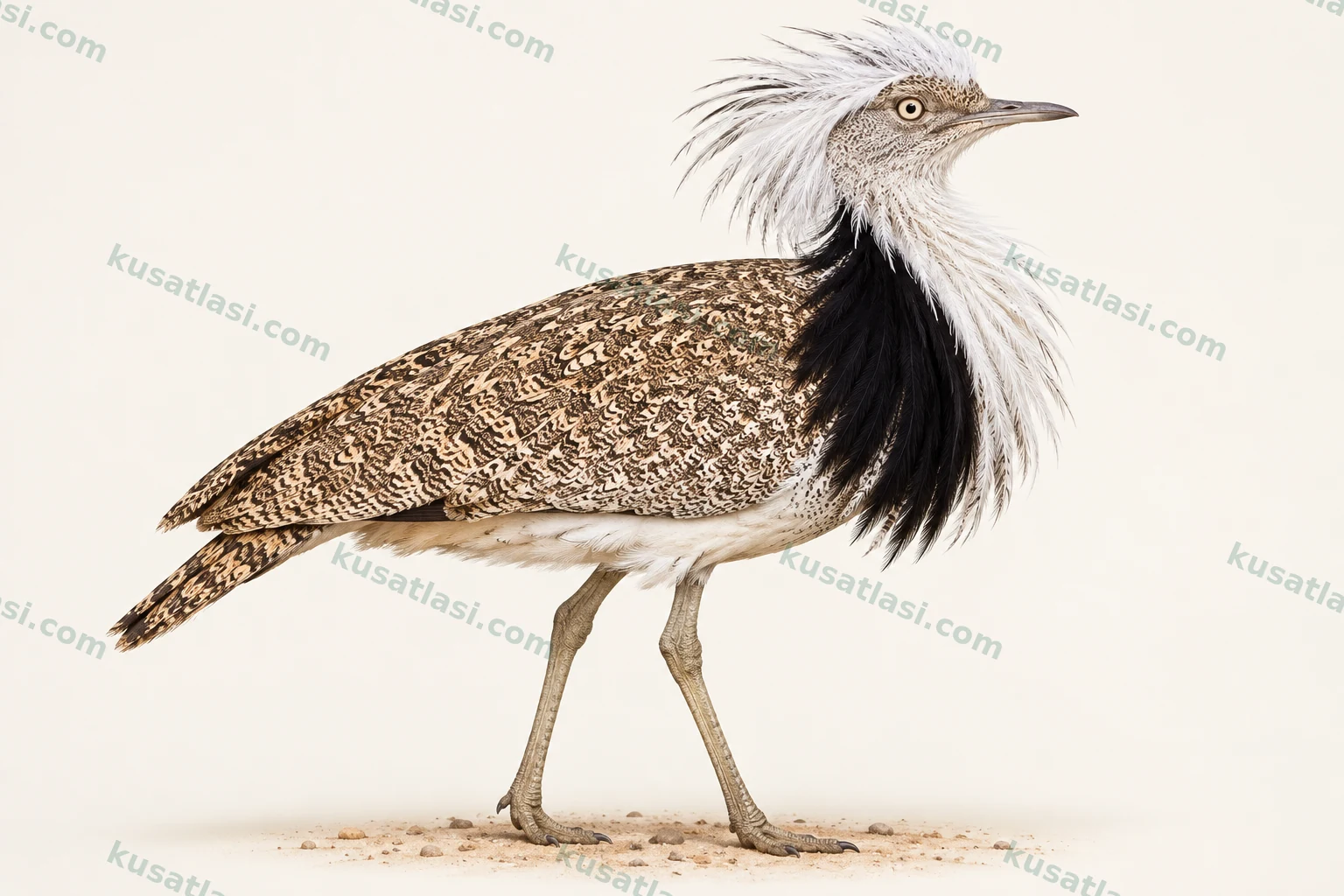
Sandy upperparts, white underparts, black neck ornaments and white head feathers spread during display; African and Canary populations are separate from the Asian species.
Biometrics
Length
Male55–75 cm
Female55–75 cm
Shared species value
Wingspan
Male135–170 cm
Female135–170 cm
Shared species value
Weight
Male1.5–3.2 kg
Female1.1–1.7 kg
Houbara Bustard
North Africa and the eastern Canary IslandsObservation guide in its natural range
Look for three features together
Do not rely on a single featureThe white head feathers and black neck ornaments spread during display; they look plainer when folded.
It has a long neck and legs, sandy upperparts with dark markings and pale underparts.
The species occurs in North Africa and the eastern Canary Islands; Asian Houbara is a separate species.
Compare male and female
 FemaleMale
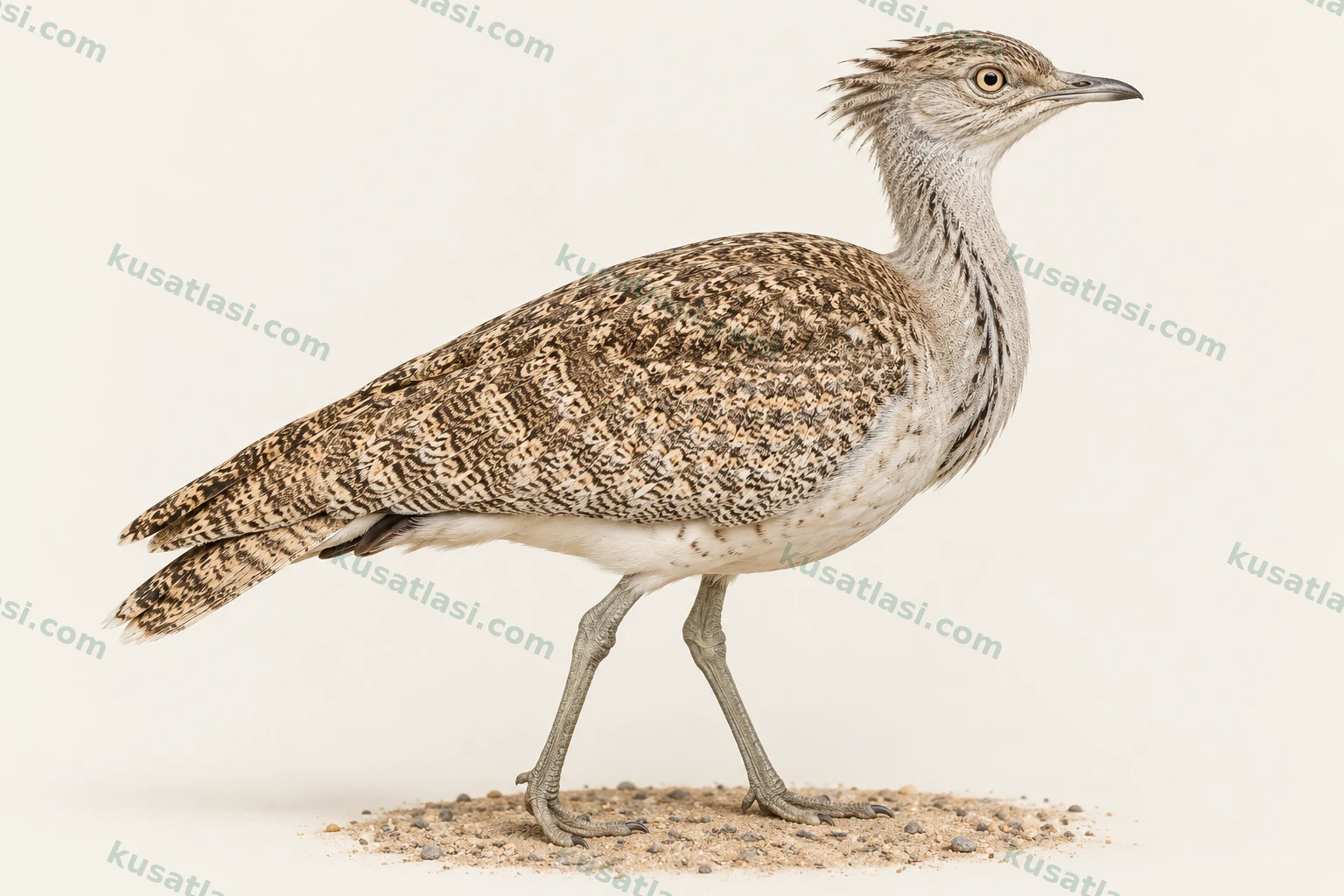
Males are larger on average and have more developed display feathers; body-length ranges overlap. Geographical population differences are not sex differences.
Where to look in its natural range?
Watch open dry country with low vegetation from a distance.
Breeding timing is regional and linked to rain; Morocco and the Canary Islands are not merged into one calendar.
January
Movements are mostly local; some Canary individuals show short-distance partial migration. Eastern Canary Islands: These are the main breeding months in the specialist account; in some years breeding can also begin in December.
February
Movements are mostly local; some Canary individuals show short-distance partial migration. Morocco: This is the main breeding period in the field study, not a fixed period for every year or all of North Africa. Eastern Canary Islands: These are the main breeding months in the specialist account; in some years breeding can also begin in December.
March
Movements are mostly local; some Canary individuals show short-distance partial migration. Morocco: This is the main breeding period in the field study, not a fixed period for every year or all of North Africa. Eastern Canary Islands: These are the main breeding months in the specialist account; in some years breeding can also begin in December.
April
Movements are mostly local; some Canary individuals show short-distance partial migration. Morocco: This is the main breeding period in the field study, not a fixed period for every year or all of North Africa. Eastern Canary Islands: These are the main breeding months in the specialist account; in some years breeding can also begin in December.
May
Movements are mostly local; some Canary individuals show short-distance partial migration. Morocco: This is the main breeding period in the field study, not a fixed period for every year or all of North Africa.
June
Movements are mostly local; some Canary individuals show short-distance partial migration. Morocco: This is the main breeding period in the field study, not a fixed period for every year or all of North Africa.
July
Movements are mostly local; some Canary individuals show short-distance partial migration. No verified regional date specific to this month was given; this does not mean local absence.
August
Movements are mostly local; some Canary individuals show short-distance partial migration. No verified regional date specific to this month was given; this does not mean local absence.
September
Movements are mostly local; some Canary individuals show short-distance partial migration. No verified regional date specific to this month was given; this does not mean local absence.
October
Movements are mostly local; some Canary individuals show short-distance partial migration. No verified regional date specific to this month was given; this does not mean local absence.
November
Movements are mostly local; some Canary individuals show short-distance partial migration. No verified regional date specific to this month was given; this does not mean local absence.
December
Movements are mostly local; some Canary individuals show short-distance partial migration. No verified regional date specific to this month was given; this does not mean local absence.
Nest, egg and incubation
The nest is a shallow scrape on the ground; usually 2–3 eggs are incubated by the female for about 23–24 days. Chicks walk early and follow her; no verified first-flight age in days was found.
The species is generally quiet; displaying males give low, resonant sounds. Voice and natural display are assessed together.
Do not play recordings to attract birds; observe quietly, especially near nests.
Species information
Quick Identification
Houbara Bustard Chlamydotis undulata is a long-necked, long-legged bustard of open dry country in North Africa and the eastern Canary Islands. Dark markings on sandy upperparts, pale underparts, black ornamental feathers on both sides of the neck and white head feathers that can be raised help identification together. These ornaments are less obvious in a relaxed bird than during display. A large white crest or inflated black collar should not be expected in every photograph.
Its current English name is Houbara Bustard. Mainland African undulata and Canary Islands fuertaventurae are two populations of the same species. Asian Houbara Chlamydotis macqueenii is a separate species. Since old publications could include both under one scientific name, migration, diet and breeding information in particular are not combined without establishing geography. This page covers African and Canary birds; long migration routes from Central Asia are not added to this species' map.
General Appearance and Posture
The upperparts carry finer, irregular dark markings over light brown and sandy tones. Fine dark spotting occurs on the front of the neck and breast; the belly looks whiter. The body stands longer and taller than a short-necked partridge's. The slender neck can be stretched upwards when walking; when the bird crouches, much of the body's height and the legs' length are concealed. A bird among stones and dry vegetation can be harder to pick out than a single image suggests.
The long black feathers at the sides of the neck and the white head feathers spread during display. When a male draws his head back and fluffs these feathers, even part of the face may be hidden. A narrow head in ordinary feeding posture and a broad, puffed-up display appearance can belong to the same bird. Rather than treating a display illustration as an unchanging year-round head shape, identification compares the feathers folded and spread.
Males, Females and Young Birds
Males are larger and heavier on average, with more developed display feathers on the head, neck and breast. Females have shorter ornaments. Nevertheless, the apparent size of one distant bird is insufficient to establish sex. Measurement ranges can overlap; posture and viewing distance alter visible size. Comparing individuals seen in the same plane is more meaningful than interpreting size in separate photographs as a sex difference.
Young have a plainer, sandy crown; adults' long display feathers are undeveloped or only faintly apparent. Markings and pale edges on the upperparts can differ from those of adults. An adult with its ornaments folded can also look plain-headed, however. Age assessment is not based solely on how puffed-up the crown is; the entire feather structure and the bird's behaviour are considered together.
The Canary population is generally darker, with stronger black patterning on the upperparts; some measurements also differ from the mainland. These geographical differences are not female or juvenile marks. Comparing a dark Canary bird with a pale mainland individual to determine sex can give the wrong result. Species, population, age and sex should be treated as separate questions.
Appearance in Flight
Long wings, a long tail and the distinct light–dark wing contrast revealed in flight attract attention. Dark areas towards the wingtip and white regions form a pattern not visible on a folded wing. While the underwing looks largely pale, dark markings become prominent towards the tips. Light and viewing angle can enlarge or shrink the apparent white areas, so one wing patch cannot establish species identity with certainty.
The bird can often move away by walking or running on the ground; immediate flight should not be expected at every encounter. Failure to fly does not make it a flightless species. A flight seen in treeless country is assessed together with body shape and location. Night flights in the Canary Islands tracking study show that movements can occur unnoticed during a daytime observer's brief visit.
Voice and Behaviour
It is generally a quiet bird. Males' low, resonant display sounds differ from the ordinary calls of small passerines in open country. A written sound comparison is not as reliable as the recording itself or the bird's appearance. On hearing a sound, watching the displaying bird's natural posture from a distance is useful; playing recordings to force a display is unnecessary.
A displaying male walks and runs with neck and head feathers fluffed, and can draw his head backwards. The female comes to the display area, but after mating she undertakes incubation and chick care. The male's display area and the female's nest need not be in the same place. The presence of several males on one tract of land does not prove eggs are at that display site either.
Similar Species
Asian Houbara Chlamydotis macqueenii is the closest comparison. The African species' raised white head feathers, the Asian species' black-tipped head feathers, the base of the neck ornaments and the pattern on the adult male's fore-neck matter together. These details are particularly exposed during display; not all can be seen when feathers are folded or the angle is poor. The former shared species name and geography alone do not replace certain visual identification.
Little Bustard Tetrax tetrax is smaller, while Great Bustard Otis tarda is much more heavily built; the arrangement of pale wing areas in flight also differs. These species are not presented as usual neighbours in every North African desert, however. Comparison considers the country, habitat, season and species genuinely possible at the observation. Sandy colour alone is not enough to identify Houbara Bustard.
Global Distribution
The main natural range is arid and semi-arid country in North Africa. The historical belt extends from Mauritania and Western Sahara in the west through Morocco, Algeria, Tunisia and Libya to northwestern Egypt. This historical belt does not mean continuous wild populations remain in every country today. Losses have been very large in some eastern and southwestern parts; the current situation in Egypt and released birds are not confused with a natural wild population. The fuertaventurae population of the eastern Canary Islands is treated in its separate island context; Fuerteventura, Lanzarote and La Graciosa are important.
Status Within Its Natural Range
The current global assessment is Vulnerable. Hunting pressure, habitat change and degradation of drylands matter on the mainland. Canary Islands studies have investigated overhead lines, roads and other human-related hazards. Seeing birds bred and released for conservation does not prove that a self-sustaining wild population has fully recovered. The model on the map does not replace a dated field count either; not every point in a remaining predicted area is verified habitat.
Movements and Migration
Local and seasonal movements, rather than regular long intercontinental migration, predominate in mainland populations. That does not mean every individual can be described as never moving. Of 41 birds tracked in the Canary Islands during 2017–2019, more than a third made short-distance movements, mostly at night, between breeding areas and warm-season feeding grounds. Not every individual showed this partial migration, which is not combined with the Asian species' long migration. No new route is drawn using the study's restricted raw tracking data.
Breeding Habitat
Open sandy or stony drylands with low vegetation are used. Sparse shrubs and herbaceous plants matter for both food and concealment. Moroccan breeding sites and the semi-desert and farmland mosaic of the Canary Islands are not copies of the same habitat. Rain-driven vegetation changes can also alter use of the same land between years. Intensive grazing or land alteration can affect this structure; not every treeless vacant area is suitable breeding habitat.
Nest Site
The nest is a shallow scrape on the ground; nearby vegetation helps the bird blend into its surroundings. The female usually lays 2–3 eggs; the specialist compilation also gives a total range of 1–3. Incubation lasts about 23–24 days and is undertaken by the female. Chicks can move after hatching and follow her; that does not mean they can immediately fly. A first-flight age reliably transferable to the African species was not verified in this research.
Daily Space Use
A foraging bird walks between plant clumps and suitable ground within open country. Canary birds may also use farmland at some times. Females during nesting and chick care and males during display can be associated with different areas. A Moroccan study of thousands of nests showed that the relationship between habitat suitability and nest survival can change within a season; one suitability colour does not guarantee the same breeding success every month. Observation should be from a road or existing viewpoint without approaching nests.
What Does It Eat?
It consumes both plant and animal foods. Leaves, shoots, seeds and other plant parts, together with insects and other small invertebrates, form parts of the diet. A non-breeding-season study in Morocco examined the stomach contents of 42 adults and found that the shares of plants and invertebrates varied between places and years. No significant dietary difference between sexes in this sample does not prove the same diet at every life stage and everywhere. A regional study is not a ready-made year-round food percentage for Canary birds.
How Does It Forage?
It picks up plants and small prey with its bill while walking on the ground. Slow progress with short pauses can be seen in sparse cover, but not every step of a moving bird is feeding. Plant growth and invertebrate availability can change after rain. A separate seasonal investigation in Morocco considers this variability. To understand foraging, distinguish the moment when the bird actually takes something from when it simply scans its surroundings. Results of a detailed behavioural experiment on Asian Houbara are not automatically transferred to this African species.
A Displaying Head and a Relaxed Head Do Not Look the Same
The ornamental feathers on the head and neck greatly change appearance, particularly when spread during male display. A male drawing his head back and fluffing his feathers can look very different from a relaxed narrow-headed bird. This difference is not another species or age class. When examining a plate or photograph, the behaviour shown should be known; a puffed white crest is not sought on every bird all the time.
Short-Distance Night Migration Has Been Documented in the Island Population
Canary Islands tracking showed regular movements by some individuals between breeding places and areas used in other seasons. Not every bird behaved the same, and flights were mostly at night. Therefore, seeing the species on the same land only by day does not prove that it stays put throughout the year. These movements within or around the islands are not interpreted as a small copy of the Asian species' long-distance migration.
A Suitable Nest Place May Not Give the Same Result Every Month
A Moroccan study considering 3108 nests from 2003–2014 found that the relationship between habitat suitability and daily nest survival changed over the breeding season. This shows that a habitat map alone does not explain all breeding success. Nest timing, environmental conditions and the study's scope must be read together. Daily nest survival is not the same measure as a chick's chance of surviving to adulthood.
Conservation Involves More Than Releasing Birds
Breeding and release programmes can be important, but if hunting pressure, habitat loss or collisions with overhead lines continue, the number of birds released alone does not show lasting success. Canary studies investigated human-related causes of death separately. Protecting a wild population also depends on the safety of the areas where birds live and move. An observation record does not automatically prove natural origin or successful breeding.