

World Birds IUCN statusAccording to the source taxonGlobal IUCN. BirdLife v10 (2025); taxon matching AviList 2026 / IOC 15.2; checked: 29.10.2026. The checklist year is not the species assessment date. Related IUCN assessment: Porphyrio porphyrio — Purple Swamphen: LC · Least Concern. These categories belong to the named source taxa. An exact match to this page’s species scope has not been verified, so they are not transferred as an independent species category. Source and method OrderGruiformesCranes and allies FamilyRallidaeRallidae
African Swamphen
Porphyrio madagascariensis
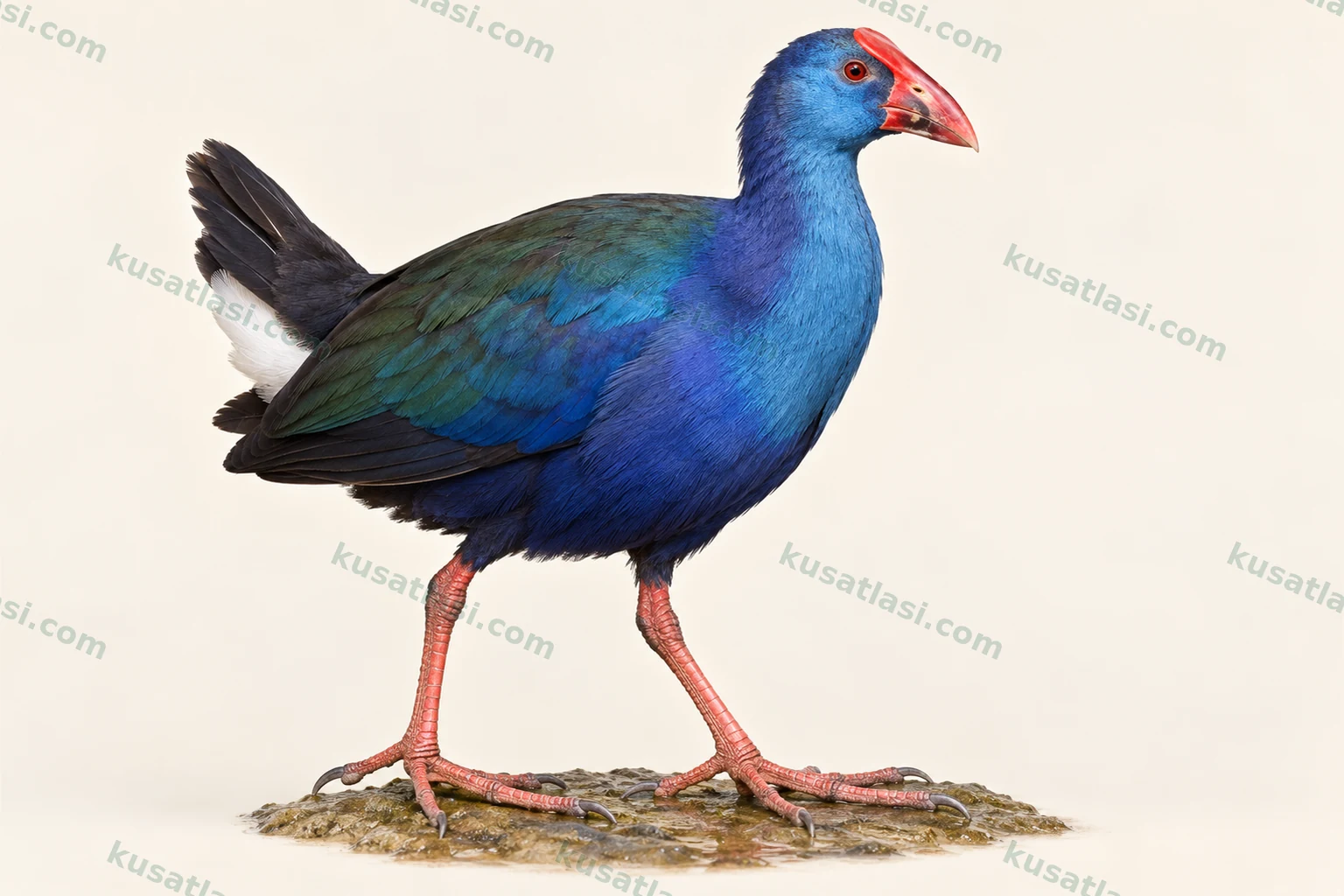
In the African population, blue-purple head and underparts, bronze-green back, large red bill and long reddish toes are distinctive together.
Biometrics
Length
Male40–46 cm
Female40–46 cm
Shared species value
Wingspan
Male100 cm
Female100 cm
Shared species value
Weight
Male528–687 g
Female480–737 g
African Swamphen
Wetlands of Egypt, sub-Saharan Africa and MadagascarObservation guide in its natural range
Look for three features together
Do not rely on a single featureWatch the large red bill and frontal shield together.
It is bronze-green in African adults; head and underparts are purplish-blue.
Look for long reddish toes; distinguish smaller relatives with yellow legs.
Compare male and female
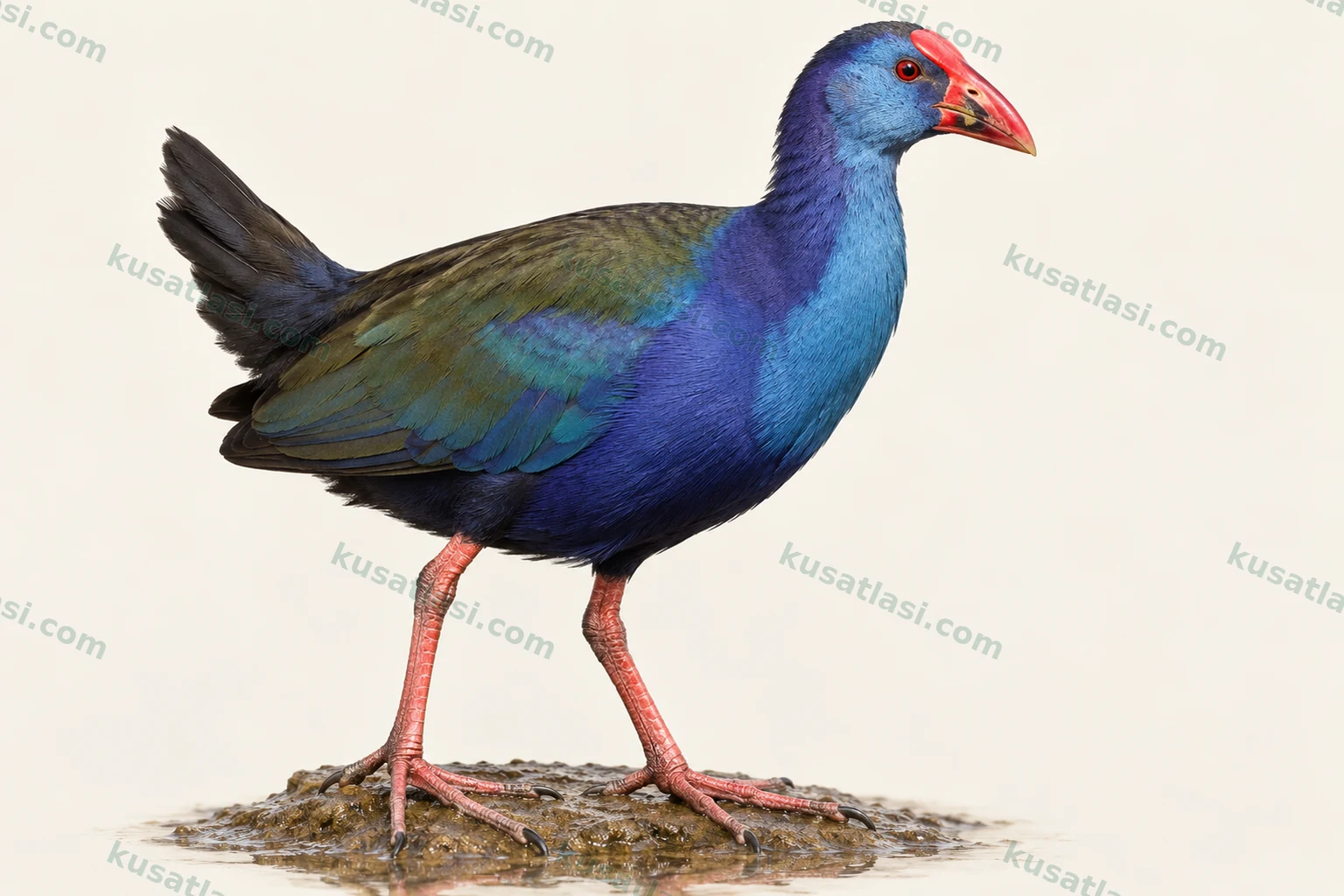 FemaleMale
Adult males and females have similar plumage patterns. Young may show brown upperparts and a grey-and-white mix below.
Where to look in its natural range?
Watch still or slow-flowing water with dense shore cover.
Breeding timing varies regionally in the southern African atlas. These months are not one shared calendar for the entire African population.
January
It is essentially resident; water conditions may prompt local movements. Southwestern Cape, regional breeding account: this month is in the reported breeding-record period. Northern Botswana, Namibia and northern Cape, atlas sample: these are rainy-period breeding records, not generalized to the whole range.
February
It is essentially resident; water conditions may prompt local movements. Southwestern Cape, regional breeding account: this month is in the reported breeding-record period. Northern Botswana, Namibia and northern Cape, atlas sample: these are rainy-period breeding records, not generalized to the whole range.
March
It is essentially resident; water conditions may prompt local movements. Northern Botswana, Namibia and northern Cape, atlas sample: these are rainy-period breeding records, not generalized to the whole range.
April
It is essentially resident; water conditions may prompt local movements. Northern Botswana, Namibia and northern Cape, atlas sample: these are rainy-period breeding records, not generalized to the whole range.
May
It is essentially resident; water conditions may prompt local movements. Northern Botswana, Namibia and northern Cape, atlas sample: these are rainy-period breeding records, not generalized to the whole range.
June
It is essentially resident; water conditions may prompt local movements. No verified regional date specific to this month was provided; this does not mean local absence.
July
It is essentially resident; water conditions may prompt local movements. No verified regional date specific to this month was provided; this does not mean local absence.
August
It is essentially resident; water conditions may prompt local movements. Southwestern Cape, regional breeding account: this month is in the reported breeding-record period.
September
It is essentially resident; water conditions may prompt local movements. Southwestern Cape, regional breeding account: this month is in the reported breeding-record period.
October
It is essentially resident; water conditions may prompt local movements. Southwestern Cape, regional breeding account: this month is in the reported breeding-record period.
November
It is essentially resident; water conditions may prompt local movements. Southwestern Cape, regional breeding account: this month is in the reported breeding-record period. Northern Botswana, Namibia and northern Cape, atlas sample: these are rainy-period breeding records, not generalized to the whole range.
December
It is essentially resident; water conditions may prompt local movements. Southwestern Cape, regional breeding account: this month is in the reported breeding-record period. Northern Botswana, Namibia and northern Cape, atlas sample: these are rainy-period breeding records, not generalized to the whole range.
Nest, egg and incubation
A large cup nest is built on a vegetation platform over water. Regional sources report 2–5 or 2–6 eggs and 24–27 days of incubation. First nest departure and flight development at about eight weeks are separate events.
Its loud, distinctive sounds can reveal it within reeds; a sound record is not evidence of migration or a nest.
Do not play recordings to attract birds; observe quietly, especially near nests.
Species information
Quick identification
African Swamphen is a large waterbird whose thick red bill stands out among reeds. Purplish-blue head and underparts, a paler blue face and a greenish back form the adult's basic colour pattern. The red frontal shield joins the bill; long reddish toes may be visible as it moves over vegetation. There is a white area beneath the short tail. These marks are considered together: seeing a blue body alone does not exclude every similar bird sharing the habitat.
The African population catalogued as Porphyrio madagascariensis is included by AviList v2025b within the broader swamphen species as Porphyrio porphyrio madagascariensis. This page describes the African population. Plumage features and measurements from European, Asian or Australian populations are not transferred here. African Swamphen remains a valid name in sources using the former species boundary; a name change does not mean African birds have suddenly appeared on other continents.
General appearance and posture
Despite its large body the bird can disappear almost completely in dense reeds. The tall, nearly triangular bill helps distinguish it from slender-billed waterbirds. The frontal shield is bare, with the red area continuing upwards from the bill. The neck is distinct relative to the body but not as long as a heron's. Toes are large and slender. While it walks, they can be seen extending between stems; during feeding one foot may take on another task.
In the African population, the adult's rear crown and upper back are dark purple, while the lower back and closed wings are bronze-green. The rump is darker olive and the undertail white. A change of direction helps reveal this arrangement. Shade can make the whole body dark, while sun brings out blue and green. This lighting difference is not evidence of a separate subspecies or sex. The white undertail shows best with the tail raised.
Males, females and young birds
Adult male and female plumage colours are similar. A large, bright red bill does not establish a male. Appearance can change with individual, age, light and posture. A small size difference between two pair members is not, alone, a reliable sexing key either. Male and female plates represent this shared adult appearance, not two different colour patterns that are not seen in nature.
Young birds have not yet developed the adults' saturated blue and green appearance. The upperparts can be browner and the underparts grey, with white spotting on flanks and belly. Bill and frontal shield are not as vivid red as the adult's. More developed but still immature birds may show a mixture of dark grey and white from breast to undertail. A juvenile appearance should not be equated with another bird's female plumage.
Plumage development is continuous; dark back and pale underparts together in a photograph do not always mean illness. First assess bill shape, long toes, frontal shield and feather arrangement together. More detailed evidence is needed for exact age in months or days. Nor can family tasks be established simply from birds near a nest: previous young may help at some nests.
Appearance in flight
In flight the body looks bulky and the wings relatively short. Legs may hang down on a short move but are stretched backwards on a longer flight. Leg angle alone therefore does not identify a different species. The first few movements after take-off and established flight posture are observed separately. A bird passing just over reeds is seen only briefly; do not invent a pattern on a wing surface not visible.
Long legs and a thick bill help distinguish a flying swamphen from smaller moorhens in the same wetland. The blue-green pattern can darken with the sun's direction. White undertail is not equally exposed at every angle. Walking after landing and the frontal shield can also strengthen identification. Entering reeds to make it fly again disrupts both natural behaviour and the young's safety; wait for spontaneous flight.
Voice and behaviour
A bird hidden in reeds is sometimes detected by its powerful voice. The regional atlas notes that its large body and distinctive loud sounds make recording easier. A heard location and a place where the bird is actually seen do not have equal certainty. Swamphens may occur in pairs or larger groups. Several together do not automatically constitute one breeding family or a migratory flock.
While foraging, it may pull a stem with the bill and hold it in one foot. Tail movements expose the white underside. Bending reed and cane stems into standing platforms is also reported. Not every platform is an egg-containing nest; structures for rest and daily habitat use also occur. It may leave cover to feed on an open shore, but usually has vegetation nearby in which to shelter.
Similar species
Porphyrio alleni is a smaller relative that can occur in some of the same African wetlands. Its adult frontal shield appears bright blue and is compared with African Swamphen's red shield and large heavy body. Young may lack the full adult marks, so size, bill proportions and other plumage characters must be seen together.
Porphyrio martinicus is another similar bird reported as a very rare visitor to South Africa. Its smaller body, yellow legs and yellow bill tip differ from adult African Swamphen's reddish legs and red bill. Presenting it as a routine alternative in every African wetland is wrong; locality is part of identification.
Non-African populations of Porphyrio porphyrio belong to the same broad species in the current AviList classification. Geographic differences in face and back colour must not be read as differences between male and female African birds. This page's African range does not stand for the world distribution of the whole broad species.
World distribution
This account covers the madagascariensis population in Egypt, sub-Saharan Africa and Madagascar. Populations are locally discontinuous from West Africa to Ethiopia; it occurs more broadly along suitable wetlands in central, eastern and southern Africa. In the southern African region it is not usual in much of the dry Karoo and Kalahari. Yet a wetland record within a dry region does not turn all the surrounding dry ground into occupied habitat. Nor does the Nile population in Egypt imply that every northern African coastal reedbed belongs to this bird.
Status within its natural range
The southern African regional assessment of 2025 treats African Swamphen as Least Concern. That regional result does not mean every swamphen population has the same trend. Wetland loss, removal of shore vegetation and disturbance may affect local life. It also uses artificial wetlands such as dams and treatment ponds, but this flexibility does not make natural wetland loss unimportant. Denser reeds can make birds harder to detect, so fewer records do not always mean a population decline of the same proportion.
Seasonal movements
It is essentially resident; no regular migration route following the same long distance every year has been verified. It may move as wetlands dry, water levels change or new flood areas form. The atlas reports that breeding presence in the Nyl floodplain can differ markedly between wet and dry years. This is an example of condition-dependent movement, not a single departure month or country sequence for all African birds. Observation examples on the map are not linked as a migration itinerary.
Breeding habitat
Sheltered still or slow-flowing water and dense aquatic vegetation matter together. It inhabits lake shores, marshes, reed-lined streams and some artificial water bodies. It may use fresh or slightly salty water. Cover of reeds, canes, bulrushes and papyrus provides both hiding and movement space. Permanent water is typical, but temporary wetlands are also used. Water on a map alone does not show that the shore cover required for breeding is present.
Nest site
A large vegetation cup is built on a flattened platform within dense plants, usually over water; surrounding stems can be pulled over it for cover. Male and female contribute, along with helpers in some families. Southern African specialist sources report 2–5 or 2–6 eggs and incubation of 24–27 days or about 25 days, figures kept separate by source and population context. Young may leave soon after hatching and return for food and overnight roosting; flight development at about eight weeks is not the same event as first leaving the nest.
Daily habitat use
It walks among plants, climbs onto floating leaves and feeds at the shore. Resting platforms and breeding nests are not confused. Using an existing path outside the reeds preserves the bird's shelter. Bending or breaking stems to expose nest locations can affect hidden young and adults.
What does it eat?
Aquatic plants form an important part of the diet: fresh shoots, leaves, roots, stems, flowers and seeds are eaten. Specialist accounts mention water-lily tubers and the soft interiors of old reed stems. Animal food includes molluscs, leeches and small crustaceans. It is therefore not described as exclusively plant-eating. Taking one prey type does not make it the dietary majority everywhere; local food abundance matters.
How does it forage?
It may pull a stem down with the bill, hold it with a foot and tear off pieces. Long toes are used for holding food as well as walking. It can put its head and neck into water to reach soft plant parts and climb stems to reach seeds and flowers. These actions are understood better when recorded together with visible food-taking. Artificial food at the shore changes its natural food selection and habitat use. Watching plant-tearing from afar helps reveal which part is taken.
Classification changes, but the African account keeps its scope
AviList v2025b treats the swamphen group as one species with many subspecies pending more research. The earlier six-species split relied largely on mitochondrial DNA and interpretations of differentiation; more extensive sampling of nuclear DNA is said to be needed. This decision does not prove every geographical population identical. African back and face colours, habitats and local breeding continue to be described in their own context.
Toes also hold food
The function of long toes in moving among reeds is easy to notice. Less conspicuous is holding a stem with a foot and tearing pieces off with the bill. Not every object in the foot is prey; plant food is a clear example of the behaviour. Combined foot and bill use shows why feeding should not be imagined only as picking something from the water surface.
Leaving the nest is not flying
Young may leave the nest soon after hatching, while still needing family care and protection. They can also return to it for feeding or overnight roosting. Flight-feather development is later. First nest departure, first flight and full independence are therefore not written as the same duration.
Denser reeds may affect counts
The southern African assessment points out that denser reeds can make access and detection harder at some wetlands. Detectability and survey method matter as well as bird numbers when interpreting changes in a count. This possibility does not automatically reject a real population decline, just as every low record count cannot be called population loss. Natural cover, water conditions and repeated counts are assessed together.