

World Birds IUCN statusLC · Least ConcernGlobal IUCN category. BirdLife v10 (2025); taxon matching: AviList 2026 / IOC 15.2; checked: 29.10.2026. The list year is not the species assessment date. Source and method · BirdLife OrderStrigiformesOwls FamilyStrigidaeStrigidae
African Scops Owl
Otus senegalensis
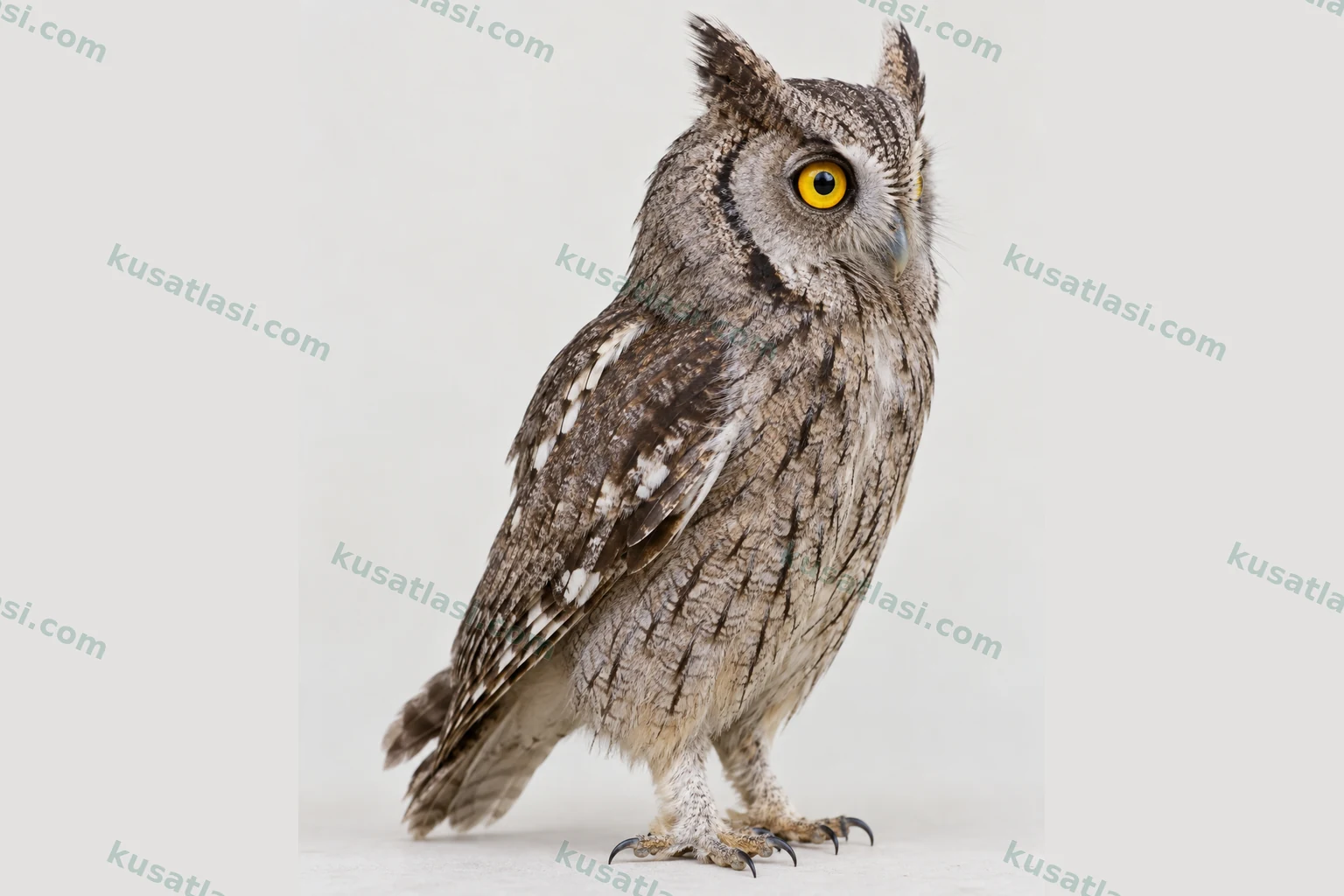
A small bark-patterned owl with yellow eyes and small ear tufts. Its short, rough, frog-like natural call is assessed together with its appearance.
Biometrics
Length
Male16–19 cm
Female16–19 cm
Shared species value
Wingspan
Male45 cm
Female45 cm
Shared species value
Weight
Male45–65 g
Female57–123 g
African Scops Owl
Suitable savannas and open woodlands of sub-Saharan AfricaObservation guide in its natural range
Look for three features together
Do not rely on a single featureFlattened tufts may be hidden; do not decide they are absent from one photograph.
Grey and brown appearances are not sex marks.
Match the sound with the calling individual; silence does not prove absence.
Compare male and female
 FemaleMale
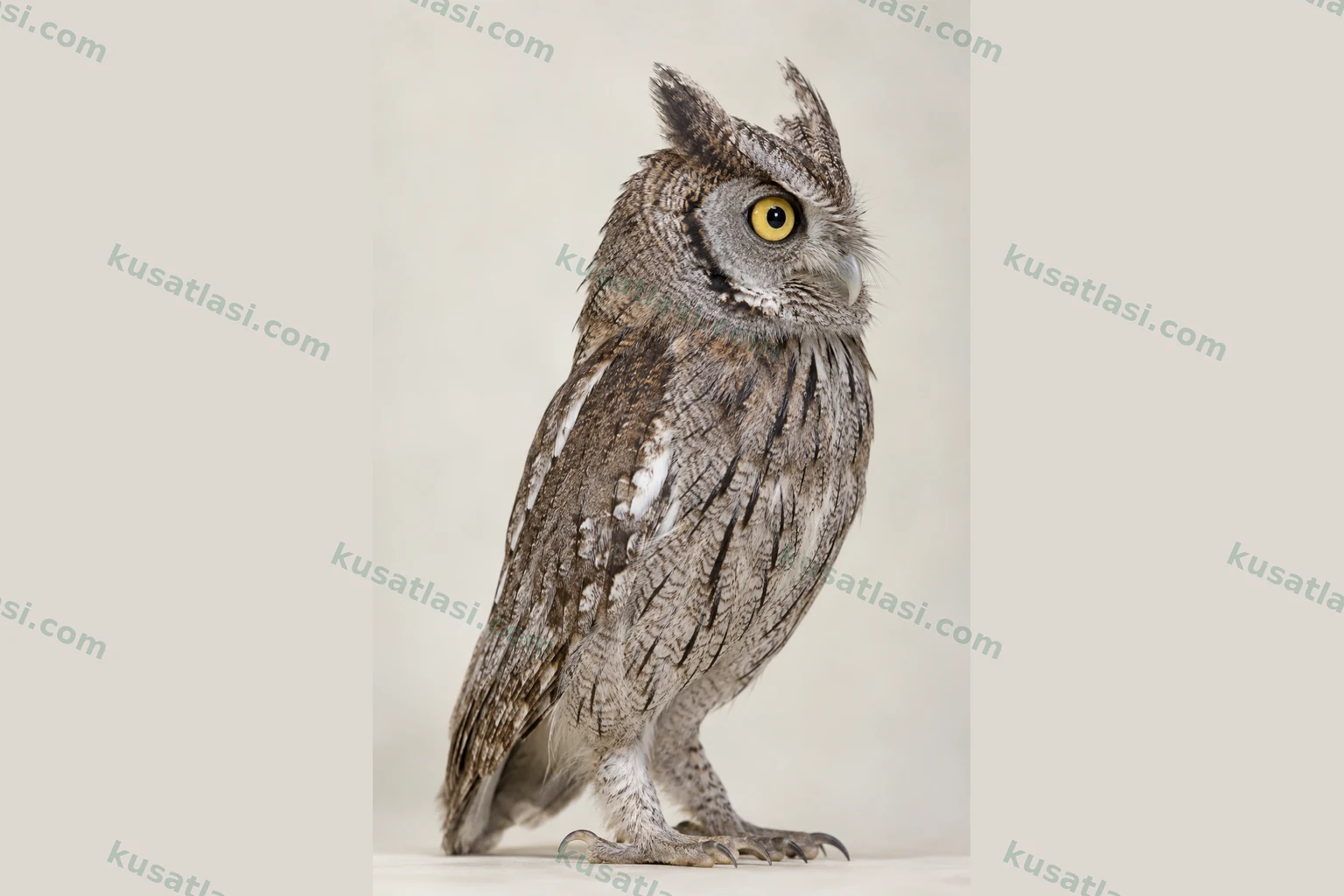
Adults of both sexes have similar plumage. Grey or brown tone and size in a photograph do not determine sex; a detailed juvenile plumage key was not verified.
Where to look in its natural range?
Listen quietly along woodland edges. Do not make a bird resting by day or breeding in a cavity move by using light, sound or close approach.
Some regional movements are reported alongside resident populations. Calling frequency affects observation numbers. The months below are the atlas’s explicit regional examples of egg-laying, not a calendar for all Africa.
January
Residency and movements vary regionally; record frequency is also influenced by the frequency of natural calling. No verified regional date specific to this month was supplied; this does not mean local absence.
February
Residency and movements vary regionally; record frequency is also influenced by the frequency of natural calling. No verified regional date specific to this month was supplied; this does not mean local absence.
March
Residency and movements vary regionally; record frequency is also influenced by the frequency of natural calling. No verified regional date specific to this month was supplied; this does not mean local absence.
April
Residency and movements vary regionally; record frequency is also influenced by the frequency of natural calling. No verified regional date specific to this month was supplied; this does not mean local absence.
May
Residency and movements vary regionally; record frequency is also influenced by the frequency of natural calling. No verified regional date specific to this month was supplied; this does not mean local absence.
June
Residency and movements vary regionally; record frequency is also influenced by the frequency of natural calling. Zimbabwe atlas example: within the reported egg-laying interval; most records are in September–October.
July
Residency and movements vary regionally; record frequency is also influenced by the frequency of natural calling. Zimbabwe atlas example: within the reported egg-laying interval; most records are in September–October.
August
Residency and movements vary regionally; record frequency is also influenced by the frequency of natural calling. Zimbabwe atlas example: within the reported egg-laying interval; most records are in September–October.
September
Residency and movements vary regionally; record frequency is also influenced by the frequency of natural calling. Zimbabwe atlas example: within the reported egg-laying interval; most records are in September–October. Botswana atlas example: among the months represented by seven regional egg-laying records.
October
Residency and movements vary regionally; record frequency is also influenced by the frequency of natural calling. Zimbabwe atlas example: within the reported egg-laying interval; most records are in September–October. Botswana atlas example: among the months represented by seven regional egg-laying records.
November
Residency and movements vary regionally; record frequency is also influenced by the frequency of natural calling. Zimbabwe atlas example: within the reported egg-laying interval; most records are in September–October. Botswana atlas example: among the months represented by seven regional egg-laying records.
December
Residency and movements vary regionally; record frequency is also influenced by the frequency of natural calling. No verified regional date specific to this month was supplied; this does not mean local absence.
Nest, egg and incubation
A tree cavity or old woodpecker hole. The South African specialist synthesis gives two to four eggs, about 22 days of incubation by the female and nest departure at 25–28 days. The other expert account’s approximately 24 days is a separate context; no average was calculated. Nest departure is not independence.
The short, rough, frog-like call may repeat at regular intervals. One sound or one quiet night is insufficient for a certain decision about species or presence.
Do not play recordings to attract birds; observe quietly, especially near nests.
Species information
Quick identification
African Scops Owl Otus senegalensis has finely patterned, bark-like plumage, yellow eyes and small ear tufts. Head and body together look compact and small. Birds may look grey or brownish; colour alone determines neither species nor sex. By day, a bird resting on a branch close to the trunk may blend into the bark pattern. What first looks like a projection of a branch may turn out to be the owl. However, trying to identify it by making it move at its resting place is inappropriate. Clearly visible eyes, facial outline, shoulder pattern and head shape are compared on the same individual.
Its short, rough, frog-like call helps identification. This sound, repeated at regular intervals, should be seen to come from the bird or matched with a reliable recording. A nearby frog, another owl’s call or distortion at a distance can cause confusion. Hearing one call cannot establish that every suitable patch of woodland on the map is occupied. Identification combines the sound’s structure, the bird’s appearance and its wooded environment. A small owl is not named African Scops Owl simply because it is small; other small owls in the same region must be considered.
General appearance and posture
The face has a dark border. Dark lengthwise marks and finer cross-patterning occur together on the crown and body. Pale marks may show along the shoulder, although some disappear in shade. Cross-marks on wings and tail are assessed together with the shape of the folded wing against the body. A grey bird looking browner in warm light is not actually changing colour. Brown appearance alone is not proof of another species either. Yellow eyes are an important supporting mark; reflected eyeshine at night is not substituted for natural eye colour.
Ear tufts are not hearing organs: they are projections formed by feathers on the head. When flattened, they can make the head look rounder. Their absence from a photograph therefore does not prove that the bird is a tuftless owl. The dark-looking bill is assessed with the facial pattern and its relationship to the eyes. Resting close against the trunk and looking around while waiting for prey can give the same bird different apparent head proportions. A head looking large in the frame should not be interpreted as a real measurement.
Males, females and young birds
Adult males and females look similar in plumage. Females being potentially heavier does not mean sex can be established from an ordinary photograph. Viewing angle, fluffed feathers and the branch’s distance affect the apparent body size of an unmeasured bird. Grey or brown feather tone is not a sex label either.
No reliable age key covering all juvenile plumage details was verified for this work. A bird looking softer or fluffier is therefore not labelled young solely from its image. A young bird that has left the nest and remains near its parents may be assessed through behaviour and breeding context; colour in one frame does not prove that relationship. Nest departure and independent feeding are different stages. Nor is a bird on the ground or a low branch automatically assumed to need help. Watching nearby adults from a distance is more appropriate than approaching to determine age.
Appearance in flight
Small body, the wings’ proportions to the body and patterned tail may be seen in flight, but details easily vanish at dusk. A brief view beneath a branch does not reveal enough about facial outline and eye colour. If the upperwing is visible, its upper-surface marks are assessed; if the underwing is visible, its lower-surface marks are assessed. A shaded wing looking entirely dark does not prove that its feathers are uniformly coloured. Identification should not rest solely on a flight silhouette. Perched features and call are more useful when safely matched to the same bird.
Flying from one tree to another is not a migration route. Hunting, changing a resting site and longer seasonal movements are different events. Map observation points do not distinguish these events either. A particular flight direction does not show which country the bird came from or where it will go. Avoid tracking a night bird with light and repeatedly making it fly. Watching natural movements lets it return to its chosen perch and hunting area and provides more reliable behavioural evidence for identification.
Voice and behaviour
African Scops Owl is mainly nocturnal. By day it may rest concealed among leaves, on a branch close to the trunk or in a cavity. Using a perch at night while waiting for prey does not mean it hunts continuously; it may also listen or rest briefly. Two birds resting near each other do not prove a communal breeding system involving many adults raising young. Their proximity in one tree is considered in the context of a pair, family or simply a suitable resting place.
The repetition pattern of the short frog-like call is more informative than one sharp note. More calling still does not directly mean more birds. The southern African atlas links a substantial part of seasonal reporting differences to how much birds vocalise. Failure to record the bird on a quiet night does not establish absence either. This is a written description of voice and behaviour. Playback to draw the owl out or prolonged lighting of its resting place is unnecessary; watching from a distance where the natural voice originates and which bird produces it is sufficient.
Similar species
Eurasian Scops Owl Otus scops is also small, yellow-eyed and tufted, and occurs seasonally in parts of Africa. Similar bark-like patterns prevent separation by grey body colour alone. Its regular single-note song is compared with African Scops Owl’s short, rough, frog-like call. Seeing the calling individual and checking current regional distribution matter. If the photograph has no sound, that missing evidence remains explicit; one of the two species is not forced as an answer.
Sandy Scops Owl Otus icterorhynchus is another small owl to consider in western and central African forests. Spots on paler underparts and a descending, whistle-like voice help comparison. African Scops Owl also has brown birds, so brown tone alone does not identify the other species. Forest versus open-woodland preference is useful, but vegetation alone does not establish identity at a habitat edge. Pattern, face and natural voice are examined together on the same individual.
Global distribution
African Scops Owl has a widespread but discontinuous distribution in suitable woodlands and savannas south of the Sahara. Its range from western Africa through eastern Africa and Ethiopia to suitable southern regions does not imply occupation of every forest and savanna. Closed equatorial forests and very open areas with few suitable trees are not used in the same way. The southern African atlas describes connections with Angola, Zambia and eastern Africa, and suitable areas of Mozambique, Zimbabwe, Botswana, Namibia and the Republic of South Africa in the south. Local gaps must remain visible within the broad continental picture.
Status within its natural range
Its southern African distribution is patchy in places. Records in northern Botswana and neighbouring regions do not show equal use of all central Botswana. Separate areas such as the dry valley woodlands of Eastern Cape are also assessed in their own habitat context. Because the owl is hard to see, many records rely on voice; few reports do not directly mean few birds. Modelled suitability and verified observation points on the map are different kinds of evidence. A point shows that a bird was seen there, not breeding throughout that cell or staying all year. The ranges of Arabian Scops Owl Otus pamelae and Socotra Scops Owl Otus socotranus are not added to the present African Scops Owl account. Older combined-species records need reassessment with that distinction.
Migration
One residency or migration calendar for every population would mislead. The southern African atlas suggests migration or irregular movements in some areas while also emphasising calling frequency’s effect on seasonal reporting changes. These explanations are not substituted for each other. Hearing more calls alone does not prove arrival of new birds, and some movement records do not show all birds across the continent following one route. No country-by-country itinerary or unverified distance is given here. Regional breeding months, observation months and actual movement evidence remain separate; one month without records is not coloured as definite absence.
Breeding habitat
Wooded savanna and open woodland are important. The southern African atlas particularly highlights relatively tall, scattered trees; closed forests are not used in the same way. Mopane and acacia woodlands are regional examples. Trees near streams may be suitable, but not every waterside is breeding habitat. Trees, a safe cavity and nearby hunting ground must be assessed together. Higher reporting in one vegetation type in the atlas does not prove the same habitat ranking across the continent.
Nest site
Natural tree cavities, hollows at broken branch ends and old woodpecker holes may be used. The nest should not be imagined as an open cup built among branches. The South African specialist synthesis reports two to four eggs, about 22 days of incubation by the female and nest departure at 25–28 days. About 24 days of incubation in another expert account is a separate source context; no new average is produced from the two. The male may supply food. Nest departure does not mean that the young no longer need care. Looking inside the cavity, shaking the branch or using playback to bring the owl out is inappropriate.
Daily space use
Dense leafy cover and sheltered perches close to a tree can be used for resting, and more open surroundings for hunting at night. Not finding the bird by day does not show that the same tree is unused at night. Quiet observation from woodland edges allows behaviour to be followed without forcing movement. Removing hollow trees and a single branch providing shade are not the same ecological situation; the area’s structure is assessed as a whole. Describing the general habitat rather than publicly sharing precise nest or resting-site coordinates reduces disturbance risk.
What does it eat?
Insects and other small invertebrates are important in African Scops Owl’s diet. Expert accounts report arachnids alongside various insects and occasional small vertebrates. This diversity does not mean every prey group is eaten in the same proportions everywhere. One night’s prey or food brought to a nest is not converted into a continent-wide dietary percentage. Records of a small bird, reptile or frog do not make those the main food either. The list describes possible and recorded prey, not a menu every bird eats daily.
How does it hunt?
Watching from a perch and moving towards prey on the ground or in the air explains the joint use of woodland and openings. A short descent without visible prey is not recorded as a successful hunt. Returning to a branch does not always mean carrying food. Night insect activity and the owl’s voice may provide clues, but directing prey or bird with light changes natural behaviour. Do not block the route of adults bringing food near a nest. Feeding, leaving bait or using live prey to draw the bird close for a photograph does not replace natural hunting behaviour. If prey cannot be identified, record only the verified level, such as insect or small invertebrate.
A quiet gap in the records
The distinction between calling and presence is particularly important when observing African Scops Owl. The southern African atlas assessment says reporting is strongly influenced by vocal behaviour. A period with fewer calls at the same place is not necessarily a period when birds have left. Real movements may also occur, but proving them requires more than call counts. This explains why the calendar does not assign one arrival or departure date to every month. When and how an observation was made form part of its interpretation.
The small-tuft misconception
The feather projections on the head are not ears. Flattening them can make the head appear rounder. Different postures of the same species may therefore be interpreted as two different owls. Looking at eye, facial outline and body pattern together reduces this mistake. A mark hidden in a photograph is distinguished from a genuinely absent mark. A concealed shoulder patch or flattened tuft shows how limited identification from one frame can be.
One cavity, several different stages
The end of incubation, departure of young from the nest and independent feeding are separate stages. An approximate incubation period therefore does not describe the young bird’s entire development. Young can remain nearby after leaving the nest. Seeing one on a branch does not mean care has ended or that the day of sighting was the egg-laying date. A regional calendar’s breeding record is not turned into a laying month without knowing the stage observed.
The geographical limits of an old name
Birds formerly considered within one broad species account may now belong to different taxa. The separation of Arabian and Socotra birds in Cornell’s 2014 taxonomy update requires care when transferring old distribution information to present-day African Scops Owl. An island or peninsula under the same heading in an old book is not automatically added to the new species’ map. The scientific name, text and map used here describe the same current taxon. Choosing the right birds within a name’s scope matters as much as spelling it correctly.