

World Birds IUCN statusVU · VulnerableGlobal IUCN. BirdLife v10 (2025); taxon matching AviList 2026 / IOC 15.2; checked: 29.10.2026. The list year is not the species’ assessment date. Source and method · BirdLife OrderGalliformesGamebirds FamilyPhasianidaePhasianidae
Sichuan Partridge
Arborophila rufipectus
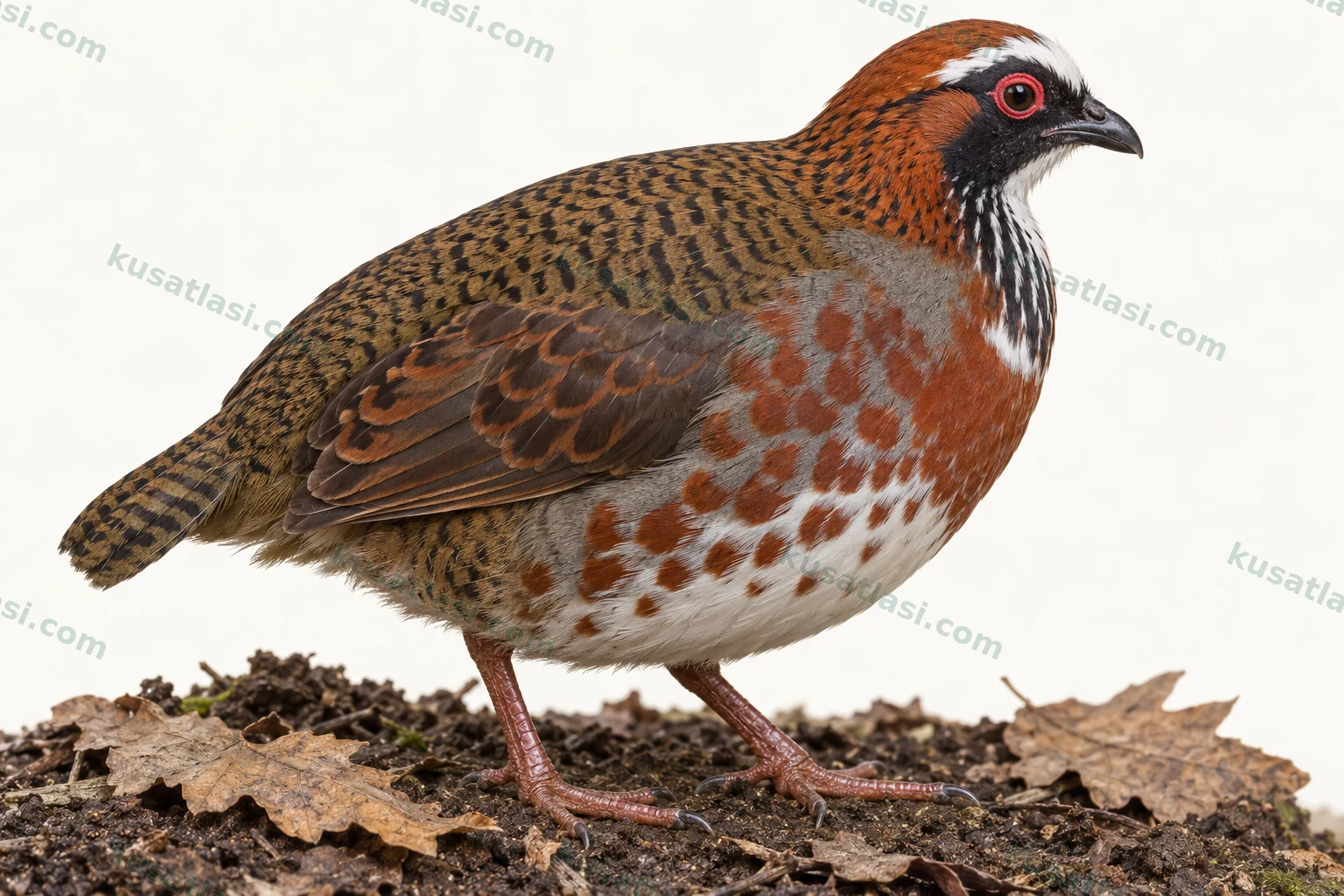
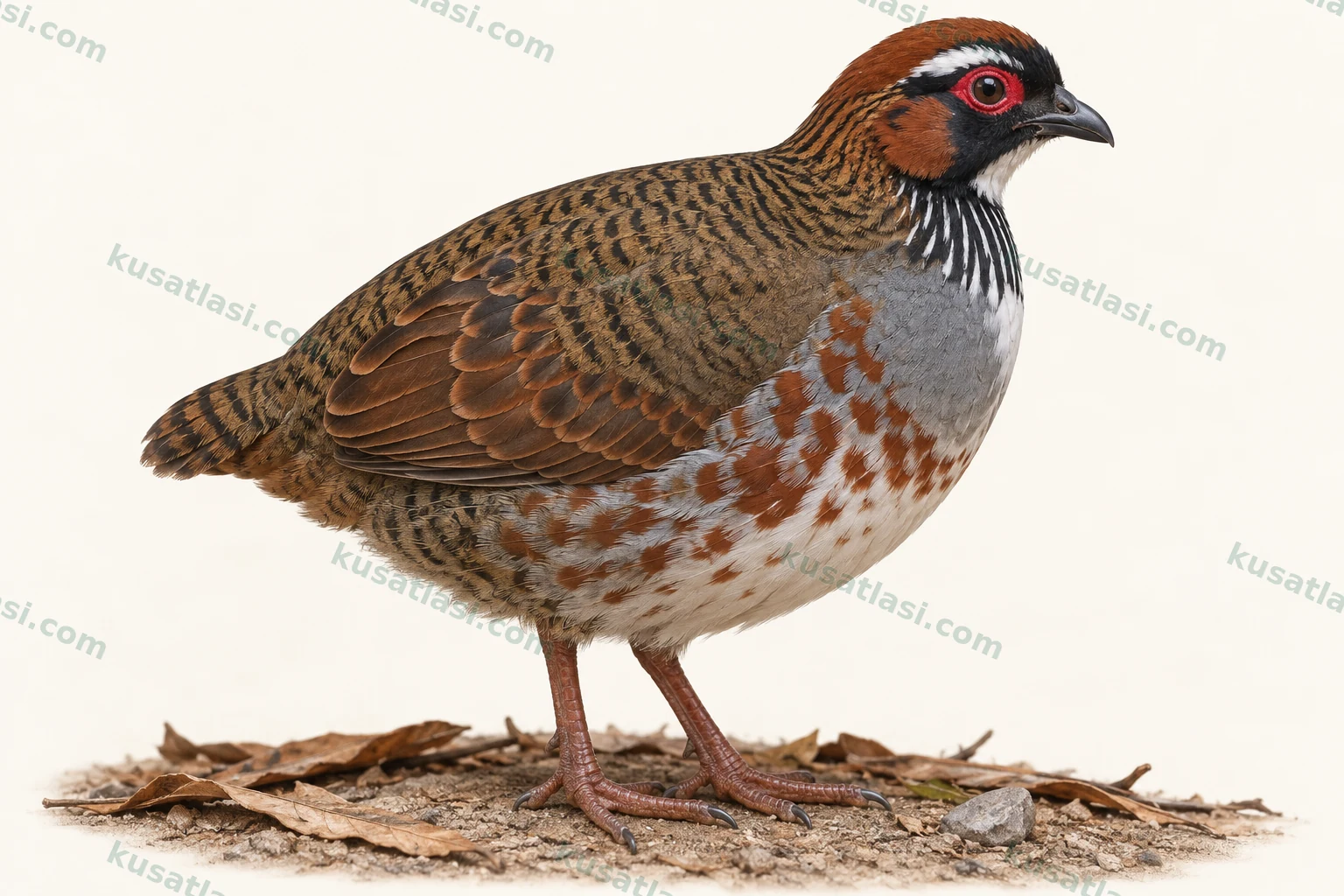
Look for an orangish cheek, a pale throat with dark streaks and a broad chestnut breast band. This shy ground-dwelling bird is often heard in the mountain forests of Sichuan.
Biometrics
Length
Male28–31 cm
Female28–31 cm
Shared species value
Wingspan
MaleData unavailable
FemaleData unavailable
Weight
Male410–470 g
Female350–380 g
Sichuan Partridge
Mountain forests of south-central Sichuan, ChinaObservation guide in its natural range
Look for three features together
Do not rely on a single featureExamine the orangish cheek together with the light and dark head pattern.
A broad chestnut band lies below the pale streaked throat.
A single mark seen in cover is insufficient. Watch the bird without flushing it from the ground.
Compare male and female
 FemaleMale
The original description was based on an adult male. A complete field key for all ages and both sexes has not been verified.
Where to look in its natural range?
Look in broadleaf mountain forests with leaf litter, shrubs and night roosts.
BirdLife's historical account reports breeding from April to June. The Laojunshan studies report families with chicks in spring and summer. Study months are not treated as the egg-laying season.
January
The species is resident. Seasonal changes in elevation within the region do not amount to a long-distance migration route. No verified regional date was provided for this month. This does not mean the species is locally absent.
February
The species is resident. Seasonal changes in elevation within the region do not amount to a long-distance migration route. No verified regional date was provided for this month. This does not mean the species is locally absent.
March
The species is resident. Seasonal changes in elevation within the region do not amount to a long-distance migration route. No verified regional date was provided for this month. This does not mean the species is locally absent.
April
The species is resident. Seasonal changes in elevation within the region do not amount to a long-distance migration route. BirdLife's historical species account reports a breeding period. It does not show that breeding happens at the same time everywhere.
May
The species is resident. Seasonal changes in elevation within the region do not amount to a long-distance migration route. BirdLife's historical species account reports a breeding period. It does not show that breeding happens at the same time everywhere. The 2005 Laojunshan field study reports a regional period when young emerge and families with chicks are observed.
June
The species is resident. Seasonal changes in elevation within the region do not amount to a long-distance migration route. BirdLife's historical species account reports a breeding period. It does not show that breeding happens at the same time everywhere. The 2005 Laojunshan field study reports a regional period when young emerge and families with chicks are observed.
July
The species is resident. Seasonal changes in elevation within the region do not amount to a long-distance migration route. The 2005 Laojunshan field study reports a regional period when young emerge and families with chicks are observed.
August
The species is resident. Seasonal changes in elevation within the region do not amount to a long-distance migration route. No verified regional date was provided for this month. This does not mean the species is locally absent.
September
The species is resident. Seasonal changes in elevation within the region do not amount to a long-distance migration route. No verified regional date was provided for this month. This does not mean the species is locally absent.
October
The species is resident. Seasonal changes in elevation within the region do not amount to a long-distance migration route. No verified regional date was provided for this month. This does not mean the species is locally absent.
November
The species is resident. Seasonal changes in elevation within the region do not amount to a long-distance migration route. No verified regional date was provided for this month. This does not mean the species is locally absent.
December
The species is resident. Seasonal changes in elevation within the region do not amount to a long-distance migration route. No verified regional date was provided for this month. This does not mean the species is locally absent.
Nest, egg and incubation
The nest is on the ground. The specialist account reports 3–7 eggs and incubation by the female. Incubation duration and the number of days to flight have not been verified.
The birds exchange strong calls at dawn and dusk.
Do not play recordings to attract birds; observe quietly, especially near nests.
Species information
Quick identification
The Sichuan Partridge Arborophila rufipectus inhabits forests in China's Sichuan region and is often heard without being seen. Look for the orangish cheek, the pale throat with dark streaking and the broad chestnut breast band together. The Turkish name refers to the pale throat, although its feathers are not all unmarked white. Follow the sequence of marks on the head and breast instead of relying on one pale patch glimpsed through a gap.
The English name is Sichuan Partridge and the accepted scientific name is Arborophila rufipectus. Boulton's original description of 1932 was based on an adult male museum specimen collected in Sichuan. It does not provide a complete description of the female or all young birds. Sharing a genus does not justify transferring another hill partridge's measurements, incubation duration or range to this species.
General appearance and posture
The head combines a pale forehead area, orangish crown and nape, dark streaks and orangish ear feathers. The dark area at the front of the face contrasts with the pale throat. The first museum description gives dark-based, white-edged throat feathers and a paler area lower on the throat. At a distance these small streaks can merge visually into a single dark area. A description of the throat as white is thus compatible with a streaked pattern seen close up.
A broad rufous chestnut band crosses the upper breast, with a pale lower breast and belly beneath. The flank feathers have a greyish brown ground colour and chestnut edges. There are light and dark streaks on the back and tail, and brown and chestnut areas of the wing feathers come together on the folded wing. This pattern differs from the outline of a brightly and uniformly coloured chicken. The orangish head area and the chestnut breast band are separate areas of plumage.
Leaves, branches and shadow often partly conceal this forest-floor bird. A brief view of the back does not confirm the full facial pattern. Waiting for the bird to emerge provides a better view than driving it towards a path. Light reflected from the ground may change the appearance of the pale underparts. A warm cast in a photograph should not be interpreted as a new subspecies or a sex-specific colour.
The apparent size of an individual alone does not establish its sex.
Males, females and young birds
The adult male in the original description is a historical starting point for the head and breast pattern. The pattern may appear less distinct in females or young birds than in adults, but the sources examined did not provide a complete field key for every age and posture. A bird in shadow, with dull colours or with its breast hidden should therefore not be labelled female automatically. Distinguish visible appearance from certain information about sex.
The roosting study at Laojunshan considered the sexes alongside behaviour observed during breeding. Members of a pair could remain close during the day and roost in separate plants at night. The observation shows that two birds need not stand next to each other in a single view to be a pair. Seeing one member alone does not prove it is a young bird or one whose sex is undetermined.
After the chicks emerged, females were seen sheltering chicks at night on the ground in dense cover. The male could stay close at first and return to a separate high roost as the young grew. This behaviour was recorded only in the families followed by the study. It does not show the plumage colour of a young bird or its exact age at first flight. Do not open the cover or approach so closely that the young move in order to see a family close to the ground.
Appearance in flight
The streaked appearance of the folded wing does not describe the whole surface of the open wing. In the first description, the flight feathers are dark with chestnut on some edges and areas of pattern. The forehead, throat and broad breast band can be difficult to see during a brief movement in the forest. A dark wing and short body alone do not establish the identification. Flushing the bird just to see it fly causes unnecessary disturbance.
Voice and behaviour
Cornell's field account describes strong calls exchanged at dawn and dusk. Researchers also used male calls to locate birds and then watched their actual roosts. Counts based on calls and direct sightings provide different data. Two calls need not be from two individuals. The place where a call was heard should not be marked as a nest site on a map.
This bird occurs on the forest floor during the day and can roost in a tree or shrub at night. Males in the Laojunshan study climbed from lower branches to their chosen roost. In the morning most came straight down to the ground. The ground roosting of families with chicks shows that the pattern can change with age and breeding status. The forest floor, shrub cover and suitable roosts should therefore be protected together.
Similar species
When comparing it with other Arborophila hill partridges, look for the combination of an orangish cheek, streaked pale throat and broad chestnut breast band. Boulton compared the overall pattern of the first specimen with Arborophila torqueola. This historical comparison does not make them the same species. If locality and the head and breast pattern are missing, retain the uncertainty rather than assigning a definite name.
Global range
Its natural range is restricted to the mountain forests of south-central Sichuan in southwestern China. Laojunshan, Leibo and neighbouring protected forests are important study sites. A broad shaded area linking them would not mean that every valley or agricultural area between them is occupied. The map shows the geographical context of the supported region.
Status within its natural range
Forest fragmentation matters to the species. Use of old broadleaf secondary forests in studies does not show that those forests serve every function of natural forest. Nest success has to be measured separately. The current taxonomic record gives the category Vulnerable. Older papers calling the species Endangered reflect the assessment current at the time. Categories from different dates are not presented as if they formed one new population census.
Movements and migration
The species is not a regular long-distance migrant. Sources from Laojunshan report seasonal use of different elevations and dispersal of families over a wider area after breeding. This local movement is not a migration tracked from country to country. Seasonal observations at particular elevations are not plotted as a single verified route for all individuals. The date of an observation cell alone does not establish a nest with eggs.
Breeding habitat
It uses mountain forests with deciduous and evergreen broadleaf trees. In the Leibo study, old natural and old planted broadleaf forests were used more than more disturbed cover. The structure of the canopy and of the ground cover both matter. The presence of trees alone does not show that the habitat is suitable. A conifer plantation is not treated as equivalent to natural broadleaf forest.
Nest site
BirdLife's specialist account in a foreign language reports a ground nest, 3–7 eggs and incubation by the female. Records show that both sexes care for chicks after the young emerged. The duration of incubation and the number of days to flight could not be verified. Durations from other hill partridges are not added. A branch used for roosting at night is not labelled a nest.
Daily use of habitat
The birds feed on the forest floor and sometimes roost high up at night. Families with young can use dense ground cover. Leaf litter, shrubs and suitable branches thus serve different purposes within the same area. Do not clear leaves or cut cover to see the bird. Watch quietly from a path.
What does it eat?
It eats both plant foods and small invertebrates. A DNA study based on 60 faecal samples from Laojunshan detected flies, butterflies and moths, and spiders, as well as various fruiting and seed-bearing plant groups. Blackberry relatives and local climbing plants were among this diversity. The findings show why describing the bird solely as a seed eater or insect eater would be incomplete.
How does it forage?
It looks for food in leaf litter on the forest floor. The study sampled breeding, post-breeding movement and winter separately, and diet composition differed between seasons. The percentage of DNA reads does not directly represent grams of food eaten or the share of daily energy. Nor do 60 samples necessarily represent 60 different birds. The finding shows a varied diet at the site and in the periods studied. Identical prey proportions should not be expected in every forest and season.
A ground-dwelling bird can roost high at night
Direct observations at Laojunshan showed males climbing into trees and shrubs at night. Forest-floor behaviour seen during the day does not mean the bird always sleeps on the ground. Ground roosting by families with chicks is a different stage of life. To understand daily use of habitat, record time of day together with family status.
Roosting places change within the same family
In the study, the male could remain close to the female and chicks while the young were small and return later to a separate roost. This is not a change in plumage colour or a measurement of the day on which the young first flew. It shows a relationship between family ties and night roosting. Seeing the bird on one night does not describe its whole breeding behaviour.
Old and new forest may not produce equal results
The Leibo study showed that the birds could use old secondary broadleaf forest. It did not establish that breeding success there was equal to that in natural forest. The difference between an area the birds use and a place where they breed successfully shows why conservation planning needs more than a sighting.
The original description began with one adult male
The 1932 description was based on a male specimen with a specific museum number and collection date. The specimen is valuable for scientific identity, but cannot by itself explain the appearance of all females, young birds and seasons. A first description and current comprehensive field knowledge serve different purposes and cannot substitute for each other.
How the birds were counted matters
For this forest bird, calls helped researchers find individuals. A place where a call was heard, a directly observed roost and a nest containing eggs are separate records. Keeping that distinction prevents a call location on a map from being mistaken for a confirmed breeding site. A bird heard repeatedly in the same forest is not counted as a new individual each time.