

World Birds IUCN statusLC · Least ConcernGlobal IUCN category. BirdLife v10 (2025); taxon matching: AviList 2026 / IOC 15.2; checked: 29.10.2026. The list year is not the species assessment date. Source and method · BirdLife OrderFalconiformesFalcons and caracaras FamilyFalconidaeFalconidae
Pygmy Falcon
Polihierax semitorquatus
A small compact daytime raptor of dry savannas. White face and underparts, white rump and the adult male’s grey or female’s chestnut back are assessed together.
Biometrics
Length
Male20 cm
Female20 cm
Shared species value
Wingspan
Male34–40 cm
Female34–40 cm
Shared species value
Weight
Male56 g
Female59.3 g
Pygmy Falcon
Separate dry-savanna regions of East Africa and southwestern AfricaObservation guide in its natural range
Look for three features together
Do not rely on a single featureUseful in adults; do not force a sex from a frontal view or a young bird.
Conspicuous in fast, slightly undulating flight.
Distinguished from openly perched shrikes by face, back and body proportions.
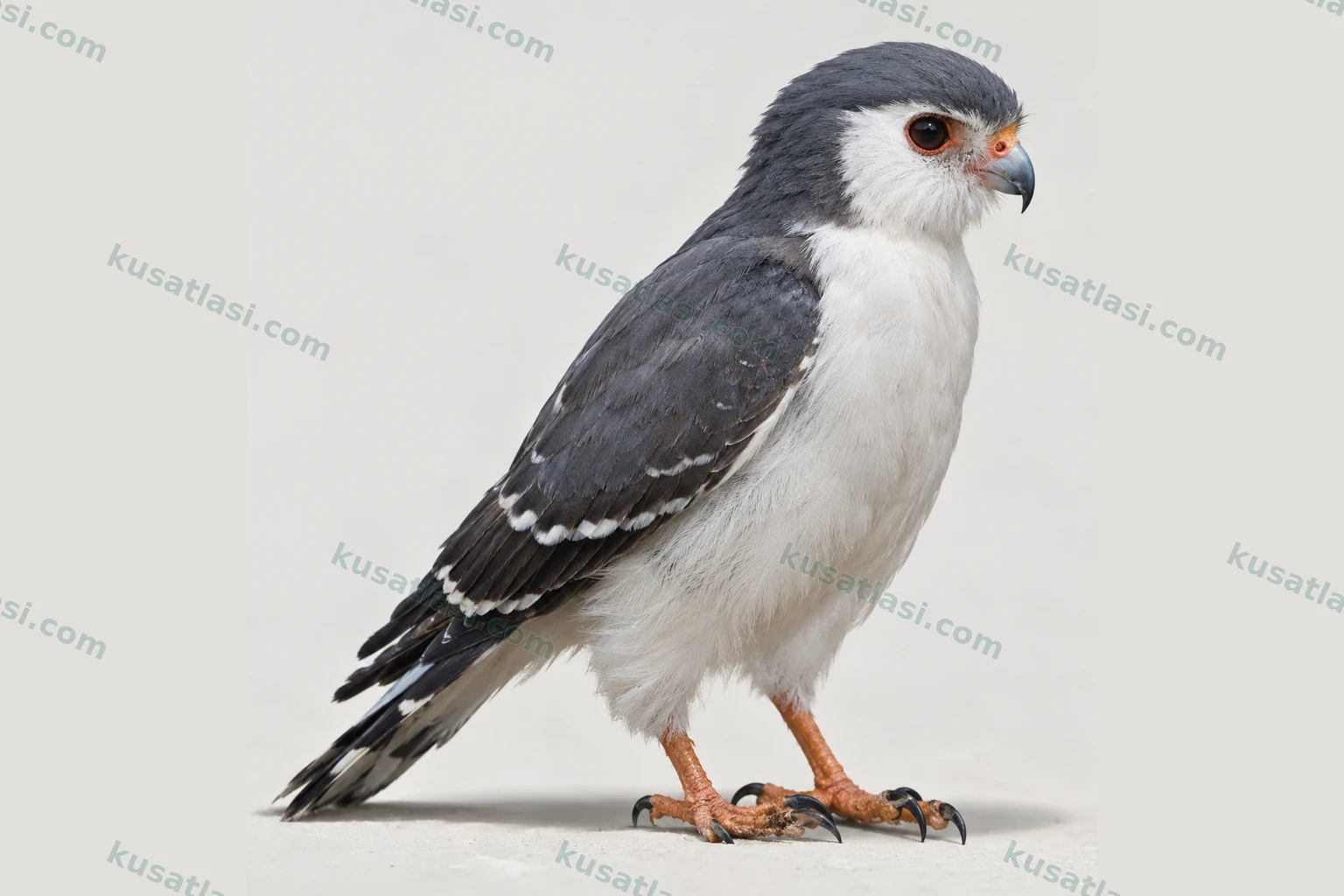
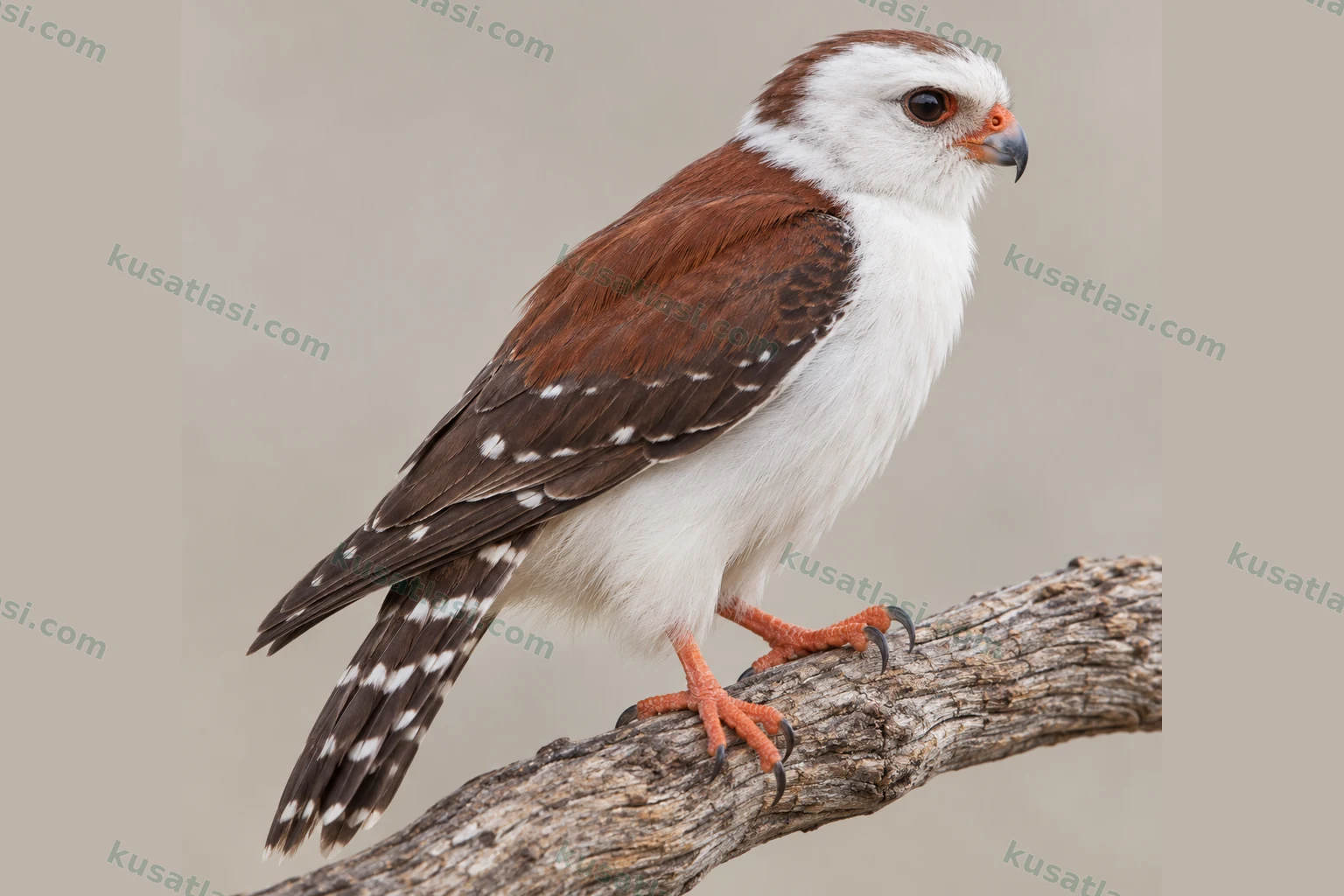
Compare male and female
 FemaleMale
The adult male has a grey back, the female a chestnut-brown back. Both have white underparts. Warm breast tones and variable upperparts in young birds must not be forced into the adult sexing key.
Where to look in its natural range?
From existing roads watch exposed tree perches and the surroundings of weaver colonies. Do not approach colony entrances or try to drive out roosting birds.
The calendar is a regional example from ten breeding seasons at Tswalu Kalahari: laying was recorded in August–February, with concentrated starts in September–December. These dates are not extended to East Africa or the whole population.
January
Basically resident. Regional laying example from the Tswalu Kalahari study: within the recorded August–February period. These months do not establish a common East African calendar.
February
Basically resident. Regional laying example from the Tswalu Kalahari study: within the recorded August–February period. These months do not establish a common East African calendar.
March
Basically resident. Regional laying example from the Tswalu Kalahari study: outside this study’s laying period; this does not mean local absence or no breeding. These months do not establish a common East African calendar.
April
Basically resident. Regional laying example from the Tswalu Kalahari study: outside this study’s laying period; this does not mean local absence or no breeding. These months do not establish a common East African calendar.
May
Basically resident. Regional laying example from the Tswalu Kalahari study: outside this study’s laying period; this does not mean local absence or no breeding. These months do not establish a common East African calendar.
June
Basically resident. Regional laying example from the Tswalu Kalahari study: outside this study’s laying period; this does not mean local absence or no breeding. These months do not establish a common East African calendar.
July
Basically resident. Regional laying example from the Tswalu Kalahari study: outside this study’s laying period; this does not mean local absence or no breeding. These months do not establish a common East African calendar.
August
Basically resident. Regional laying example from the Tswalu Kalahari study: within the recorded August–February period. These months do not establish a common East African calendar.
September
Basically resident. Regional laying example from the Tswalu Kalahari study: a month with concentrated breeding starts reported. These months do not establish a common East African calendar.
October
Basically resident. Regional laying example from the Tswalu Kalahari study: a month with concentrated breeding starts reported. These months do not establish a common East African calendar.
November
Basically resident. Regional laying example from the Tswalu Kalahari study: a month with concentrated breeding starts reported. These months do not establish a common East African calendar.
December
Basically resident. Regional laying example from the Tswalu Kalahari study: a month with concentrated breeding starts reported. These months do not establish a common East African calendar.
Nest, egg and incubation
In the south it usually breeds in a chamber of a Philetairus socius colony, and in the east in the nests of other weavers. The newer Kalahari study recorded one–three eggs, usually three; mean incubation was 33 days (57 periods, standard deviation 4 days) and mean nestling stay was 37 days (51 periods, standard deviation 5 days). Older reports of one–four eggs, 27–31 days of incubation and 27–40 days in the nest retain their own contexts. Young may return to the nest chamber after leaving it. Do not insert tools into entrances or alter cover or structure.
Rapid thin, harsh call series may be heard during breeding and alarm. A silent visit does not prove absence; match the sound’s source with the individual seen.
Do not play recordings to attract birds; observe quietly, especially near nests.
Species information
Quick Identification
The Pygmy Falcon, Polihierax semitorquatus, is a small daytime raptor with white underparts and a grey head. On an open branch it may initially suggest a small shrike, but its body is more compact, its head rounder and its raptor's bill evident. Adult males have grey backs, adult females chestnut-brown backs. This helps separate adult sexes; a bird showing only its face and white breast must not be sexed as though its back had been seen.
The white rump catches the eye in fast, slightly undulating flight. White markings on dark wings and tail combine with the white body. Size alone can mislead when watching a small white bird in a tree, since distance and the tree's scale alter the impression. Pale face, compact shape, back colour, rump and flight together strengthen identification. Look in dry savannas of eastern and southern Africa; it is not widespread throughout the continent.
Pygmy Falcon and African Pygmy Falcon name the same African taxon. Similar names do not unite Asian small falcons or other tiny raptors with it. Matching Polihierax semitorquatus in the local record is especially important when comparing genera and common names in older books. Nest associates differ between the two main geographic populations, so a southern African detail must not automatically be extended across the range.
General Appearance and Posture
Adults have a white face, breast and belly. The head is grey, as is the male's back. The female's chestnut back contrasts sharply with the grey head and dark wings. A white rump helps in both adult sexes. Darker flight feathers and white wing markings break up the upperparts, rather than leaving an entirely grey bird. The pale nape area may be obvious from one angle and hidden by feathers from another; do not expect a permanently exposed complete collar.
Eyes are dark brown, with a warm orange eye-ring and orange-rufous areas around the bill. The bill is dark and legs orangish. These details may show in good light; inability to see them in shade or at long range is not proof of absence. Distinguish shadow on chin and bill from a real dark feather mark. When comparing a black-and-white shrike, facial pattern and body proportions together are more reliable.
It may use an exposed branch, treetop or another elevated lookout. Watching the ground and dropping briefly towards prey is typical of a small raptor, but shrikes do this too, so behaviour alone does not identify it. Retreat to shade in hot hours may explain why an open perch is not equally productive all day. Do not attempt to move the bird or change its perch for a clearer view.
Males, Females and Young Birds
Adult back colour is a useful field sexing feature: grey in males and chestnut-brown in females. Grey head and white underparts are shared. A front-facing bird makes the two adults look very similar; greater whiteness or apparent size is not a reason to select a sex. When comparing plates, remember that the main difference is on the back. A female's brown patch does not mean her whole body is brown.
Young birds may have a warm cream or rufous wash on the breast rather than clean adult white underparts. Grey and brown upperpart areas do not always fit the adult sexing key either. A young bird is therefore not called an adult female from back colour alone. Check feather development, age-related tones and whether the bird truly has adult appearance. Being near a parent provides age context but alone does not establish an exact plumage stage.
Fledged young may return to colony chambers. Finding a nest empty during one visit is therefore not the same as determining the exact day of first flight. Flight ability also does not imply immediate food independence. Watch parents carrying prey from a natural distance; moving or approaching a young bird disrupts behaviour without adding reliable age evidence.
In some groups, birds outside the breeding pair help care for young. A study covering six breeding seasons found helpers at 19% of nests; most were young remaining from the preceding year. This is a result for that study population, not a fixed African rule. Three or four adults in one colony do not demonstrate that all are parents.
Appearance in Flight
Flight is fast and slightly undulating, with wingbeats sometimes interspersed with brief glides. The white rump stands out ahead of dark wings and tail when turning or flying away at an angle. From above, a male's grey or female's chestnut back may show, provided angle and light permit reliable views. A dark shadow on a passing bird must not be mistaken for chestnut feathers.
From below, the white body contrasts with darker wings and white transverse tail markings. Upperwing and underwing views differ; seeing only the white body says nothing about the sexing feature on the back. White rump and lower body are separate anatomical areas. Their positions can be recorded in a quick sketch or note without making the bird fly again.
When comparing a larger grey-and-white raptor over open country, consider wing shape, body proportions and flight behaviour as well. Smallness can be unreliable in a distant view without scale. A return to a perch, exposed back or view of the face can complete the flight impression. The word falcon does not mean it has the same flight profile as every Falco species.
Voice and Behaviour
Rapid repeated thin, harsh calls may be heard, especially in breeding-area alarm and communication. Silence at other times does not prove absence from a suitable colony. Match the source tree with the bird seen: other birds also alarm near colonies. Written descriptions convey the rhythm of a natural call, not a certain identification on their own.
Pairs and small family groups may perch openly. In southern Africa, chambers in communal weaver nests are used for both roosting and breeding. White droppings around an entrance may help locate a used chamber but do not establish eggs or young inside. Watch entries and exits from outside rather than standing below to peer into the nest.
Similar Species
1. Southern Fiscal, Lanius collaris, can give a similar distant impression through black-and-white plumage, open perching and short drops to ground prey. Compare its black upperparts and face with the falcon's pale grey head and grey male or chestnut female back. The compact falcon shape and white rump should also be seen. Shared hunting behaviour does not imply the same family.
2. Black-winged Kite, Elanus caeruleus, may be compared at a distance because of grey upperparts and a white body. Prominent black shoulders, wing proportions and flight including hovering help. In the Pygmy Falcon, assess white rump, small compact body and rapid slightly undulating flight together. Without reliable scale, apparent smallness alone must not decide.
Global Distribution
The Pygmy Falcon has two main, separate African range areas. The southern one includes dry parts of southern Angola, Namibia, southwestern Botswana and northwestern South Africa. The eastern area extends from South Sudan and Ethiopia towards suitable parts of Somalia, Kenya and Tanzania. A broad gap separates them; central Africa must not be coloured as continuous range. Comparing broader country lists in older accounts with modern taxonomic range summaries requires more than name similarity.
Status Within Its Native Range
Southern semitorquatus and eastern castanonotus describe the geographic structure. Southern African nesting is closely linked to Philetairus socius colonies; in East Africa it uses nests of weavers such as Dinemellia dinemelli. Suitable open savanna does not guarantee suitable nest chambers. Assess both hunting ground and structures for nesting and roosting.
A long-term Tswalu Kalahari study showed occupied territories and breeding decisions changing among years in the same area. Not every apparently suitable site produced breeding every year. This describes local population dynamics, not abundance in Kenya or Ethiopia. A cluster of map observations does not establish falcons in every weaver colony nearby. Record numbers depend also on effort and access.
Migration
It is generally resident. A southern African specialist account mentions possible local winter movements, not a regular long-distance migration. A family shifting between colonies is not a seasonal journey linking the two main populations. With no verified route, no transcontinental migration arrow or hypothetical distance is added.
The displayed breeding months are a regional southern Kalahari example. East African rain patterns and nest associates differ; southern-hemisphere spring months cannot be assigned to every eastern bird. Even a resident species can change local food use, colony use and juvenile dispersal. Understanding those movements requires individuals followed at the same place.
Breeding Habitat
Open dry savanna, lightly wooded grassland, thorn scrub and semi-desert are main habitats. A high lookout and open ground where prey is visible facilitate hunting. In the southern breeding area, large communal weaver structures may sit in trees or on suitable human-made supports. Tree species alone is not enough: colony structures and usable chambers matter too.
Nest Site
It mostly uses a chamber in a nest built by other birds. Southern Philetairus socius structures contain many separate chambers within one large communal construction; the falcon enters the chamber it uses. Eastern nesting involves different weavers. Do not try to confirm reported nest use by inspecting inside or enlarging entrances. One colony can house several species and different breeding states.
A ten-breeding-season Tswalu Kalahari study recorded one–three eggs, most often three. Older accounts include one–four, from a different sample. The newer study measured mean incubation of 33 days (57 incubation periods, standard deviation 4 days) and mean nestling stay of 37 days (51 periods, standard deviation 5 days). These are neither exact durations for every individual nor averages calculated here. Older ranges of 27–31 days incubation and 27–40 days in the nest retain their separate research contexts.
Droppings indicating colony use do not prove egg number or the start of incubation. Even researchers reported that some birds may have been disturbed by nest checks. Do not enter the nest, insert tools or try to drive roosting birds out. Protecting nests takes priority over close images of their contents.
Daily Space Use
It watches from open perches, may drop to the ground after prey and return to a high point. Roosting colonies and open hunting ground complement one another. A group using several colonies does not mean every entrance represents a different pair or independent territory. Colour-ring identification reduces such confusion in studies; observers should not count every movement of unringed birds as a new individual.
What Does It Eat?
Small reptiles and insects are principal prey groups; lizards, grasshopper-like insects and beetles are recorded. Small rodents and birds are also taken occasionally. Its small body limits prey size, but it is not exclusively insectivorous. If prey cannot be identified clearly, record the broad group rather than supplying unseen detail.
It may prey on young of the weavers whose nest structure it shares. Using a chamber and preying on other colony inhabitants can coexist in one species' behaviour. This does not mean it attacks every weaver nearby or eats nothing else. Frequency, season and local food resources require separate measurement.
How Does It Hunt?
Usually it watches the ground from a high perch, reaching prey by gliding or a short fast descent. Some prey may be caught in flight. Head movements scanning the surroundings help identify a lookout, but perching does not establish that prey has been seen; resting and watching can occur in the same place.
Defence around a colony and prey capture are distinct. An attack on a model snake was assessed experimentally as defence, not proof it mistook the model for food or hunts every snake. Do not bait or present live prey. Watch capture and carrying from afar, without approaching so closely that a bird drops prey intended for young.
The Colony's Small Raptor
The large communal structure of Philetairus socius provides a ready chamber for the southern African falcon. This goes beyond sharing a tree: another bird built the structure used for roosting and breeding. White droppings at the entrance may reveal the occupied chamber from outside. Hypotheses about the accumulation's function differ from traces actually observed; droppings do not reveal chick numbers.
Protection Alongside Predation
Defending its own nest from snakes may indirectly benefit nearby weavers, yet the falcon may also take their young. Calling it an unconditional protector is therefore misleading. Experiments and field observations recorded fewer snake encounters in colonies with falcons, without a marked improvement in weaver nesting success. Benefits and costs depend on season and colony conditions. In one experiment, breeding birds responded more strongly to snake models than to a control object.
The model-snake defence occurred during breeding; repeat tests outside breeding did not elicit the same attack. One behaviour cannot therefore be treated as an unchanging year-round duty. Sharing a colony does not imply that both species gain equally at every life stage.
Variation Revealed by Long Studies
Kalahari data over ten breeding seasons showed variation in clutch size and breeding success among years. Three was the most frequent clutch, not an obligation for every pair each year. Some made one attempt, while others started again. Laying once, making two attempts and raising two successful broods are separate outcomes.
The newer local incubation mean and older published ranges are different statistics. A longer new estimate does not require combining and averaging old values. Nest-check intervals, which egg marked the start, and regional conditions must be considered; no single cause is declared without evidence.