

World Birds IUCN statusVU · VulnerableGlobal IUCN. BirdLife v10 (2025); taxon matching AviList 2026 / IOC 15.2; checked: 29.10.2026. The list year is not the species’ assessment date. Source and method · BirdLife OrderPasseriformesPerching birds FamilyCorvidaeCorvidae
Collared Crow
Corvus torquatus
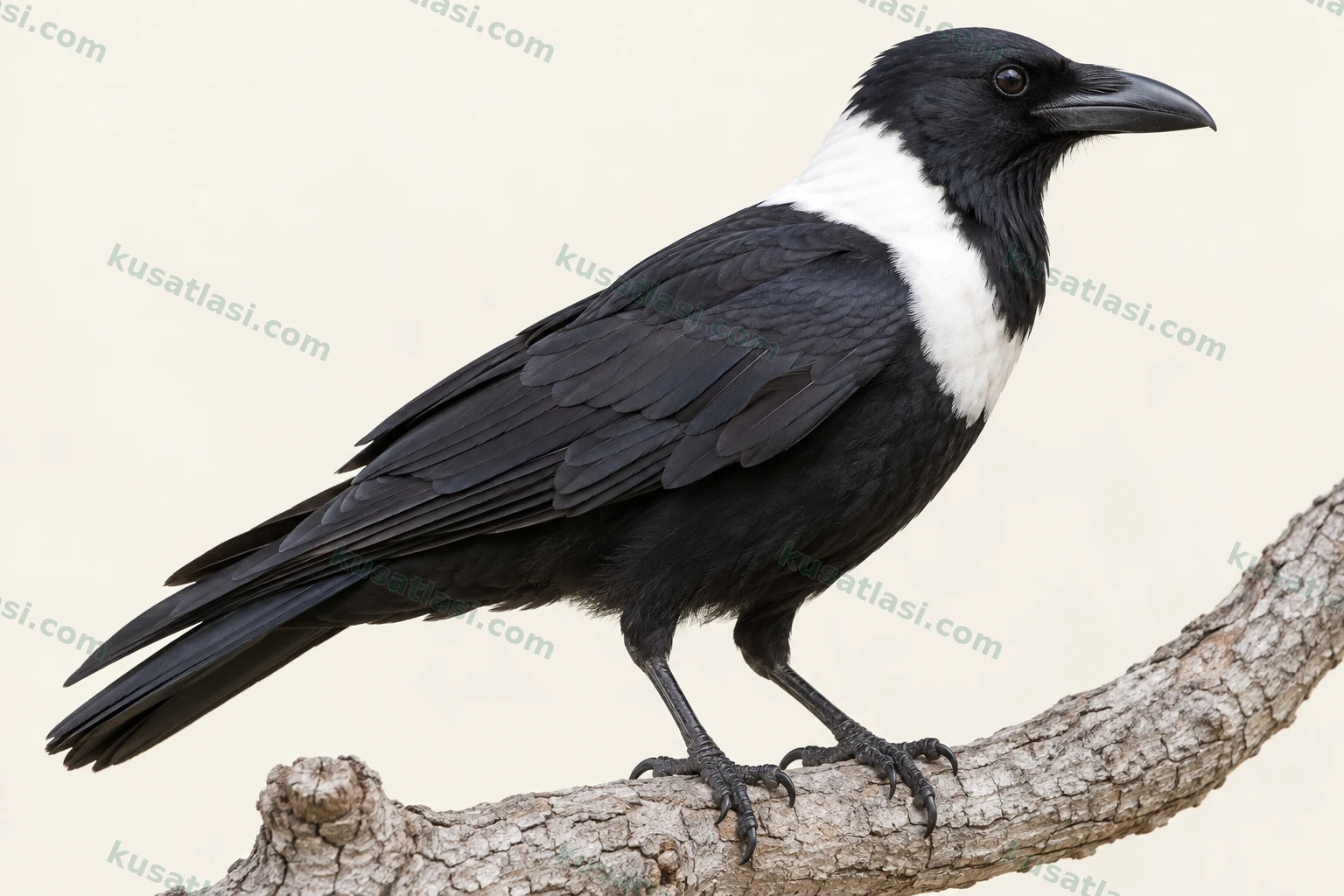
On a black crow, white connects the nape to the breast band; the belly remains dark.
Biometrics
Length
Male50–55 cm
Female50–55 cm
Shared species value
Wing length
Male31.8 cm
Female31.8 cm
Shared species value
Weight
Male450–512 g
Female347–500 g
Collared Crow
Central and eastern China, northern Vietnam and the Kinmen areaObservation guide in its natural range
Look for three features together
Do not rely on a single featureSee the white nape-to-breast connection together with the dark belly.
The Daurian Jackdaw’s white extends onto the belly; consider differences in distance.
Compare male and female
 FemaleMale
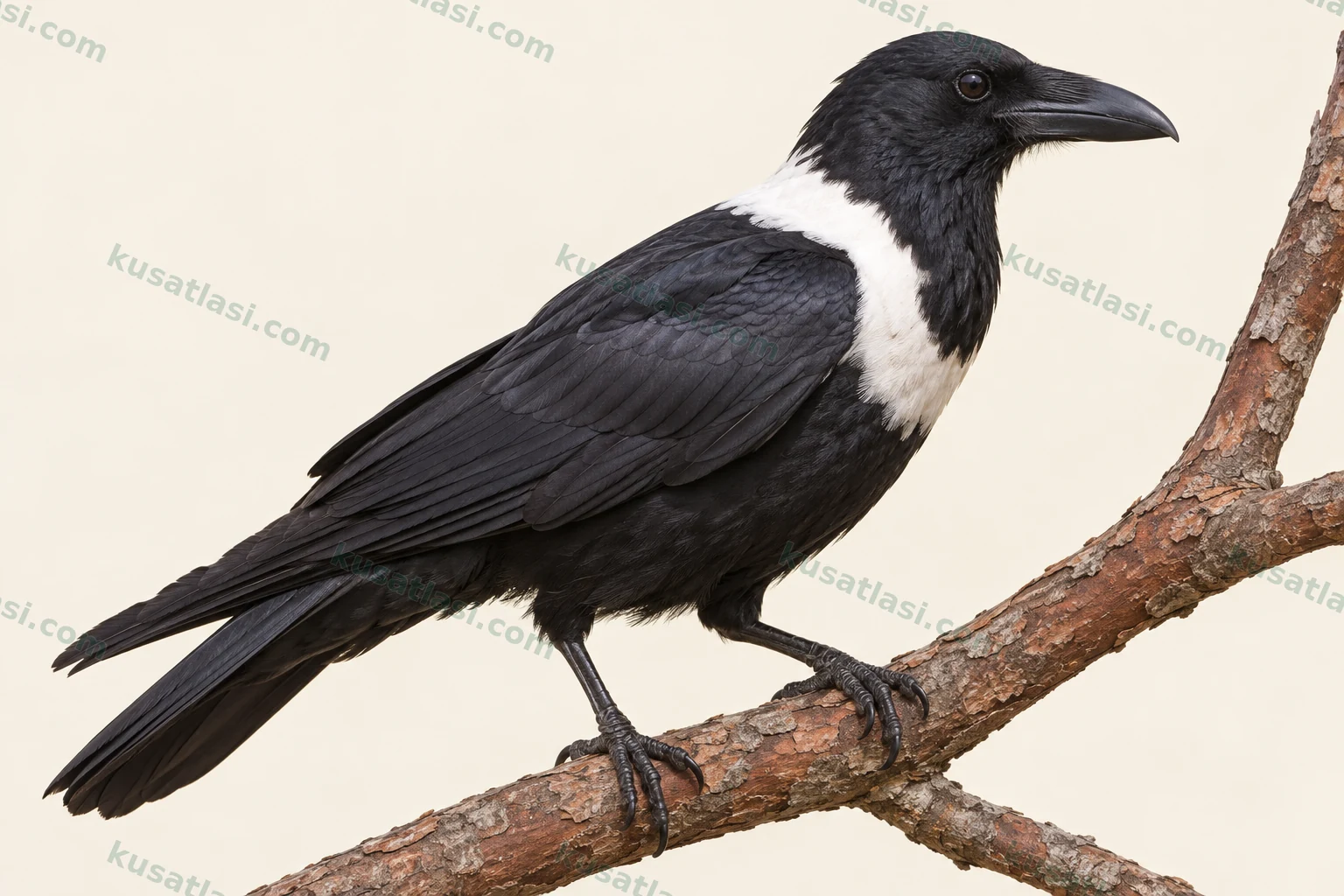
Adult sexes are very similar; the width of the white band alone does not distinguish them.
Where to look in its natural range?
Wet lowlands, fishponds, farmland and coasts.
Mainly resident; Hong Kong’s breeding months are not a shared calendar for the entire range.
January
Resident; local movements to roosts are not mapped as migration routes. No verified regional date is given for this month. This does not imply local absence.
February
Resident; local movements to roosts are not mapped as migration routes. The main egg-laying period in Hong Kong. Months when young leaving the nest have been seen in Hong Kong.
March
Resident; local movements to roosts are not mapped as migration routes. The main egg-laying period in Hong Kong. Months when young leaving the nest have been seen in Hong Kong.
April
Resident; local movements to roosts are not mapped as migration routes. Months when young leaving the nest have been seen in Hong Kong.
May
Resident; local movements to roosts are not mapped as migration routes. Months when young leaving the nest have been seen in Hong Kong.
June
Resident; local movements to roosts are not mapped as migration routes. No verified regional date is given for this month. This does not imply local absence.
July
Resident; local movements to roosts are not mapped as migration routes. No verified regional date is given for this month. This does not imply local absence.
August
Resident; local movements to roosts are not mapped as migration routes. No verified regional date is given for this month. This does not imply local absence.
September
Resident; local movements to roosts are not mapped as migration routes. No verified regional date is given for this month. This does not imply local absence.
October
Resident; local movements to roosts are not mapped as migration routes. No verified regional date is given for this month. This does not imply local absence.
November
Resident; local movements to roosts are not mapped as migration routes. No verified regional date is given for this month. This does not imply local absence.
December
Resident; local movements to roosts are not mapped as migration routes. No verified regional date is given for this month. This does not imply local absence.
Nest, egg and incubation
A nest of twigs, mud and grasses in a tree fork; records of up to five eggs. Numbers of days for incubation and development could not be verified.
A higher-pitched call than some other large crows; compare it with an individual whose identity is confirmed visually.
Do not play recordings to attract birds; observe quietly, especially near nests.
Species information
Quick Identification
The Collared Crow Corvus torquatus is recognised by a white band joining the nape, sides of the neck and breast on an otherwise black crow. The belly stays dark; the white does not cover all the underparts. On birds in farmland or coastal wetlands, first examine the boundaries of this pattern. A small pale patch on a large black bird is not enough to identify the species.
From the front, the breadth of the breast band may be striking, but identification can remain limited if the nape cannot be seen at the same time. As the bird turns naturally, watch how the white continues along the neck sides. Reflections on black feathers in bright light must not be mistaken for white feathers. White in shade may look grey; without considering the light, do not attribute this tone to age, sex or another species.
General Appearance and Posture
The bill is black and relatively slender, and the legs are dark. Although the contrast between the dark head and white neck is important, the bill alone is not a reliable yardstick. Side and front views, and changes in head angle, can alter its apparent thickness. A nearer individual in the same photograph also looks larger. Size is a useful supporting comparison only when birds are at similar distances and in similar postures.
Do not think of this species as an ordinary urban crow occurring in every setting. Wet lowlands, fishponds and coastal surroundings are important parts of its natural environment. An individual may occur near settlements, but this does not mean all towns are used at the same density. A local gathering of crows may contain different species; count separately those individuals in which the white neck band has actually been seen.
Males, Females and Young Birds
Adult males and females look very similar. The width of the white band, an apparently large head or a single flight view does not reliably distinguish sex. Of two birds thought to be a pair, the larger-looking individual must not automatically be labelled male.
Juvenile plumage may look looser and softer, and the pale areas may be greyish. The clean black-and-white contrast of adults should therefore not be expected to be equally sharp in every young bird. Yet white turning grey in shade is not evidence of age. Examine feather texture together with the bird's overall appearance. Rather than deciding the age of a distant bird whose neck alone is visible, uncertainty can be retained.
Family groups may be seen after breeding. Do not assume all small or pale birds in such a group are the same age. A juvenile standing beside an adult is not necessarily that adult's offspring; feeding or other direct behavioural evidence is needed. Do not invent unverified colour differences to distinguish sexes with similar plumage.
Appearance in Flight
The Hong Kong guide describes it as looking more lightly built in flight than the Large-billed Crow. This comparison is helpful for birds at similar distances and angles; it is not sufficient identification on its own. Seeing the connection between the white nape and breast is more valuable. If wing angle or a bright sky hides a pale area, an unseen mark must not be treated as absent.
On a bird approaching head-on, the breast band may be visible while the back of the head is hidden. On a bird flying away, the nape may show while the belly cannot be seen. These views complement one another; a single frame does not locate the whole pattern. Size comparisons with smaller black-and-white crows can mislead when the birds are at very different distances. A natural side view after landing can reduce uncertainty left by a flight view.
Voice and Behaviour
Cornell's account describes its call as higher pitched than those of the Carrion Crow and Large-billed Crow. Compare this relative difference with identified birds heard in the same region. A rendering of a call in human words is not a definitive identification key. Wind, distance and several birds calling together affect the tone; a bird heard but not seen must not be used to give a single species name to an entire crow flock.
Birds may assemble in the open before going to communal roosts. Daily use of the same place does not show that every individual has a nest there. A resting gathering, the number of breeding pairs and a feeding gathering are separate things. A large gathering does not prove that the species is also abundant elsewhere within its natural environment. In regular counts, keep the time, area and observation duration comparable.
Similar Species
In the pale adult plumage of the Daurian Jackdaw Coloeus dauuricus, white extends onto the belly; the bird is smaller and more compact. In Collared Crow, the dark belly is distinct from the white breast band. When two birds are at different distances, do not decide by size alone. In a brief flight record without a view of the underparts, this distinction can explicitly be left unresolved.
Dark crows such as Corvus macrorhynchos and Corvus corone lack a regular broad white connection from nape to breast. An isolated pale feather, a reflection or an unusually coloured individual is not equivalent to this pattern. Different crow species may gather together at some communal roosts. Do not label the whole flock as one species on the strength of a single black-and-white bird.
World Distribution
Its natural range lies mainly in the central, eastern and southeastern Chinese lowlands and northern Vietnam. Inland plains and farmland also matter. Records from Kinmen do not mean it breeds regularly throughout Taiwan's main island; the distribution review treated mainland Taiwan records under a different status. A historical record from Hainan likewise does not guarantee that the bird is now easily found everywhere on that island.
Status within Its Natural Range
The review by Leader and colleagues, based on records from 2003–2014, shows that the abundance described in older accounts differs from more recent field conditions. This dated population estimate must not be presented as a new present-day census. Current taxonomy and the specialist Hong Kong account list the species as Vulnerable. Strong local gatherings do not show that the entire natural range is in good condition; the species was not recorded even at some apparently suitable sites.
Migration
It is mainly resident. Regular flights to a roost and local changes in gatherings after breeding are not equivalent to long-distance seasonal migration. Records from different dates on a map must not be turned into the route of one individual. Isolated wanderings in the north or outside the core natural range are considered separately. Scarcity at one coast in one year does not by itself prove a new migration route or an entirely new resident population.
Breeding Habitat
Wet lowlands, farmland, fishponds and coastal areas are associated with feeding. Suitable nesting trees are needed as well; open feeding grounds alone do not meet every requirement. Dense forest or high hilly country should not be assumed to be used as intensively as lowland wetlands. Changes in the environment also need consideration when assessing old and recent locality records.
Nest Site
The Hong Kong account describes nests of twigs, mud and grasses in a tree fork. Clutches may contain up to five eggs; this maximum is not the usual number in every nest. Regional records place laying mostly in late February–March and young leaving the nest in February–May. Verified numbers of days for incubation and nestling development were not found for the species; durations from other crows have not been substituted.
Daily Use of Space
Roosts and nest sites may be separate. There is no need to climb trees or open dense vegetation to watch the birds. Feeding surfaces in wetlands and surrounding natural trees should be conserved together. Constantly following a bird to its nest may obstruct comfortable access; keep a distance that leaves its behaviour unchanged.
What Does It Eat?
Its diet is varied; AVONET places it in the group able to use both animal and plant food. The Hong Kong account records feeding on carrion, dead fish, shellfish and snakes. Prey seen in one record is not the daily dietary percentage of the entire species. A coastal individual's diet need not be the same as that of a bird on inland farmland. A record of feeding young also does not alone represent everything adults eat throughout the year.
How Does It Feed?
It searches for accessible food on open surfaces and wetland edges, and may also use dead animal remains. Not every bend towards the ground counts as successful feeding unless food is actually seen being taken and swallowed. Gathering before a communal roost and feeding simultaneously are different behaviours. Concentrating birds with food alters their natural use of space; observe the surfaces and movements they choose themselves.
Two Scientific Names for the Same Bird
Corvus pectoralis has been used for this species in older publications. The current AviList accepts Corvus torquatus and explains the nomenclatural reasoning. When using a measurement published under the old name, verify that the taxon really is the same. A name change alone does not mean a new colour form has become a species or that two different populations have been merged.
Local Abundance, Decline across the Wider Range
The 2016 distribution review showed that extrapolating directly from its strong presence in Hong Kong to other areas could overestimate the population. Even though the bird is easy to recognise, it cannot be assumed to occupy every apparently suitable plain. Conservation assessment considers places without records together with survey duration and historical range information.
Roost Counts and Pair Counts
Counting birds arriving at a communal roost is a useful monitoring method. However, the result is not the number of nests there; nonbreeders may join the gathering. The arrival of young birds and local movements can affect the total. Two counts made at different times should not directly be read as population growth or decline; comparisons are more meaningful when the method is consistent.
The Boundary of the White Band
The dark belly helps in comparison with pale adult Daurian Jackdaws. The pale area around the neck joining the breast band is the Collared Crow's distinctive pattern. A belly hidden in a photograph must not be filled in by assuming it is white or dark. Waiting for the bird to turn naturally provides a more reliable record than a definite identification based on an assumption. Recording which marks were actually seen keeps missing views distinct from the true pattern in a later comparison.