

World Birds IUCN statusLC · Least ConcernGlobal IUCN category. BirdLife v10 (2025); taxon matching: AviList 2026 / IOC 15.2; checked: 29.10.2026. The list year is not the species assessment date. Source and method · BirdLife OrderPasseriformesPerching birds FamilyHirundinidaeHirundinidae
White-throated Swallow
Hirundo albigularis
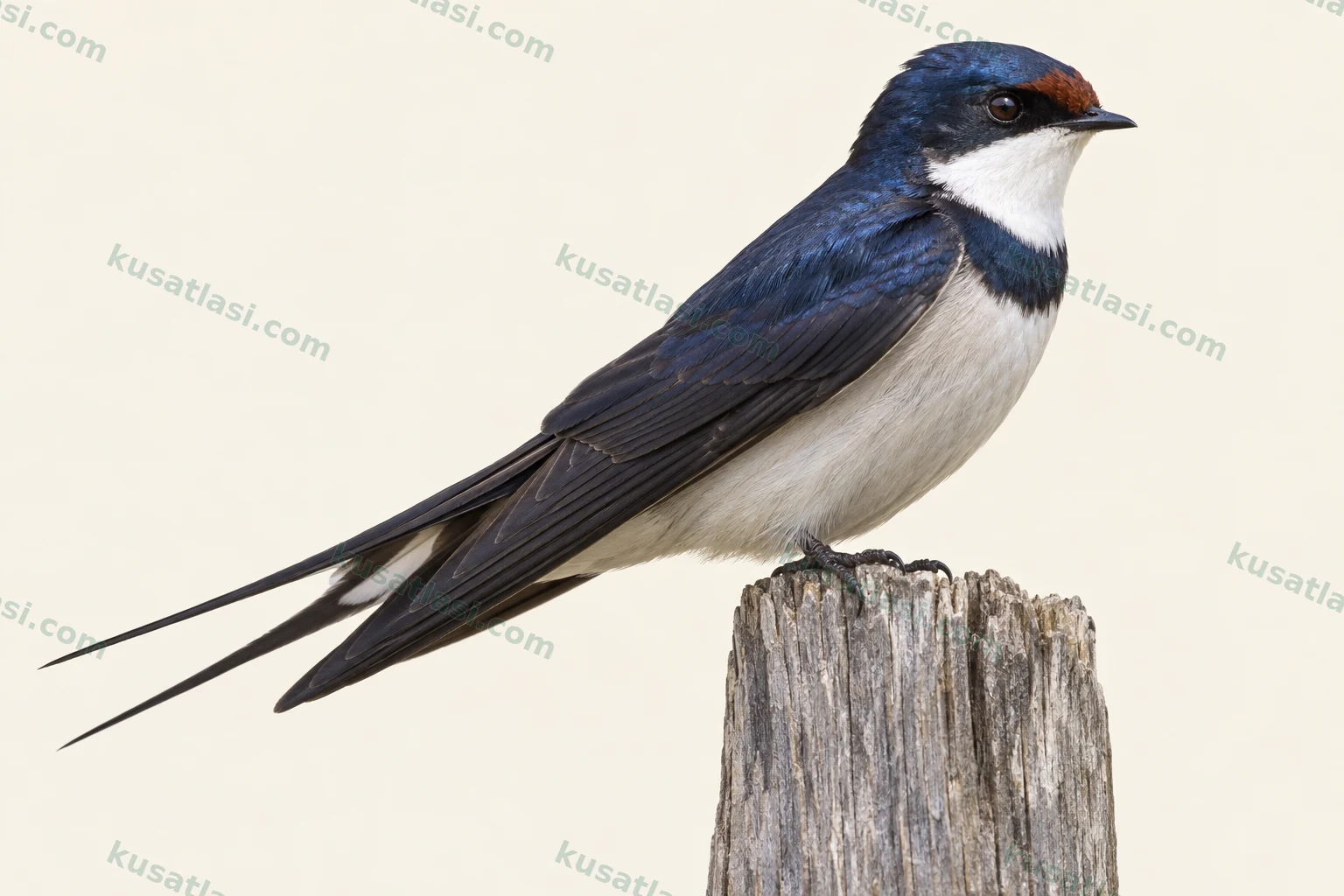
Look for a chestnut forehead, white throat, broad dark breast band and forked tail together.
Biometrics
Length
Male14–17 cm
Female14–17 cm
Shared species value
Wing length
Male12.55 cm
Female12.55 cm
Shared species value
Weight
Male16–19 g
Female21–29 g
White-throated Swallow
Southern Africa, in open habitats near waterObservation guide in its natural range
Look for three features together
Do not rely on a single featureCheck that chestnut covers only the forehead rather than the crown.
Look for the broad dark band below the white throat.
Compare the forked tail together with the head and breast pattern.
Compare male and female
 FemaleMale
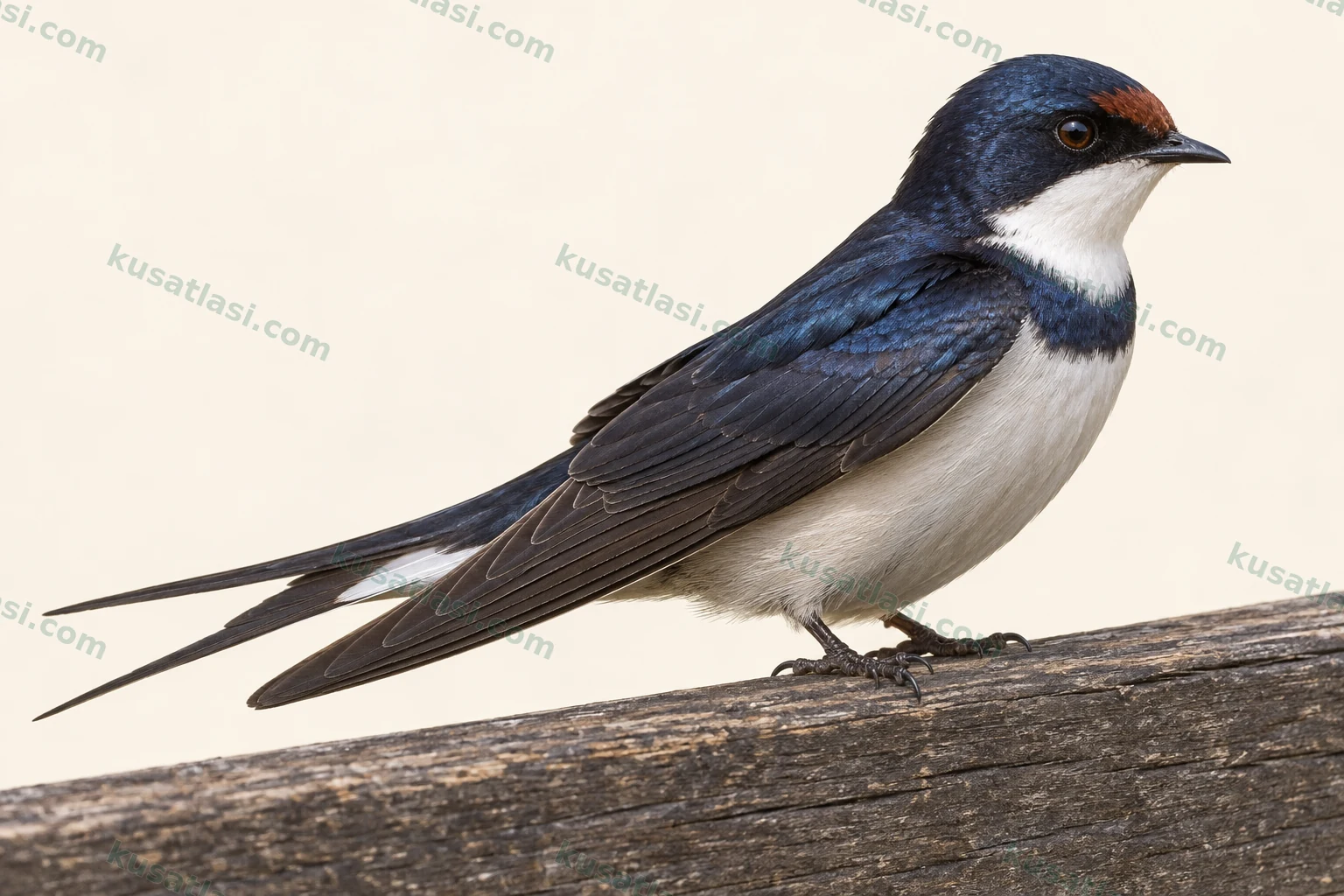
Adults share the same pattern. The female’s tail is usually shorter, but a single photo cannot reliably establish sex. Young birds are paler with a shorter tail and weak forehead colour.
Where to look in its natural range?
Watch hunting flights over water, birds on wires and sheltered nesting areas from a distance.
The species moves seasonally within Africa. The months shown describe the regional breeding area in South Africa.
January
In South Africa, arrival is in July–September, breeding is mainly in August–March and return is in April–May. Some birds remain in Zimbabwe in winter. The breeding period in South Africa.
February
In South Africa, arrival is in July–September, breeding is mainly in August–March and return is in April–May. Some birds remain in Zimbabwe in winter. The breeding period in South Africa.
March
In South Africa, arrival is in July–September, breeding is mainly in August–March and return is in April–May. Some birds remain in Zimbabwe in winter. The breeding period in South Africa.
April
In South Africa, arrival is in July–September, breeding is mainly in August–March and return is in April–May. Some birds remain in Zimbabwe in winter. Return from South Africa.
May
In South Africa, arrival is in July–September, breeding is mainly in August–March and return is in April–May. Some birds remain in Zimbabwe in winter. Return from South Africa.
June
In South Africa, arrival is in July–September, breeding is mainly in August–March and return is in April–May. Some birds remain in Zimbabwe in winter. No verified regional date is given for this month. That does not imply local absence.
July
In South Africa, arrival is in July–September, breeding is mainly in August–March and return is in April–May. Some birds remain in Zimbabwe in winter. Arrival in South Africa.
August
In South Africa, arrival is in July–September, breeding is mainly in August–March and return is in April–May. Some birds remain in Zimbabwe in winter. Arrival in South Africa. The breeding period in South Africa.
September
In South Africa, arrival is in July–September, breeding is mainly in August–March and return is in April–May. Some birds remain in Zimbabwe in winter. Arrival in South Africa. The breeding period in South Africa.
October
In South Africa, arrival is in July–September, breeding is mainly in August–March and return is in April–May. Some birds remain in Zimbabwe in winter. The breeding period in South Africa.
November
In South Africa, arrival is in July–September, breeding is mainly in August–March and return is in April–May. Some birds remain in Zimbabwe in winter. The breeding period in South Africa.
December
In South Africa, arrival is in July–September, breeding is mainly in August–March and return is in April–May. Some birds remain in Zimbabwe in winter. The breeding period in South Africa.
Nest, egg and incubation
The open mud cup is built on a sheltered ledge. There are usually three eggs. The South African account gives 15–18 days of incubation and 18–25 days for the young in the nest.
Listen for lively twitters and harsher alarm sounds. Match the sound to the bird you see.
Do not play recordings to attract birds; observe quietly, especially near nests.
Species information
Quick identification
The White-throated Swallow Hirundo albigularis lives in open places and near water in southern Africa. On an adult, chestnut is confined to the forehead. The rest of the head and the upperparts are dark metallic blue. A broad dark breast band lies below the white throat. Check the pale underparts, forked tail and head and breast pattern together. A white throat alone on a small flying bird is not enough for a firm identification.
Watch a bird on a wire or an exposed perch near water from the side and from the front. Check whether chestnut covers the whole crown or only the forehead. The width of the breast band matters too. It can look more prominent at the shoulders and narrower in the middle. Metallic blue areas can look black in shade, so identification does not depend on the strength of the sheen. The tail is forked, but the outer feathers are not as thin and long as in some other local swallows.
General appearance and posture
The small body, short neck and pointed wings give the bird a shape suited to catching insects in the air. The dark sides of the head border the pale throat. White areas below the breast band can have grey or brownish shading in places. An off-white appearance alone does not indicate another species. The upperwings are dark. The pale and dark areas of the underwing can appear different according to flight direction. White areas on the inner parts of the tail feathers are easier to see when the tail spreads.
It can perch on wires, posts, logs or projections over water. The feet hold the body slightly above the perch and the tail extends behind, giving a good side view. The wings look narrow and long when folded against the body. A bird can look rounder when it fluffs its feathers in cold conditions, while resting or while tending its plumage. The same bird looks slimmer in flight.
Males, females and young birds
Adult males and females share the chestnut forehead, dark blue upperparts, white throat and dark breast band. The female is generally described as having shorter outer tail feathers. Wear, breakage and the angle of a photograph can obscure that difference. A shorter-looking tail in one image is not a reliable way to determine sex. Identify the species first and leave sex uncertain in the record if there is no clear indication.
Young birds are paler and less glossy than adults. The adult chestnut forehead patch is undeveloped or indistinct, and the breast band can be browner. The tail is shorter with a shallower fork. Do not expect every adult mark to appear as strongly on a young bird. Compare the head pattern, breast band, tail shape and surroundings together. Nearby adults feeding the young can provide evidence of age, but merely sitting on the same wire is insufficient.
Appearance in flight
It catches insects over water and open grassland with quick, agile turns. Pointed wings, a forked tail and a dark breast band may be seen in good light. The white throat is more prominent on approach, and the dark upperparts stand out as it flies away. The white on the inner tail does not show on every wingbeat and can be hidden when the tail is closed or the bird is viewed from behind. Following the bird for longer than a few seconds is more reliable than identifying it from a single blurred frame.
On an adult in flight, chestnut confined to the forehead helps distinguish similar species. Do not force that detail if the head looks too small. Young birds have different tail proportions from adults, so a long tail alone does not settle the identification. Frequent turns while feeding do not show that the bird is migrating. Migration requires evidence of seasonal and regional movements. Observe from the natural feeding area beside the water without blocking an adult approaching its nest.
Voice and behaviour
The song consists of lively twitters and short linked sounds. Harsher sounds can be heard in alarm. Loudness varies with distance and wind. Where several swallows occur around water, match the sound to the bird you see. One sequence of written syllables cannot convey the sound’s full structure. A general swallow twitter is insufficient for a firm identification without the head and breast pattern.
It may be alone, in pairs or in feeding groups. Outside breeding, gathered birds may take advantage of abundant insects in the same area. The bird rests on wires or exposed projections and can leave a perch to hunt and then return. It builds an open mud cup on rock ledges and in sheltered places on bridges, buildings and dams. Nesting on human structures has helped it establish itself in some local areas. This local change does not indicate the same increase across Africa.
Similar species
1. When comparing the Wire-tailed Swallow Hirundo smithii, examine the chestnut on the head. In that species it extends across the crown, while the White-throated Swallow has chestnut only on the forehead. The Wire-tailed Swallow has longer, thinner outer tail feathers and lacks the broad breast band of the White-throated Swallow. Check the head, breast and tail together.
2. The Banded Martin Riparia cincta can be confused particularly with young birds. Its squarer tail, pale eyebrow and brown upperparts help in comparison. Even though the adult forehead colour is weak in young White-throated Swallows, consider the tail shape and breast pattern together.
3. Other local swallows with dark upperparts and pale bellies may show a similar contrast in a brief view. Hunting over water alone does not distinguish them. Keep the identification open if the chestnut forehead, breast band and forked tail cannot be seen together.
Global range
Its natural range is in the southern part of Africa. Current taxonomy and regional atlas accounts include Angola, the southern Democratic Republic of the Congo, Zambia and suitable habitats farther south. It occurs in Zimbabwe, Botswana, South Africa, Eswatini and Lesotho. Its distribution in Namibia is sparser. The country list does not imply continuous habitat across all their territory. Open ground near water and suitable nest sites affect local occurrence.
Status within its natural range
It can be common in wetter parts of South Africa, while its distribution elsewhere is patchy. Local range expansion around the Cape has been reported where human structures provide nest sites. This regional atlas observation does not establish the same trend for the global population. Look for open water, grassland and a sheltered nest site together rather than relying on a country name alone.
Movements and migration
It moves seasonally within Africa. Arrivals in South Africa are reported mainly in late winter and early spring, around July–September, with the return in April–May. Angola, Zambia and the Democratic Republic of the Congo are cited for the non-breeding period. The regional account explicitly says that not all these connections are supported by ring recoveries. Some birds stay in Zimbabwe through winter. There is no single route, date or distance for every population, and the map records do not trace a migration route.
Breeding habitat
It breeds in open grassland, open mountain habitats and shrub vegetation in South Africa, generally near water. Water provides a feeding area where flying insects gather. Sheltered ledges on bridges, rocks or buildings can also make nesting possible. This helps explain why it may be sparse over large areas of the same country without suitable water and nesting sites.
Nest site
The nest is an open cup built of pieces of mud and lined with materials such as grass, fine roots and feathers. The bird can use a sheltered support on a rock ledge, bridge or building. South African accounts usually report three eggs, with the reported range varying by source and sample. The specialist summary based on Roberts gives 15–18 days of incubation and 18–25 days until the young leave the nest. The female incubates and both parents feed the young. The same pair may raise more than one brood in a season.
Daily use of habitat
It feeds in the air above water and grassland and rests on nearby exposed perches. Once able to fly, young birds can still return to the nest to roost for a time. If approaching a nest under a bridge stops an adult from coming in, move farther away. Leave the mud nest intact. There is no need to touch the young or block the approach for a close view.
What does it eat?
It feeds on flying insects. Regional species accounts list flies, wasps, beetles and winged termites. The list does not give fixed proportions for the whole year. Insect emergences around water and termite flights associated with rain can create short periods of abundant prey. The size of a feeding group alone is not an exact measure of prey abundance or of the population at that time.
How does it hunt?
It mostly catches prey in low, agile flight over water or open vegetation. It can fly briefly from an exposed perch and return. Less often it also takes prey from the ground. Continuous wingbeats and quick turns can be seen as it follows small flying insects. Do not use bait to bring insects closer or alter the feeding area. If a small item in the bill cannot be seen clearly, record the prey group that can be verified rather than assigning a definite insect species.
The value of a forehead patch
The White-throated Swallow has chestnut only on the forehead. In the Wire-tailed Swallow it extends onto the crown. When both species show white underparts and a forked tail, that small head detail is useful. If the head is too far away to see, do not assume the mark is present or absent. The breast band and tail shape offer further clues.
Bridges provide new nesting settings
The bird builds mud nests on rock ledges and can also use sheltered supports on human structures. South African atlases link some local distribution changes to these new nesting opportunities. This does not mean every bridge is occupied or the global population increased. A suitable nest support and a feeding area near water must occur together. Taking care around active nests during maintenance helps protect breeding.
The figures refer to the same stages
Specialist accounts may give approximate examples of 17 days of incubation and 22 days with the young in the nest. The account based on Roberts gives wider ranges for both stages. These are summaries of the same stages with different scopes. No new exact value is calculated from the midpoint of a range. Egg laying, the start of incubation and the young taking flight mark different points.
Read migration with its evidence
The time when birds leave South Africa and the northern areas where they are seen outside breeding are known. The regional specialist account nevertheless says that ring recoveries have not confirmed all the connections. Joining records from two countries with a straight line does not reveal the actual flight route. Birds that remain in Zimbabwe in winter also show that not all populations move in the same way.