

World Birds IUCN statusLC · Least ConcernGlobal IUCN category. BirdLife v10 (2025); taxon matching: AviList 2026 / IOC 15.2; checked: 29.10.2026. The list year is not the species assessment date. Source and method · BirdLife OrderPasseriformesPasserines FamilyLeiothrichidaeLeiothrichidae
Rufous Chatterer
Argya rubiginosa
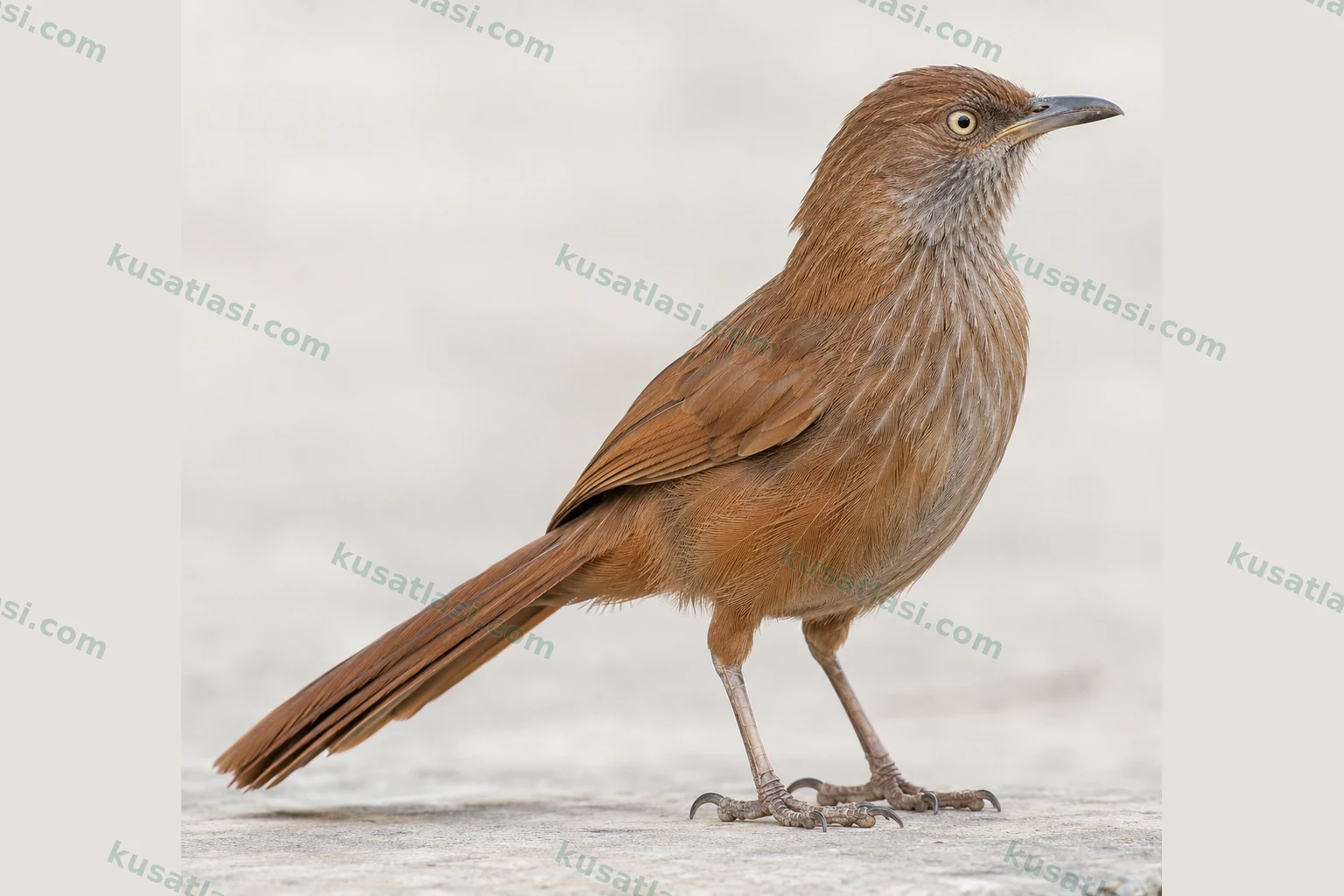
A long tail, warm cinnamon underparts and pale adult eyes; small groups moving beneath cover.
Biometrics
Length
Male19–23 cm
Female19–23 cm
Shared species value
Wing length
Male8.34 cm
Female8.34 cm
Shared species value
Weight
Male36–40 g
Female39–50 g
Rufous Chatterer
Scrub of eastern and northeastern AfricaObservation guide in its natural range
Look for three features together
Do not rely on a single featureAssess the warm underparts together with the long tail.
Do not confuse the pale adult eye with the darker eye of a young bird.
Follow other babblers feeding alongside separately.
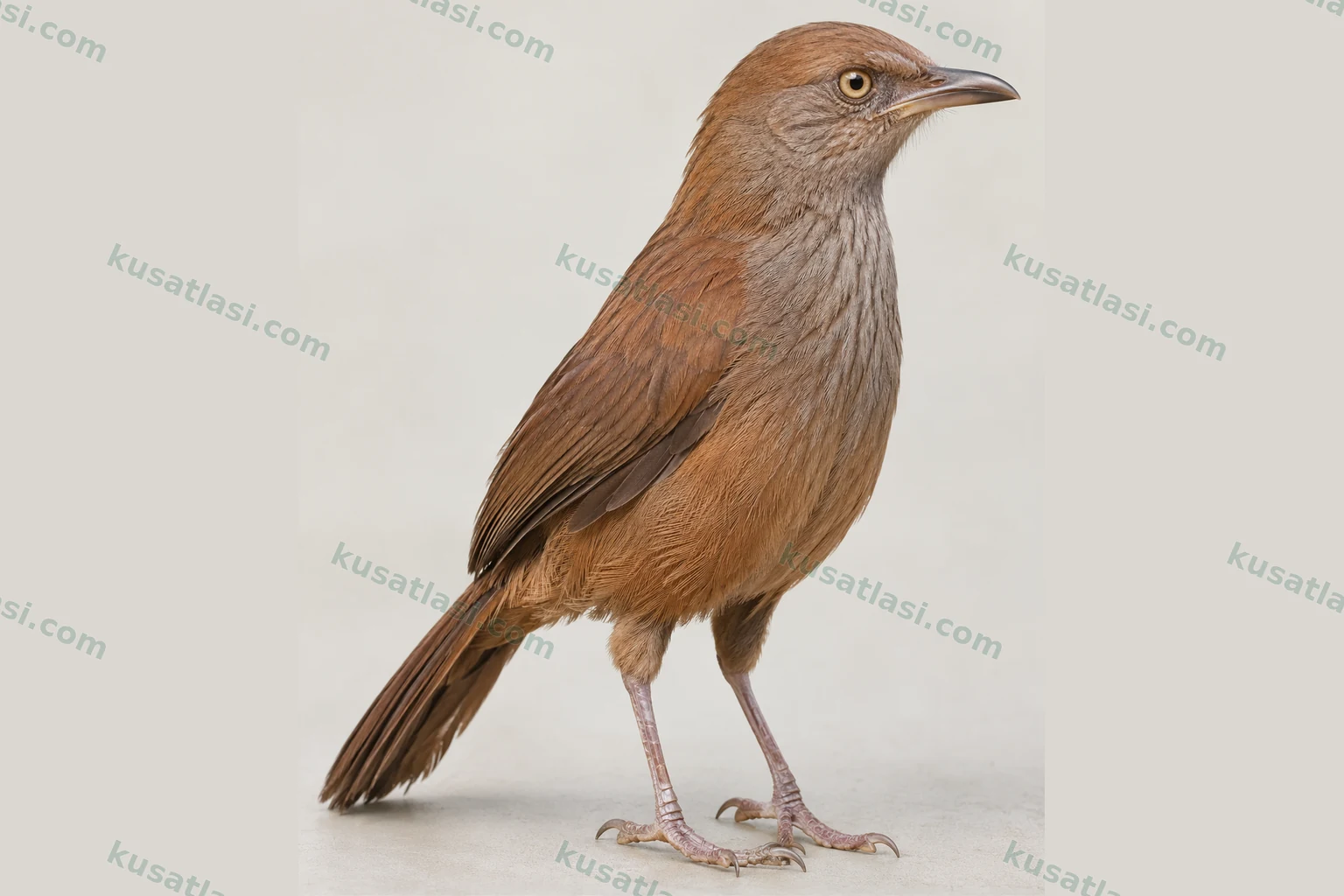
Compare male and female
 FemaleMale
Adult males and females cannot reliably be separated by appearance; young birds may have darker eyes.
Where to look in its natural range?
Watch beneath bushes, along woodland edges and in covered streambeds from a distance.
Direct events from the Kenyan field study are shown; these are not egg-laying dates.
January
It is essentially resident; local space use and visibility vary. Ol ari Nyiro, Kenya: young-bird records, not an exact egg-laying month.
February
It is essentially resident; local space use and visibility vary. Ol ari Nyiro, Kenya: young-bird records, not an exact egg-laying month.
March
It is essentially resident; local space use and visibility vary. No verified regional date specific to this month was provided; this does not mean local absence.
April
It is essentially resident; local space use and visibility vary. Ol ari Nyiro, Kenya: adults were seen carrying nest material.
May
It is essentially resident; local space use and visibility vary. Ol ari Nyiro, Kenya: young-bird records, not an exact egg-laying month.
June
It is essentially resident; local space use and visibility vary. Ol ari Nyiro, Kenya: an adult was seen taking food into cover.
July
It is essentially resident; local space use and visibility vary. Ol ari Nyiro, Kenya: young-bird records, not an exact egg-laying month.
August
It is essentially resident; local space use and visibility vary. No verified regional date specific to this month was provided; this does not mean local absence.
September
It is essentially resident; local space use and visibility vary. No verified regional date specific to this month was provided; this does not mean local absence.
October
It is essentially resident; local space use and visibility vary. No verified regional date specific to this month was provided; this does not mean local absence.
November
It is essentially resident; local space use and visibility vary. No verified regional date specific to this month was provided; this does not mean local absence.
December
It is essentially resident; local space use and visibility vary. No verified regional date specific to this month was provided; this does not mean local absence.
Nest, egg and incubation
The original Kenyan study found no nest; adults carrying material and young birds were recorded. Exact clutch size, incubation duration and time in the nest were not verified.
Thin short contact calls and whistled sequences help follow the party within bushes.
Do not play recordings to attract birds; observe quietly, especially near nests.
Species information
Quick identification
Rufous Chatterer Argya rubiginosa is a long-tailed, warm brown bird travelling in small groups through East African scrub. Cinnamon-rufous underparts, pale adult eyes and a slender bill are assessed together. While feeding beneath bushes, its whole body may remain hidden and soft short calls may be heard first. Rufous in the name does not mean every individual is brightly reddish. Feather wear and light can make the same bird's underparts look browner or paler.
Rufous Chatterer is the name matching this taxon. Older scientific publications may use Turdoides rubiginosa or Turdoides rubiginosus; biology from other babblers is not transferred without matching those names to current Argya rubiginosa. The species is now placed in Leiothrichidae. An older broad use of Timaliidae does not justify assigning that whole family's behaviour to this bird. Travelling in groups helps, but is not diagnostic alone: other nearby babblers also move in parties.
General appearance and posture
The upperparts are brownish-olive, the underparts warmer, yellowish-cinnamon. A faint eyebrow trace may be visible. In Kenyan specimen examinations, pale stripes in the breast feathers could make worn birds look streaked; not every breast streak should therefore be equated with another species' strong scaling. The long tail is conspicuous as the bird passes through scrub. Raising the tail is a moment of behaviour, not a tail angle held in every posture.
The upper mandible often appears grey or dark, the lower paler yellowish-horn. Describing the whole bill as bright yellow conceals variation in field and specimen observations. Adult eyes have been recorded as yellow to pale yellow. Bush shade can darken their appearance; assess iris colour separately from the pupil. Warm underparts, bill appearance, long tail and pale eye together provide a more reliable identification than one impression of colour.
Males, females and young birds
A reliable colour distinction between adult sexes cannot be established from appearance. A larger or more rufous group member is not automatically male, nor a quieter one female. A group can contain birds of different ages and feather condition. If sex is unknown, that uncertainty is retained.
In the Kenyan field study, young birds had darker eyes than adults, ranging from brownish-grey to paler grey. Recently fledged young can show pale gape edges. These characters together help assess age, but a single photo of a shaded eye cannot establish it precisely. Young may follow adults and beg for food; a quiet bird joining the group is not always a juvenile of that year. It matters which individual showed the behaviour.
The addition of one or two young to a party does not directly give the nest's total egg count. Not all young may be visible together or have survived. The original Kenyan study explicitly states that no nest was found. Those observations of young support breeding, but do not establish exact incubation days or the allocation of care duties. Cooperative helping known in other babblers must not be imposed as a definite rule for this species merely because a group contains many birds.
Appearance in flight
It can move in short flights between low patches of cover; a long tail and somewhat rounded wings help. When a group crosses a clearing in sequence, every bird's head and underparts may be difficult to see. Identifying the first bird does not make all the rest the same age and sex. Following the landing point helps relocate the bird in scrub. With an incomplete view, a tail-only silhouette need not become a definite species record.
A flight from one end of the scrub to the other may be an everyday movement. Regular long-distance migration was not confirmed in the original study, but failure to see the birds daily at one observation site does not prove migration either. A large, covered area of use must not be confused with visit frequency.
Voice and behaviour
Short, thin, whistling or chirping calls and the sounds of birds gathering can reveal the hidden group's location. The Kenyan study described this species as softer-voiced than some other babblers, yet calling frequently. Loudness alone therefore does not determine group size. Listen separately to a longer sequence from a bush top and short contact calls among group members. Confirm visually which species is present in the direction of the sound.
The research recorded mutual calling and brief fighting during some group encounters. These events do not show that every meeting ends alike or that all social relationships are understood. The species may feed behind other babbler parties or follow them to water. Such association does not prove that all the birds share one nest or family. If they retreat into cover on seeing a person, increase viewing distance rather than forcing them into the open for a complete photograph.
Similar species
Black-lored Babbler Turdoides sharpei may appear darker and larger; a dark area between bill and eye and a conspicuously pale eye assist comparison. The same Kenyan study treated it as a different species from Rufous Chatterer. Since both can have pale eyes, that feature alone is insufficient. Compare warm underpart tone, body size and dark facial area together.
Brown Babbler Turdoides plebejus may also occur in groups around cover. The two species have fed together in some places, making it easy to match one group's voice with another's appearance. Compare Rufous Chatterer's smaller, warm-underparted appearance at the same distance. If colour and proportions cannot be seen fully, follow every member separately rather than labelling the entire gathering with the name of its most conspicuous species.
World distribution
It occurs in suitable scrub of eastern and northeastern Africa. Ethiopia, the Eritrea area, the Sudan and South Sudan region, Uganda, Kenya, Somalia and the parts of Tanzania specified in the species account fall within its natural scope. This does not mean the entire surface of each country is used; local forms occupy different areas. A warm climate or scrub alone does not guarantee the bird's presence. Records matching the global species name are read together with regional habitat information.
Status within its natural range
The Ol ari Nyiro study in Kenya described it as an inconspicuous but regularly encountered resident. That result does not assign equal abundance to all Kenya or East Africa. Feeding inside scrub, soft calls and a party ranging over a broad area reduce visibility during short visits. Researchers gaining access to more places over time can also affect record counts; more records do not always mean population growth. Inadequately repeated observations do not justify an absence decision.
Seasonal movements
It is considered essentially resident; no verified regular long-distance migration route is available. Residency is not remaining motionless beneath the same bush all year. Food, water and shelter use need to be followed. Encounters around the same camp in the Kenyan study could become less frequent in dry periods; this is not retained as proof that birds had left the whole region. A party seen again several days later is not necessarily the same party unless individuals were marked. Seasonal records are interpreted separately from natural range and breeding evidence.
Breeding habitat
Low dense scrub, woodland edges, bushy streambeds and grassland with patches of cover are areas the species can use. It is not restricted to intact forest, but completely cleared open ground is not the same habitat either. The Kenyan field study includes records above two thousand metres; treating an older lower elevation limit as a fixed ceiling would exclude them. A regional observation does not imply preference for the same elevation across the range.
Nest site
No nests were found directly in the Kenyan study that could be reliably read. Adults carrying nest material and young birds were recorded; these support breeding, but do not measure a completed nest's structure or incubation duration. As numerical incubation and nest periods were not verified, another babbler's durations are not transferred. Egg counts are not calculated from a few visible young. Following a material-carrying bird into scrub to reveal the nest is inappropriate.
Daily habitat use
Cover beneath bushes may serve feeding and concealment, bush tops calling and nearby water drinking or bathing. Birds move short distances among these different areas. Not seeing a group at one point for several days does not show that the point is never used. Preserving connections among scrub patches is a broader habitat approach than protecting only the surroundings of a water container. Observe groups at natural water without making them wait a long time or blocking escape cover.
What does it eat?
Small invertebrates, especially insects beneath cover, are prominent in feeding observations. The Kenyan study also recorded feeding associated with mango and papaya skins left by people. These particular records should not be described as the dominant natural fruit proportion in every season. Pecking a skin and taking an insect within it are different events; an unseen bite is not named. One insect carried to young does not prove that the entire adult diet consists solely of that insect.
How does it forage?
It investigates litter on the ground and beneath bushes with its bill, and may pull, lift or throw aside plant fragments. Short hops on the ground can alternate with foraging and returning to cover. Feeding behind larger babblers was recorded in the study. There is insufficient evidence to call this an obligatory association everywhere or a relationship providing equal benefits. Separately recording how different species follow one another into the same opening is more informative.
Lifting leaves ahead of a bird or giving it food to see its prey changes natural behaviour. Distinguish actual bites taken beneath scrub from bill movements that are only searching. Dominance near water and food does not show equal intake by every group member. A brief feeding event cannot provide the entire party's daily energy need or dietary percentages; no numbers are added without verification.
Even a long study may find no nest
Short and Horne's Ol ari Nyiro study draws on several years of field observations. Its explicit statement that no nest of this species was found is an important scientific detail. Carrying material, catching young birds and an adult delivering food are not the same types of evidence. Interpretation of breeding timing arose from evaluating these different signs together. Not finding a nest does not mean breeding never occurred; it means exact egg and incubation information is unavailable.
The study recorded material-carrying in April and food-carrying in June; young were seen on other dates too. These dates do not establish a calendar in which every group lays on the same day each year. Two activity periods associated with rainfall are read as an interpretation for that study area. Dates are not transferred to another country simply because the same rain-season name is used there. Stating the real event and its location provides more information than one coloured calendar cell.
Seeming quiet is not the same as being silent
Thin contact calls can be lost beneath louder nearby birds. Researchers finding the group easier to follow in cover after learning its sounds shows how observer experience can influence record counts. One visitor may see none while another finds the bird regularly in the same area; abundance differences alone do not explain this. Confirming the bird making the sound and then repeating the same method produces more comparable observations.
Marked individuals and group observations
Following small groups beneath cover over long periods reveals behavioural details unavailable from one photograph. Recapturing the same two marked adults can show continuity of individuals; declaring unmarked groups the same family from appearance alone is not equally strong evidence. Leaving unknowns about the species explicit also shows which gaps new field records could fill.