

World Birds IUCN statusLC · Least ConcernGlobal IUCN category. BirdLife v10 (2025); taxon matching: AviList 2026 / IOC 15.2; checked: 29.10.2026. The list year is not the species assessment date. Source and method · BirdLife OrderPasseriformesPasserines FamilyMuscicapidaeMuscicapidae
White-capped Redstart
Phoenicurus leucocephalus
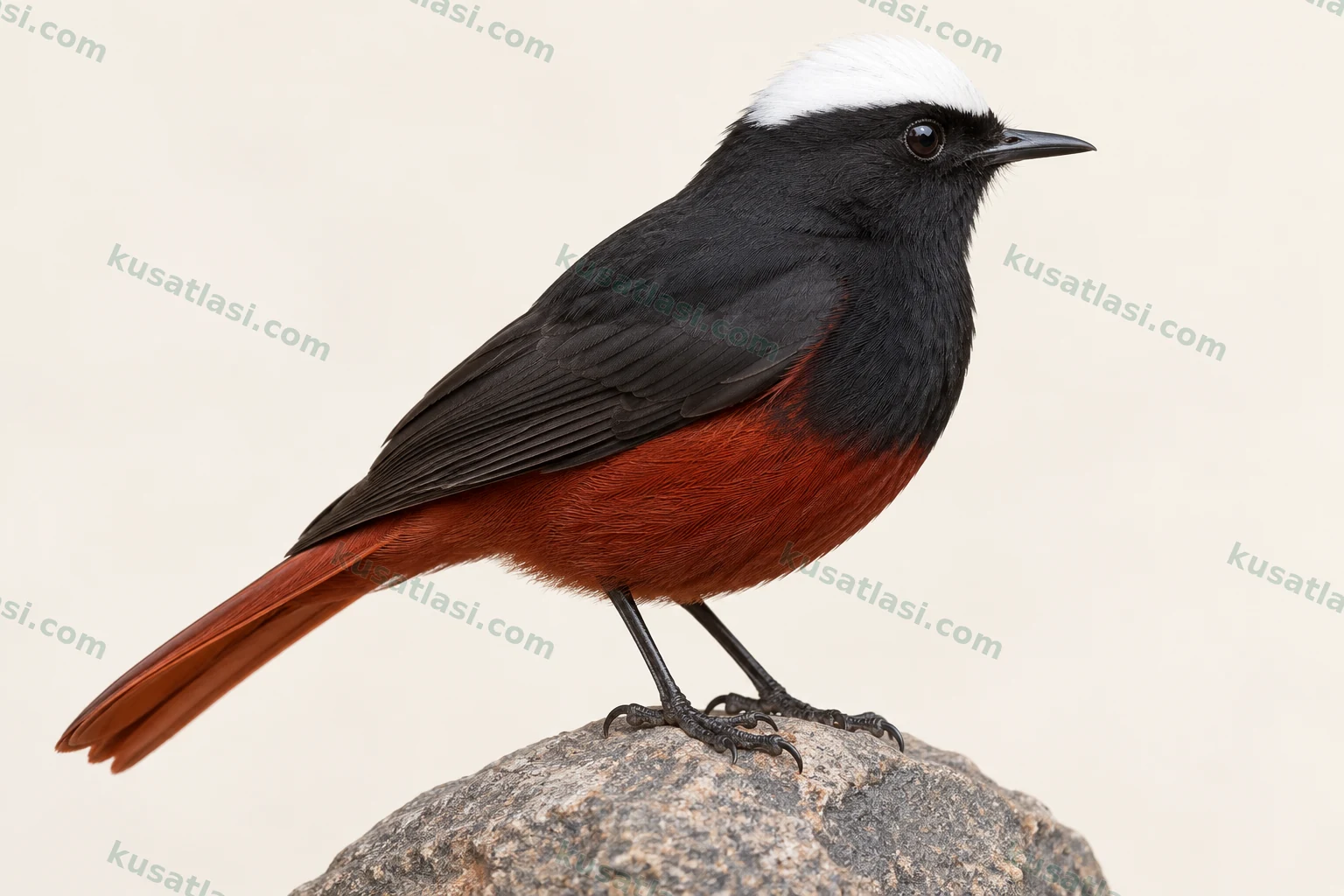
A songbird of rocky mountain streams in Asia, with a white crown, dark front and rufous tail with a dark terminal band. Adult males and females look alike.
Biometrics
Length
Male18–19 cm
Female18–19 cm
Shared species value
Wing length
Male8.96 cm
Female8.96 cm
Shared species value
Weight
Male30–37 g
Female24–30.6 g
White-capped Redstart
Himalayas and surrounding Asian mountains, with seasonal use in northern Southeast AsiaObservation guide in its natural range
Look for three features together
Do not rely on a single featureWhite crown with a dark face and throat.
Chestnut-rufous with a dark terminal band. The bird may spread and bob it when perched.
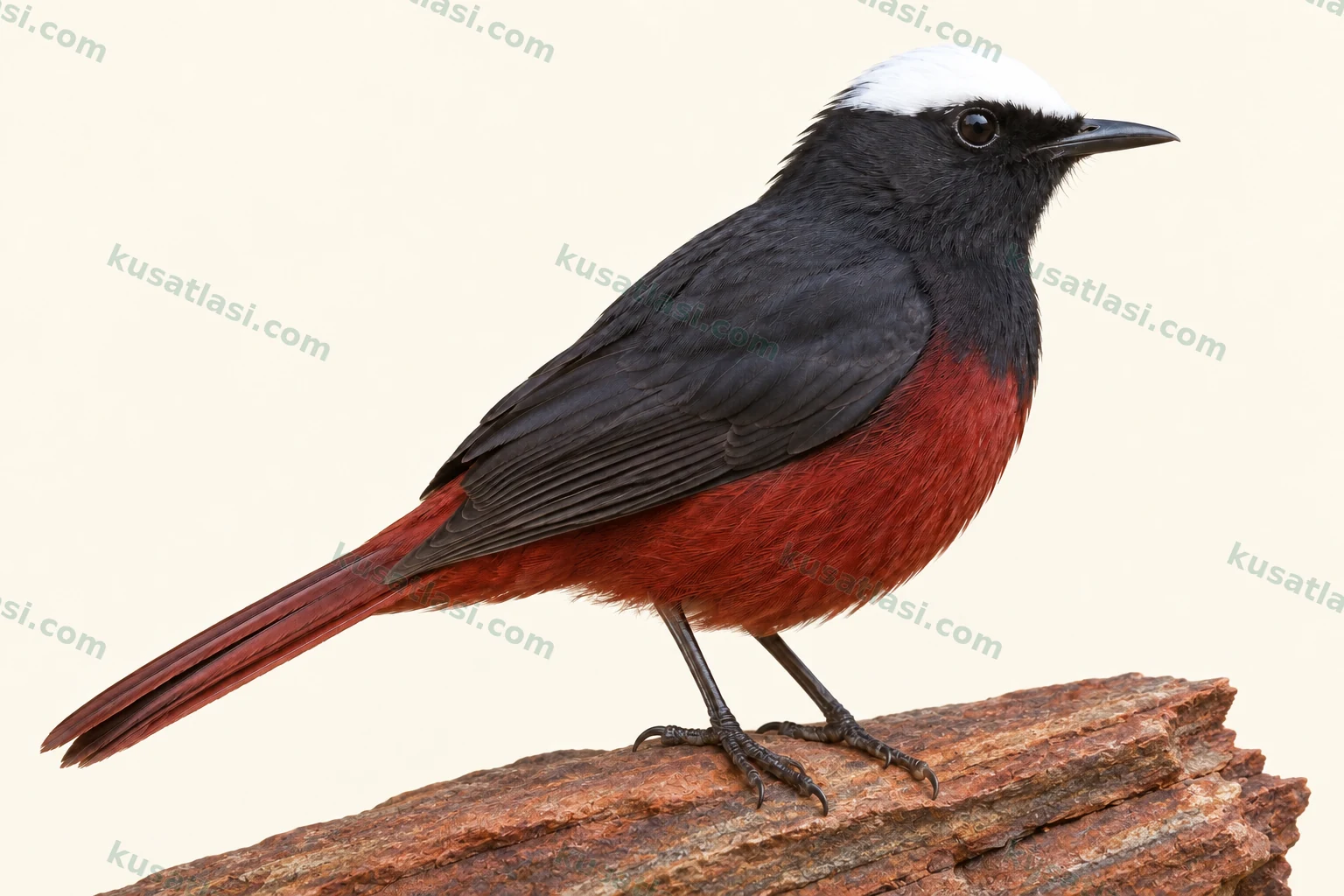
Adult males and females look alike. Dark interruptions may be visible on the crown of young birds.
Compare male and female
 FemaleMale
Adult males and females look alike. Young birds may have dark interruptions in the white crown and greyer, more scaly underparts.
Where to look in its natural range?
Fast-flowing rocky streams, rock ledges and bankside surfaces.
The specialist account’s general breeding period and the dated nest observations in Tibet are shown separately.
January
There are resident populations and seasonal movements in elevation. No single shared migration route is known. No verified regional date was given for this month. This does not imply local absence.
February
There are resident populations and seasonal movements in elevation. No single shared migration route is known. No verified regional date was given for this month. This does not imply local absence.
March
There are resident populations and seasonal movements in elevation. No single shared migration route is known. No verified regional date was given for this month. This does not imply local absence.
April
There are resident populations and seasonal movements in elevation. No single shared migration route is known. No verified regional date was given for this month. This does not imply local absence.
May
There are resident populations and seasonal movements in elevation. No single shared migration route is known. The specialist account gives a broad breeding period for the Asian mountain range. It varies with locality and elevation. The original study recorded nests at Xiongse and Dangxiong in Tibet on specified dates. Two young and one egg in July do not constitute a complete egg count.
June
There are resident populations and seasonal movements in elevation. No single shared migration route is known. The specialist account gives a broad breeding period for the Asian mountain range. It varies with locality and elevation.
July
There are resident populations and seasonal movements in elevation. No single shared migration route is known. The specialist account gives a broad breeding period for the Asian mountain range. It varies with locality and elevation. The original study recorded nests at Xiongse and Dangxiong in Tibet on specified dates. Two young and one egg in July do not constitute a complete egg count.
August
There are resident populations and seasonal movements in elevation. No single shared migration route is known. The specialist account gives a broad breeding period for the Asian mountain range. It varies with locality and elevation.
September
There are resident populations and seasonal movements in elevation. No single shared migration route is known. No verified regional date was given for this month. This does not imply local absence.
October
There are resident populations and seasonal movements in elevation. No single shared migration route is known. No verified regional date was given for this month. This does not imply local absence.
November
There are resident populations and seasonal movements in elevation. No single shared migration route is known. No verified regional date was given for this month. This does not imply local absence.
December
There are resident populations and seasonal movements in elevation. No single shared migration route is known. No verified regional date was given for this month. This does not imply local absence.
Nest, egg and incubation
The cup nest is made of plant material in a sheltered rock crevice or hollow. The specialist account gives 3–5 eggs. Both sexes carried material in Tibet. Incubation and nestling periods were not verified.
The call is a sharp, drawn-out whistle that may end abruptly. The bird also gives a softer, melodic song.
Do not play recordings to attract birds; observe quietly, especially near nests.
Species information
Quick identification
The White-capped Redstart Phoenicurus leucocephalus is a white-crowned, red-tailed songbird of Asia’s rocky mountain streams. The adult has a bright white crown. The sides of the head, throat, upper breast, back and wings are dark. The belly and tail range from chestnut-rufous to nearly orange, and the tail has a dark terminal band. The white cap is confined to the top of the head.
On a bird perched on a rock, look for the white crown, dark front and rufous rear together. In poor light, the rufous areas can look very dark, leaving the white crown as the only conspicuous mark. Waiting for the same bird to turn into the light is more reliable than assuming that a dark silhouette represents a different colour form. Other redstarts can also have white caps, so check the tail tip and wing to complete the identification.
General appearance and posture
The body is full and the tail conspicuous. The white crown contrasts sharply with the dark face. The bill and feet are dark. The chestnut-rufous tail and rear of the body are visible beside the dark wing. The dark end of the tail can be checked separately from the side or behind. The face lacks the extensive white of the White-headed Robin-Chat.
A rock or log beside the stream is a common place to see the bird perched. A perched bird may lean forward and spread and bob its tail. Tail movement alone does not determine sex or species. Other stream birds can do the same. Check the white crown, dark front and rufous tail together.
Remaining on a rock above the water for a long time is consistent with waiting for prey. A single photograph does not establish that the bird is always there or that it nests nearby. Record short movements along the stream, moments when the wings open and the way the tail moves to build a fuller view of the bird.
Males, females and young birds
Adult males and females look alike. Giving the female a brown head or a completely different grey body would conflict with the verified description of the adult. The apparent width of the white crown can vary with head angle and feather posture, so it is not a reliable sex character on its own. One member of a pair singing more often does not by itself provide a measured means of determining sex.
The young bird’s white crown may look interrupted or scaly because of dark feather tips. The dark grey area below can extend farther down than in adults, with fine grey speckling beneath the belly where it meets the rufous area. These juvenile details are not presented as a distinct adult female colour pattern. When the view is brief or the light poor, the age can remain uncertain.
The original nest study in Tibet recorded both sexes collecting nest material. A bird carrying material is therefore not necessarily a female. The movement can be recorded from a distance. Catching birds to force a sex determination or blocking their passage in and out of a nest is inappropriate.
Appearance in flight
The tail and white crown may be easiest to see during a short stream crossing. Once the bird lands on a rock again, check the dark tail tip, the sides of the head and the rufous rear. Flying over water does not identify it as a dipper or a fish hunter. A short flight after small prey also differs from regular long-distance migration.
When foraging, it may fly up from a perch and land on the ground or on a rock surface. If no prey is visible at the end of such a flight, do not give it a definite fish or insect name. Spray and gaps between rocks can briefly conceal the bird. The white mark disappearing from view does not imply a different species in flight. Follow the same individual from its starting point to its landing site.
Voice and behaviour
The call is described as a sharp, drawn-out whistle that can carry far and end abruptly. Stream noise can mask it and make the source difficult to locate. The song can be softer, melodic and variable. Its vocal repertoire cannot be reduced to one shout or a single fixed syllable.
Individuals or pairs may be seen along rocky streams. A bird defending its territory may respond to nearby birds, but an individual approaching an observer is not necessarily defending a nest. Tail spreading and leaning are parts of its natural behaviour. Approaching the same rock and repeatedly flushing the bird changes how it uses the area and makes its behaviour harder to interpret.
Similar species
The Plumbeous Water Redstart Phoenicurus fuliginosus occurs on the same kinds of fast-flowing streams. The adult male has a more uniformly slate-blue-grey body and a rufous tail, without the White-capped Redstart’s conspicuous white crown. Females and young Plumbeous Water Redstarts differ in their grey, scaly underparts and white at the base of the tail. Tail movement alone does not separate the two species.
When considering other redstarts with white crowns and rufous underparts, also examine any white on the wing, the pattern on the front of the body and the geographical setting. Check the wing as well as the white crown before identifying a White-capped Redstart. If the rufous tail is visible but the head and body are indistinct, it may be best to leave the bird identified only as a redstart.
World distribution
The natural range extends from the Himalayas and nearby mountains of central and southern Asia to suitable mountain areas in China and the north of Southeast Asia. Resident or breeding areas are distinguished from lower areas used in winter. Occurrence in places such as northern Myanmar and northern Thailand does not follow the same seasonal pattern as every Himalayan breeding area. Colouring a whole country on a map cannot show the actual distribution of rocky stream habitat.
Status within its natural range
It can be seen regularly on suitable streams locally, without occurring at the same density in every forest, plain or area of farmland around them. Field surveys in Sikkim in 2008–2018 documented the species’ locations for a habitat model. The resulting map predicts potentially suitable areas and does not count birds or active nests directly at every shaded point. The Least Concern category also does not indicate that every stream section remains undisturbed.
Migration
Many populations change elevation with the season. In some places, year-round presence at the same elevations is also reported. Dated spring observations in the Tibetan highlands and winter use of lower areas are separate evidence. These differences do not establish one intercontinental migration route. Arrival dates in one valley do not establish a calendar for all of Asia, and unverified country sequences or migration routes are not drawn on the map.
Breeding habitat
Rocky, fast-flowing mountain streams and suitable rock surfaces along the banks are its principal habitat. In the Tibetan study, nests were found on slopes and rock surfaces near streams in high valleys. These examples do not show that the entire species depends on the same elevation. Feeding areas, nest sites and lower stream sections used in winter are considered separately.
Nest site
It can build a cup-shaped nest in a rock crevice or sheltered hollow. Specialist accounts generally report 3–5 speckled eggs that are greenish or blue-green. One nest examined directly in Tibet was made of moss and fine plant stems and lined with wool and feathers. Both sexes carried material. Another nest held two young and one egg. This mixed-stage record is not a complete egg count with no losses. Incubation and nestling periods were not verified for this species.
Daily habitat use
It forages on rocks, at the water’s edge and on bankside surfaces. The Sikkim study noted that most potentially suitable stream habitat lay outside protected areas. The habitat model does not map actual nests. Local ground checks are needed. Keep away from the entrances to active nests, leave rocks in place and avoid chasing the bird along the stream for a photograph.
What does it eat?
It feeds chiefly on small invertebrates. The specialist account reports insects found near water, flies, beetles, ants and spiders, as well as occasional fruit and seeds. This variety does not show that the foods are eaten in equal amounts in every season. Living near water does not indicate a regular diet of fish.
How does it forage?
It can take prey from rock and bankside surfaces or make a short flight from a perch towards an airborne insect. Where the prey is found and whether the bird happens to move towards water are separate observations. The prolonged underwater walking seen in dippers is not attributed to this species without evidence. A short excursion over water does not establish that the bird caught a fish.
Prey is small and often cannot be identified precisely by an observer. Record the starting perch, the direction of departure and the return behaviour as seen. Stream flow and bankside surfaces offer different small feeding areas. Restricting the description of a whole valley to one way of hunting on rocks would obscure this variety.
The white cap is confined to the crown
The pale mark is a white crown above a dark face. It does not extend across the face and throat. Drawing all birds with similar white-headed names with the same pattern would be misleading. Adult males and females look similar, and the dark interruptions in the crown of young birds are considered age-related details.
Two young and an egg tell only part of the story
A Tibetan nest record documented two young and one egg together. That snapshot cannot tell when all the eggs were laid or how many days incubation lasted. Development periods given in the same paper for another bird cannot be applied to this species without checking which entry they belong to.
A shaded conservation map is a model output
The Sikkim study combined field locations with climatic and terrain variables to model potentially suitable areas. The resulting map does not show that researchers saw birds at every shaded point. It helps assess stream habitat outside protected areas. Active nests and population totals require different evidence.
Check which species a correction concerns
The 2024 correction to this habitat paper changes a table percentage for the Blue Whistling Thrush used for comparison. The White-capped Redstart’s values are in a different column of the same table. Check the row and column affected before changing species data. Following a scientific publication includes understanding the scope of later corrections as well as reading the original paper.
The older genus name refers to the same bird
The name Chaimarrornis leucocephalus may appear in older publications. The accepted name today is Phoenicurus leucocephalus. Dated nest observations of the same species are used after confirming this name match. The older genus name does not indicate a different species.