

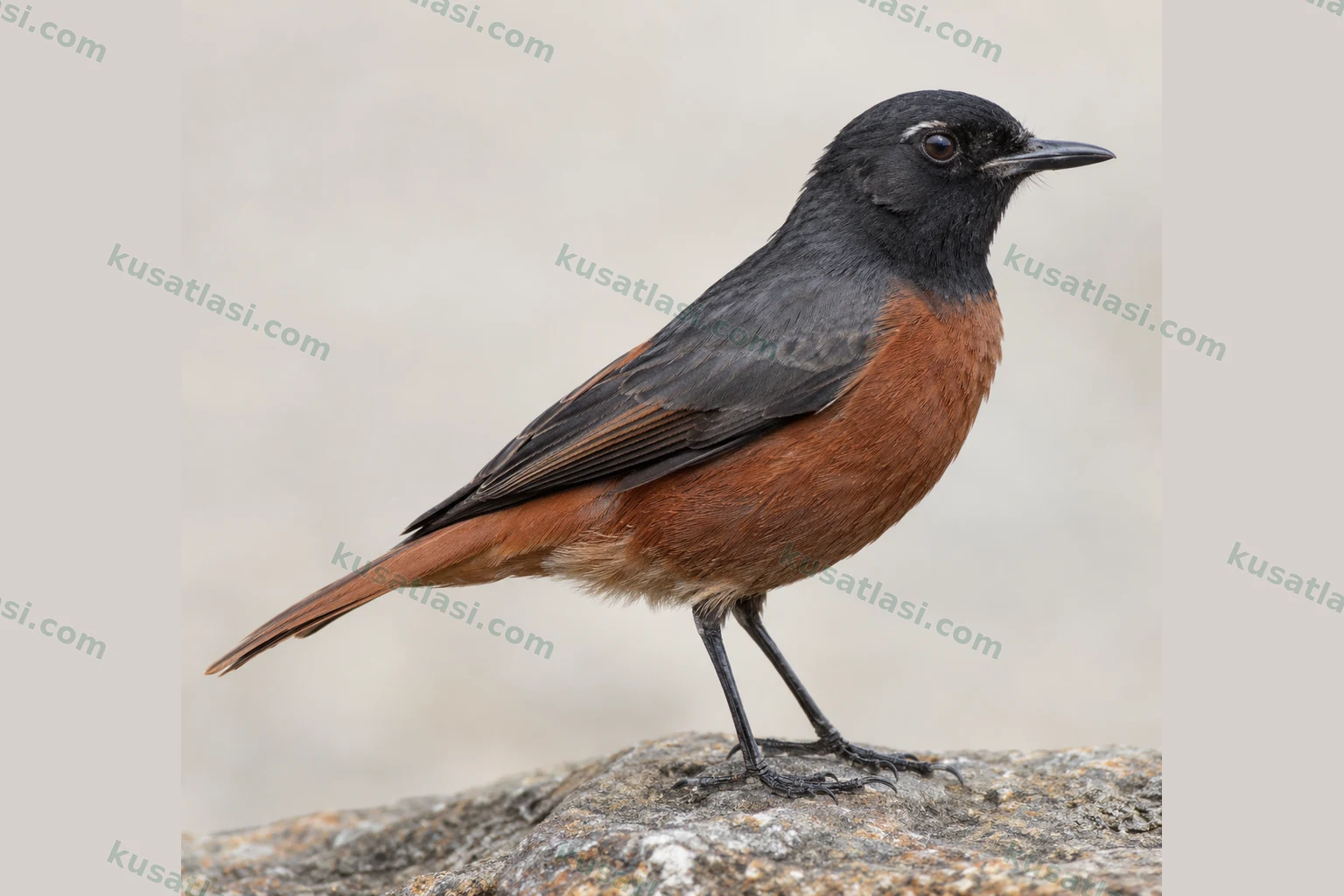
World Birds IUCN statusLC · Least ConcernGlobal IUCN category. BirdLife v10 (2025); taxon matching: AviList 2026 / IOC 15.2; checked: 29.10.2026. The list year is not the species assessment date. Source and method · BirdLife OrderPasseriformesPasserines FamilyMuscicapidaeMuscicapidae
Moorland Chat
Pinarochroa sordida
It is a small, short-tailed, long-legged bird of East African high-mountain grasslands. Plain brownish plumage, upright posture and white outer tail revealed in flight are assessed together.
Biometrics
Length
Male14–15 cm
Female14–15 cm
Shared species value
Wing length
Male7.47 cm
Female7.47 cm
Shared species value
Weight
Male18–19 g
Female20–23 g
Moorland Chat
Highlands of Ethiopia, Uganda, Kenya and northern TanzaniaObservation guide in its natural range
Look for three features together
Do not rely on a single featureProminent when upright; a closed tail may hide white.
Dark centre and tip can form an inverted T, also found in other wheatears.
Look for short movements between rocky grassland, low plants and feeding ground.
Compare male and female
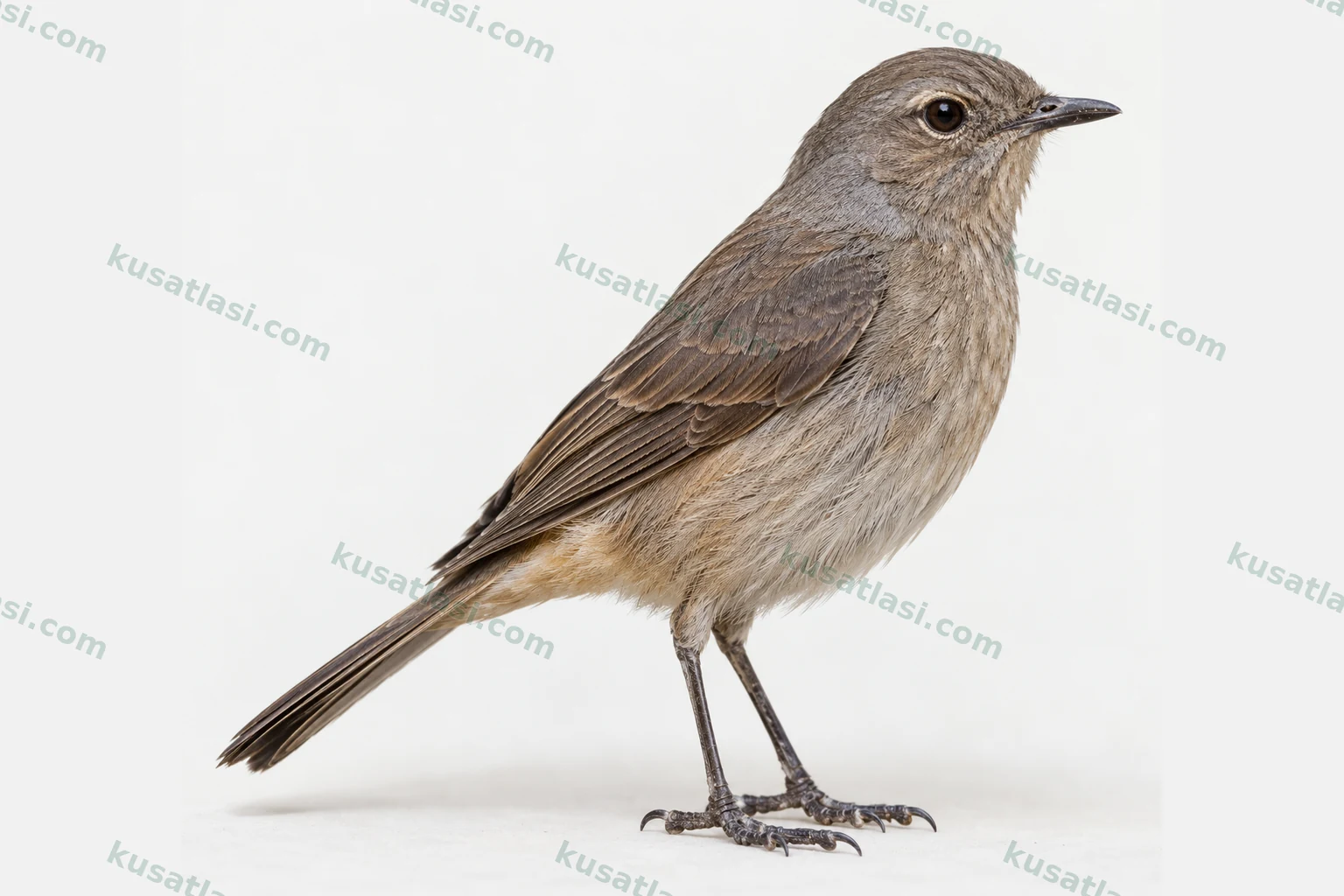 FemaleMale
Adult males and females cannot reliably be separated by appearance. Subtle tone differences do not indicate sex. Young resemble adults overall; without views of feather development and behaviour, age is left uncertain.
Where to look in its natural range?
From existing trails watch rocks and low plants in open mountain grassland. Wait for natural perching; do not feed or open cover looking for nests.
The species is basically resident. The examined sources provide no verified monthly egg-laying periods or regular migration route for its entire distribution. Observation counts are not converted into breeding probability.
All months: Basically resident. No verified regional breeding calendar was found for this month.
January
February
March
April
May
June
July
August
September
October
November
December
Nest, egg and incubation
A specialist account describes a cup nest of plant fibres, fine twigs and outer supporting materials, lined with soft materials. A life-history compilation reports three eggs; the specialist account describes examples with three–four eggs. Reliable species-specific values for incubation duration and age at first flight were not found. Do not lift stones or open vegetation to seek nests, and do not closely follow birds carrying food.
Separate the alarm call from mechanical take-off whistling produced by rapid wingbeats. Bale experiments examined them separately. Assess context and image together; do not infer a regular sentry protecting other animals.
Do not play recordings to attract birds; observe quietly, especially near nests.
Species information
Quick Identification
Moorland Chat Pinarochroa sordida is a small round-bodied, short-tailed bird of East African high mountain grasslands. Initially plain brown or brownish grey, it is best assessed through long legs in an upright stance, pale underparts and white outer tail feathers exposed in flight. The dark tail centre and terminal band form an inverted T when spread. This alone is insufficient, since wheatears can show similar tails.
The English name Moorland Chat corresponds to Pinarochroa sordida; the old name Cercomela sordida is its previous generic placement. The Turkish word for nightingale does not put it in the same genus as true nightingales. Genetics showed similar-looking chats are not always closest relatives. It is now the sole member of its genus; plain colour is not a field sign of that evolutionary position.
General Appearance and Posture
Head and body lack strong colour contrast. The back is mostly brown. The dark flight feathers may have fine pale edges. Throat, breast and belly are paler, greyish in some birds, pale brownish in others. Darker feathers between bill and eye and over the ear can frame the face. The pale eye ring is narrow and its visibility depends on the light; it is not a bold white eyebrow.
The eyes are dark brown. The bill and legs are dark, described as grey-brown to almost black. Upright on a rock, legs look long; crouched, the body looks rounder. One bird may thus appear different-sized. Short tail, closed wings and pale underparts together are better than colour alone. Outer-tail white can be entirely hidden when closed.
Males, Females and Young Birds
Adult sexes are not reliably separable visually. Even a carefully photographed adult in a Bale study was unsexed; authors explicitly noted absence of visible dimorphism. Do not expect required plate colour differences. A paler, darker or more upright appearance does not reveal sex; subspecies, light and feathers affect appearance.
Young resemble adults. Brown shade alone does not age them; development, wings and tail and any parental association matter. Do not require an unverified juvenile pattern. A small flying bird alone is not proof of full self-feeding. If distant feather detail is insufficient, leave age uncertain rather than falsely definite.
Exceptionally pale birds have also been recorded outside normal brown appearance.
Appearance in Flight
Daily movements are mainly short low flights and hops. From rock, low plant or flower stalk it may drop to ground and return to a perch. Pale outer short tail becomes prominent; dark centre and end band may be easier than body colour during quick beats. Wait for landing to recheck body shape and legs after seeing white tail.
Bale research also recorded a whistling sound from rapid take-off wingbeats. This mechanical sound differs from a vocal alarm call; conflating them changes interpretation. Residence does not mean it cannot fly farther. Short movements yield no migration route, distance or fixed dispersal limit.
Voice and Behaviour
It feeds close to ground with small hops, then watches from a low point. Some approach a still observer; this does not justify feeding or blocking its path. Short movements among mountain plants fit ground food collection. An alarm may indicate detection; watch surroundings to understand cause. Reaction or non-reaction to another species is not universalised from one observation.
Giant mole-rats illustrate this. Birds may take invertebrates from soil and plant debris pushed from burrows. A mutually beneficial warning partnership was proposed, but Bale playback found little mole-rat response to the bird's alarm, stronger to another rodent's call. This does not confirm a regular bird sentry protecting rats. Observed feeding opportunity and mutual-benefit hypothesis remain distinct.
Similar Species
Oenanthe familiaris is similarly plain brownish, but its rump and pale tail parts are rufous-orange. Moorland Chat outer tail is white. Without clear colour, assess round body, short tail and posture. One flight flash may not reliably distinguish white from rufous.
Northern Wheatear Oenanthe oenanthe has a white rump and dark inverted-T tail that may confuse. The adult male’s grey upperparts, black facial area and more pronounced black wings help identification, but this contrast is weaker in females and young birds. Also seek Moorland Chat round short-tailed body and plain face. Mountain grassland alone does not separate them.
Global Range
Moorland Chat is tied to eastern and northeastern African highlands: mountains of Ethiopia, Uganda, Kenya and northern Tanzania. Not every part of these four countries is occupied by the species; mountain grasslands and open heights differ from low plains. Bale, Kenyan mountains and northern Tanzanian highlands hold different regional forms. Country borders are not habitat boundaries.
Specialist taxonomy recognises four subspecies: sordida in Ethiopia, ernesti in Uganda and Kenya, olimotiensis in northern Tanzanian crater highlands, hypospodia on Kilimanjaro. One Ethiopian photograph therefore need not give every bird's tone. Old Cercomela is the same bird; genus change does not make an old record another species without taxon matching.
Status within Its Native Range
It can be locally frequent in suitable open highland areas. Bale observations describe rocky grass slopes and foraging among large flower stalks; the park habitat guide lists it at high elevations. These support local presence, not equal density over every mountain point. Sparse observation and missing records do not alone prove absence.
Migration
It is basically resident, with common short feeding flights and near-ground movement. No verified regular long seasonal route or country sequence is drawn. Residence does not mean lifelong use of one rock or valley. Local movement differs from migration. Monthly records also reflect effort and access; more records do not directly prove migration or breeding.
Breeding Habitat
Open high-mountain grassland and scrubby moorland are basic habitat, used with rocks, short plants, moist patches and adjacent cultivated land. Suitable openings near or above treeline matter, not elevation alone. Bale studies around 3,500 m describe a study locality, not an invariant lower or upper species limit. Substrate, cover and food are assessed together.
Nest Site
Breeding is less documented than appearance and diet. A specialist account describes a cup of twigs and fibres, moss and similar outer material. The cup may be lined with soft hair and feathers. The life-history compilation's usual three eggs and the specialist account's examples with three–four eggs are not interchangeable. Reliable species-specific values for incubation duration and age at first flight were not found; relatives' times are not inserted. Do not lift stones, open plants or follow food carriers closely.
Daily Space Use
Short returns between low perches and feeding ground stand out. Rocks, shrubs or large flower stems serve as lookouts. The Bale bird studied in October 2022 fed among Kniphofia stalks on a rocky slope and low down; this does not require that plant everywhere. Mole-rat soil heaps also offer food. Use paths and wait naturally; apparent tameness does not permit trampling fragile grassland or feeding.
What Does It Eat?
Small invertebrates are important, taken on ground and low plants in line with observed mountain movements. Bale birds ate invertebrates in mole-rat soil and plant debris. They exploit an opportunity, not prey on mole-rats or share food with them. The study did not show that all its food came from these heaps.
Martin Burd's Lobelia deckenii research also showed nectar visits and a pollination contribution. This does not mean that the species feeds exclusively on nectar. Invertebrates and flowers are different dietary aspects. One mountain plant's visits do not give range-wide percentages.
How Does It Forage?
It hops on ground or collects around low perches. Watching rock-to-plant movements shows the surfaces searched: soil, debris margins and flower stalks. If a carried item is unclear, do not assign insect family or exact prey size from appearance alone.
Increasing floral food reward in Lobelia experiments did not affect all visitors equally. When Nectarinia johnstoni defended flowers more, Moorland Chat visits fell. The local experiment shows interactions as well as food quantity influence access. Do not add sugar water or attract with human food; watch natural feeding from afar.
Plain Looks, Separate Evolutionary Position
Formerly placed with similar birds in Cercomela, Pinarochroa sordida was distinctly separated in Outlaw, Voelker and Bowie's genetic work, which found no single close lineage for the group. This explains old and new genera in sources. Classification proposals do not mean sudden appearance change or that old observations belong to another species.
Flower Visits Can Differ
Lobelia deckenii research measured pollination through visit frequency, feeding acts per visit and resulting seeds. More reward did not equally increase visitors; another bird's defence reduced Moorland Chat access. This is a measured relationship with one mountain plant, not proof it is everywhere the sole or main pollinator.
An Exceptionally White Individual
An adult seen in Bale in October 2022 was mostly white with normal dark brown eyes and partly dark wing and tail feathers. Authors considered progressive greying possible and requested later-moult follow-up to establish cause. One unusual bird did not announce a sex pattern, subspecies or population-wide disease. White feathers do not automatically mean albinism. Date and feather condition alongside photos are valuable.
Food Association Is Not Warning Partnership
Feeding on mole-rat debris was observed. Regular warning of rats had little experimental support: rats reacted weakly to bird alarms and more to another rodent. Coexistence may bring benefit, but each aspect needs testing. Calling it mutual protection goes beyond the observation.