
World Birds
Field identification plates
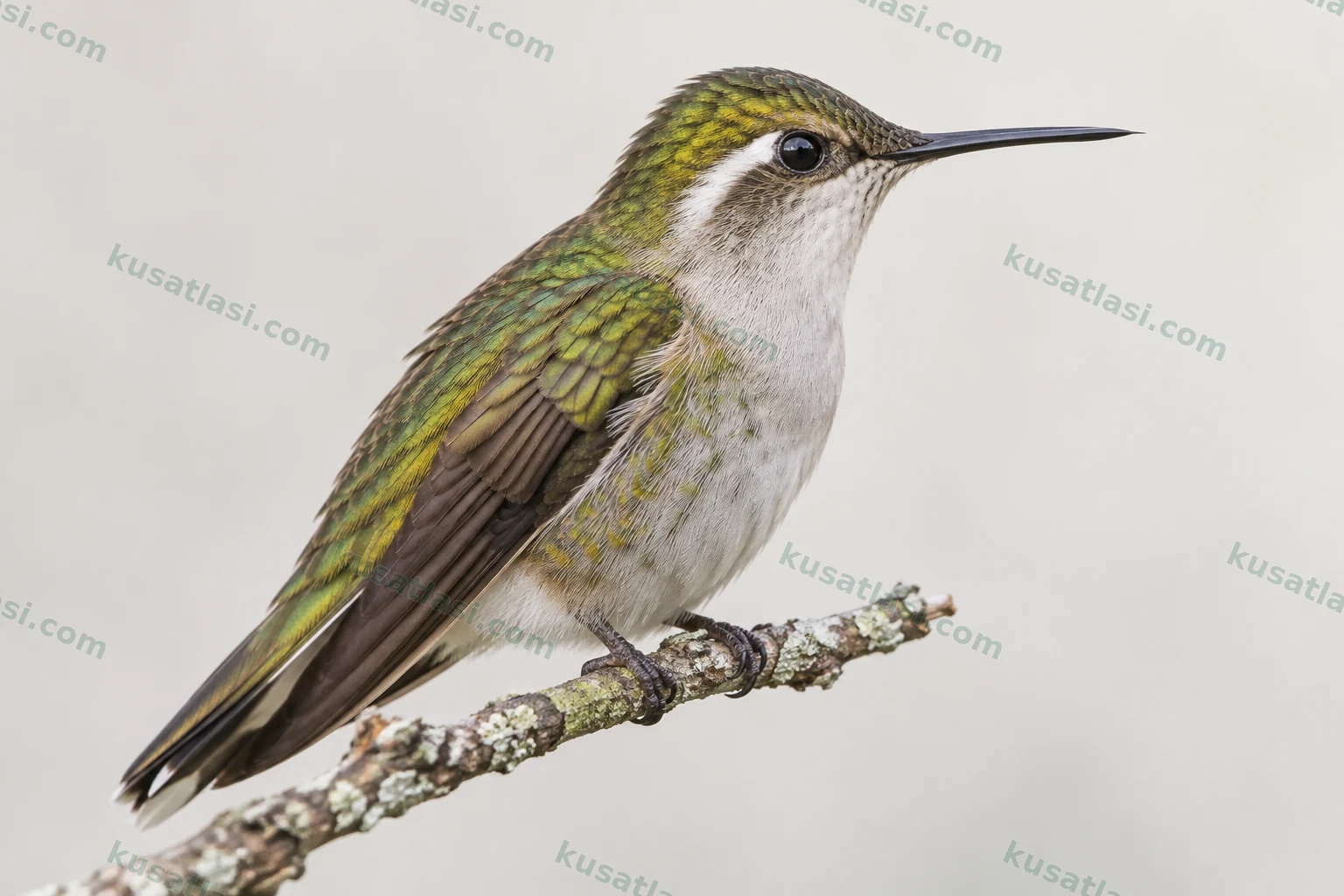
Swipe left or right between the two adult plates.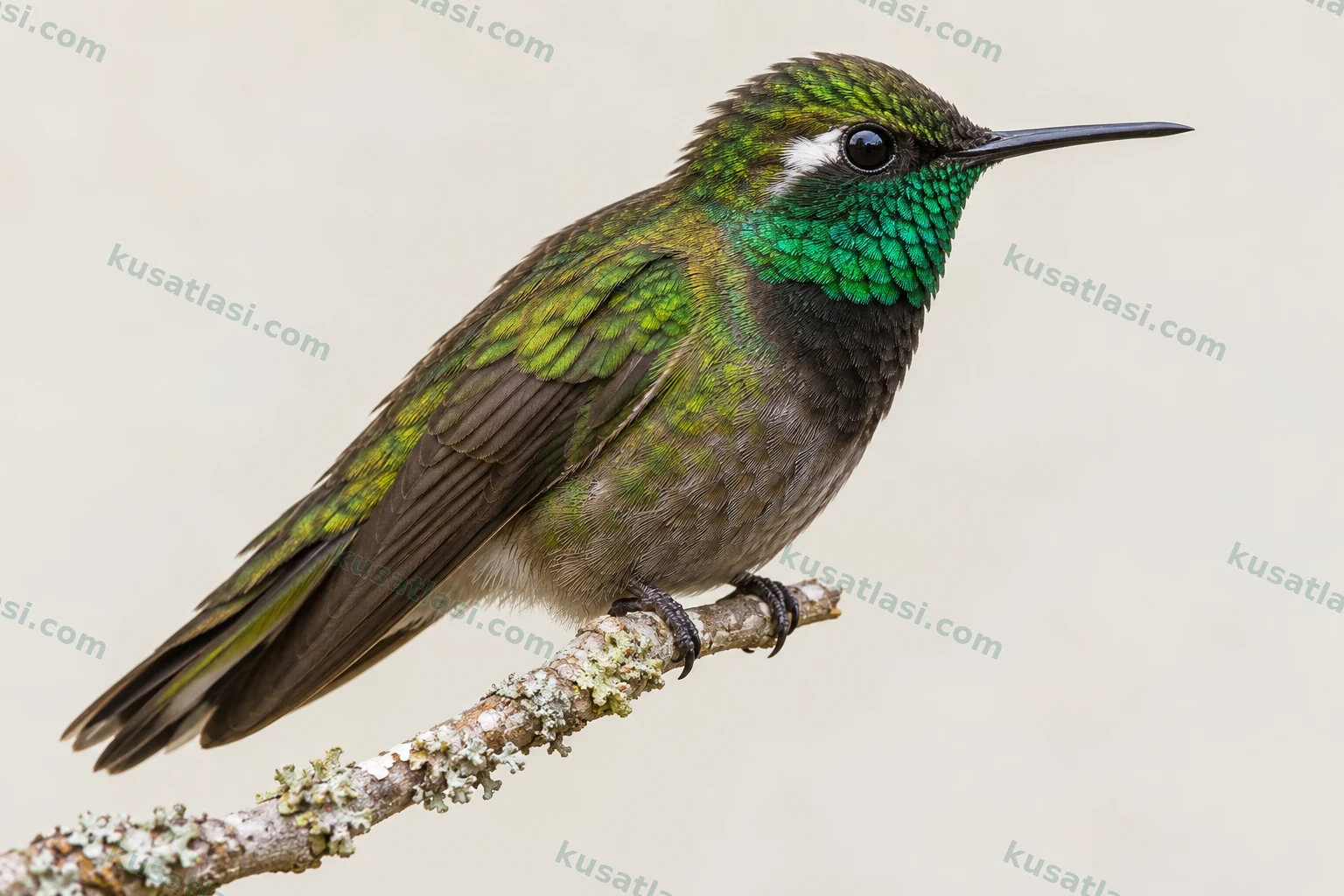
Trochilidae
Emerald-chinned Hummingbird
Abeillia abeillei
Assess it together with the white spot behind the eye.
- Order
- Apodiformes
- IUCN status
- LC · Least ConcernGlobal IUCN. BirdLife v10 (2025); taxon matching: AviList 2026 / IOC 15.2; checked 29 October 2026. Checklist year is not the species assessment date. Source and method · BirdLife
At a glance
- Very short, straight bill
Assess it together with the white spot behind the eye.
- Emerald chin in the male
Compare the dark throat below it and the grey underparts.
- Humid mountain forest
Look at low flowers in the understorey and forest edge.
Biometrics
Length
- Male
- 7–8 cm
- Female
- 7–8 cm
Wing length
- Male
- 4.7 cm
- Female
- 4.7 cm
Weight
- Male
- 3 g
- Female
- 3.5 g
Length: Shared species value Wing length: Shared species value
World distribution
Emerald-chinned Hummingbird
Customise map layers
Observation points
Preparing globe…
Monthly record count
Bars show record counts in this sample, not bird abundance or a breeding calendar. They are affected by recording and observation effort.
Rotate the globe and compare layers. Coloured areas are not exact observation or nest locations.
The source does not provide verified monthly range boundaries. All areas are shown; the month slider and monthly playback are therefore disabled.
- Jan
- Apr
- Jul
- Oct
- Dec
Generalised data and method
Base map: Natural Earth · Public domain
Open central bibliography ↗Calendar
Resident species. February–March is a possible breeding period in Mexico; an active nest was recorded in Guatemala in April. Equally well-verified information is not available for every month.
All months: Monthly data unverified.
January
February
March
April
May
June
July
August
September
October
November
December
Habitat
Mountain forests of northern Central America
Watch flowers in the understorey and at the edges of humid mountain forest. Examine the short bill, white spot behind the eye and throat pattern together.
Sound
Thin, flowing chirps and high-pitched sequences are described. Cornell notes the resemblance to the call of Eupherusa eximia; voice alone does not allow certain identification. A real bird recording with verified identity and record-specific licence has not yet been added.
Do not play recordings to attract birds; observe quietly, especially near nests.
Breeding
Species accounts describe a deep cup nest in low vegetation. Primary Guatemala record: near La Gloria on 16 April 2011, at an elevation of 1,500 m, a nest on a dead fern frond 1 m above the ground contained two white eggs and an incubating female. February–March is a possible period in Mexico; it is not generalised to the entire range. Species-specific incubation and fledging periods could not be verified. Watch without approaching the nest.
Compare
Compare male and female
Compare the dark throat below it and the grey underparts.
Species information
Quick identification
The Emerald-chinned Hummingbird is a very small hummingbird of mountain forests from southeastern Mexico to northern Nicaragua. Its short, straight bill, conspicuous white spot behind the eye and greenish upperparts are immediately noticeable. In the adult male, an emerald-green area on the chin and upper throat lies above a dark throat area. This iridescence brightens or darkens with the light; failing to see green in shade does not mean the bird belongs to another species. The white spot behind the eye also occurs in similar hummingbirds, so it is insufficient for identification on its own.
Assess the small size, short bill and plumage pattern together.
General appearance and posture
The upperparts appear metallic green to bronze-green. The side of the head is dark, with a conspicuous white area immediately behind the eye. The bill is black and short, projecting forwards with little curvature; compared with many long-billed hummingbirds, the face has a short-billed appearance. The central tail feathers are green and the outer feathers darker; paler tones may be visible at their tips. The head, back, throat and tail do not show equal brightness from different angles of light. For identification, examining the position of the markings and the proportions of the bill and head is more useful than relying on the colour saturation of a single photograph.
The bird briefly hovers while feeding at flowers in the forest understorey and moves quickly between flowers. At such moments, the eye spot may look like a pale dot and the wings like a blurred area. When it perches, the boundaries of the head and throat markings become easier to examine. The spot behind the eye is not an eyebrow stripe; it should not be described as a long white line extending above the eye along the head. Nor should the bright throat area be confused with an unbroken green bib covering the entire breast.
Males, females and young birds
In the adult male, the emerald-green iridescence of the chin and upper throat contrasts with the dark area immediately below. The underparts are greyish; the green of the upperparts does not extend across the whole belly. The female lacks the male’s conspicuous emerald chin patch and black throat area. Her underparts appear plainer grey, while the white spot behind the eye and short bill remain. Using these features together avoids describing the female merely as a “pale version of the male”.
Young males may have a few bright green throat feathers, without the fully developed adult throat pattern. Therefore, not every individual lacking a green throat can be identified with certainty as an adult female. In a shaded image taken from a single angle, the male’s bright area may also look dark. Assessing age and sex requires seeing the throat pattern in adequate light and comparing more than one view. As the sources examined do not provide a detailed ageing key covering every juvenile stage, feather tips are not used to assign a precise age.
The museum mean for wing length covers both sexes; a shared figure does not mean that the actual measurements of males and females must be identical. Assigning the lower end of a length range to females and the upper end to males would likewise not represent sex-specific information from the source. The scope of the published data is retained in the explanation below the cards. The figure thus provides useful size information without implying a sex distinction that the data do not establish.
Appearance in flight
The small body, short bill and quick movements between flowers may be noticeable in flight. Cornell’s species account notes that its feeding flight can be difficult to follow. A momentary green flash or hovering alone does not identify this species conclusively; many hummingbirds move in similar ways. If the bird perches again, examine the white spot behind the eye, throat area and tail together. Seeing the wing as a line in the air does not mean that all the feathers on its upper and lower surfaces are the same colour.
The measurement on the wing card is folded-wing length. Wingspan cannot be deduced from it, and a blurred wing area in a photograph is not a substitute for a measurement. As small head markings may disappear in flight, conclusive identification of a distant individual can be deferred. The wing and tail markings of similar species are included in the comparison only when they are seen clearly enough.
Voice and behaviour
The natural call is described as thin, flowing chirps and high-pitched sequences. Cornell notes its resemblance to the call of Eupherusa eximia. A thin hummingbird call therefore does not establish species identity on its own. If the calling bird is seen, check the bill, eye spot and throat pattern. When describing voice, distinguish an actual bird call from a listener’s comparison; syllables written down do not imply that all individuals call for the same duration.
The specialist species account describes birds usually feeding alone and capable of defending flowers. Chasing near flowers is not necessarily courtship; defending a feeding area may produce similar movements. Feeding low down does not mean the bird lives exclusively on the ground. Short movements between flowers, cover and perches are part of daily habitat use, rather than an established intercontinental migration route.
Similar species
Klais guimeti is also small, with a short, straight bill, and shares the conspicuous white spot behind the eye. In the adult male, the crown and throat are violet; in the female, the crown is paler bluish and the throat grey. Compare these with the Emerald-chinned Hummingbird male’s green chin, dark lower throat and green-bronze upperparts together. In females, head colour and the appearance of the bill and tail become important; the white eye spot alone does not distinguish them.
Eupherusa eximia appears larger-bodied; both sexes have a rufous wing area and white stripes visible when the tail is spread. A brief view of the grey-underparted female can be misleading. Assess the warm-coloured wing area, tail markings and body structure together. Similarity in their calls means that voice cannot replace this visual comparison.
Global range
The natural range covers mountain forests in southeastern Mexico and northern Central America. A reliable taxonomic account places the nominate subspecies from southeastern Mexico to northern Honduras, and the subspecies aurea in southern Honduras and northern Nicaragua. Guatemala and El Salvador lie within this regional distribution. Naming these countries does not mean that all their lowlands or coastlines provide suitable habitat; the presence of forest and elevation determine where to look for the species.
Status within its natural range
The bird occurs locally in humid mountain forests and forest edges. Cornell describes it as an infrequently encountered hummingbird that can be difficult to notice at forest flowers. The global LC, or Least Concern, category does not imply equal abundance in every valley. Regular sightings at one feeding site cannot substitute for a population trend across the entire region. The historical Jalapa record associated with its naming refers to Xalapa in the Mexican state of Veracruz; the present range is not restricted to that city.
Migration
The specialist account describes the species as resident. The sources examined do not provide a regular long-distance migration route, a shared annual journey between countries or an exact migration distance. Short movements between flowering areas cannot stand in for such information. Differences in the number of observations at a site between months may also reflect observation effort and flowering, so record counts alone cannot establish a migration calendar.
Breeding habitat
Humid evergreen mountain forests and their edges are important habitats. University and specialist species accounts mostly report elevations of 1,000–2,200 m; this range is not presented as an absolute lower and upper limit for all records. Assess the low vegetation layer within the forest, flowering clearings and suitable roadside cover together.
Nest site
The nest is a deep cup and may be placed in low vegetation. Eisermann and Avendaño’s primary record describes a female incubating two white eggs near La Gloria in Guatemala on 16 April 2011. The nest was on a dead fern frond, 1 m above the ground at an elevation of 1,500 m. This direct record concerns a particular place and date; it does not imply that all nests use the same support. Incubation and fledging periods were not measured in this observation.
Daily habitat use
The bird visits flowers in the forest understorey and flowering banks at forest edges. The relationship between cover at feeding sites and resting perches can be observed. Cutting vegetation, moving the fern or making the bird leave its nest to obtain a view is inappropriate; watching from a distance allows natural behaviour to continue.
What does it eat?
The specialist species account lists nectar and small insects as food. Nectar is obtained by taking the liquid inside a flower; not every visit means that pollen is eaten. The sources examined do not establish the percentage of insects in the year-round diet, an exact daily energy budget or a plant preference list that applies in every region. Rather than transferring the dietary proportions of another hummingbird to this small species, record the flower used and the food taken in an actual observation.
How does it obtain food?
The short, straight-billed bird feeds by briefly hovering at low flowers and may move quickly to another flower. Cornell particularly mentions flowering banks at forest edges and along roads. A short bill alone does not prove dependence on a particular plant or that the bird pierces every long flower. Taking insects and taking nectar are different feeding events; a visit that was not seen clearly should not be assigned conclusively to either. Defending flowers may affect other birds’ use of the same food source.
How does an April nest change the calendar?
Some specialist accounts suggest February–March as a possible breeding period in Mexico. By contrast, an active nest containing two eggs was directly recorded in Guatemala on 16 April 2011. These observations represent different places and different levels of evidence. The April record shows why February–March should not be presented as the sole breeding period applicable to every country; it does not, on its own, prove that the entire Guatemalan population breeds at the same time. The observation was published in 2018; the publication date is kept distinct from the 2011 field date. Incubation duration was not measured in this single observation.
The white eye spot is a shared marking
Klais guimeti also has a white spot behind the eye. Rather than naming a hummingbird from this single feature, examine bill length, the male’s throat colour and the female’s head appearance together. The angle of light may change metallic colours; the positions of the markings therefore provide an important comparison alongside colour brightness.
The same scientific name ending does not mean the same bird
The second word in Abeillia abeillei also occurs in other birds’ names. Taking measurement or nesting information from a source on the strength of the word abeillei alone may introduce the wrong taxon onto the page. Checking the genus and family together prevents confusion between this hummingbird and orioles or other birds sharing that word.