
World Birds
Field identification plates
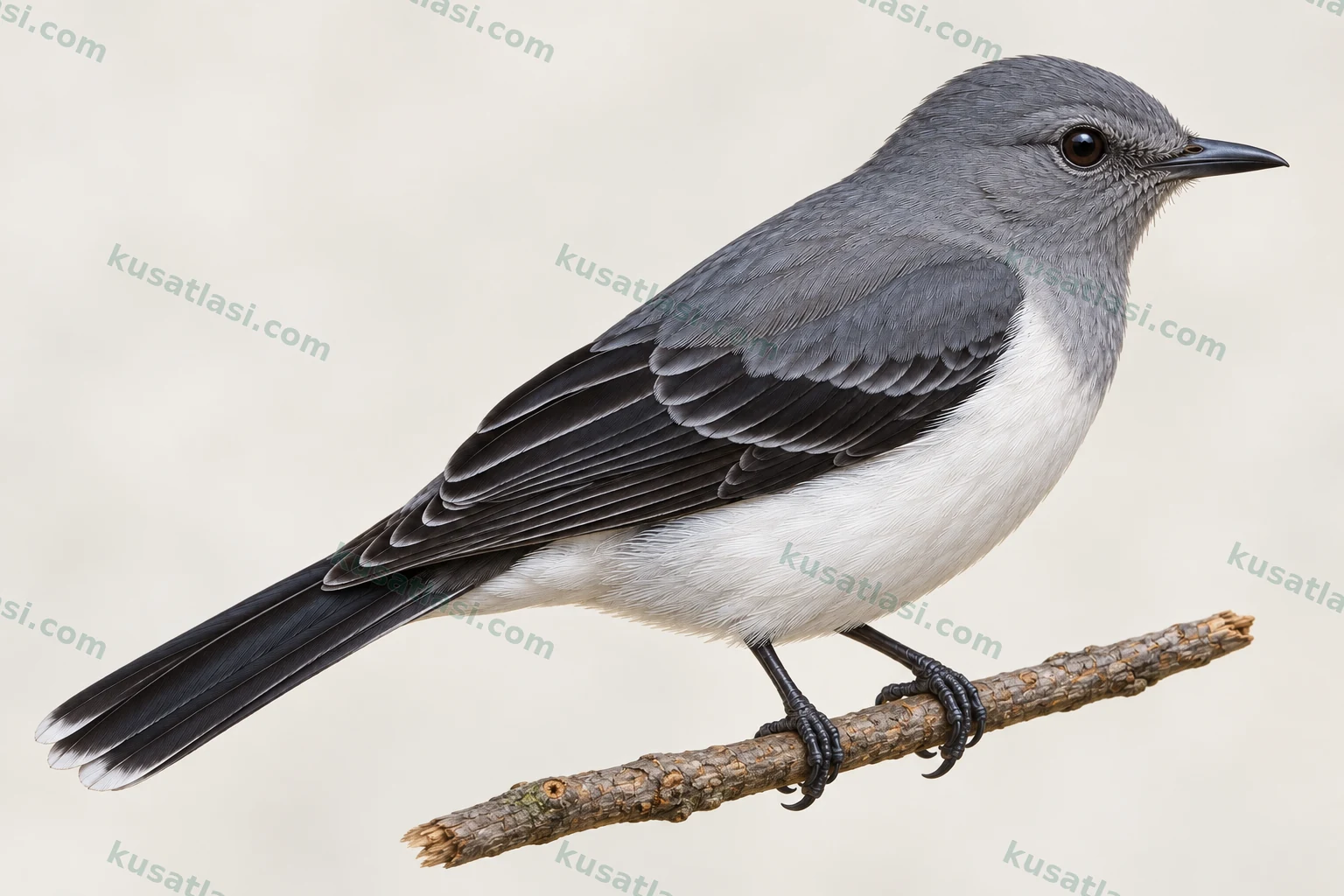
Swipe left or right between the two adult plates.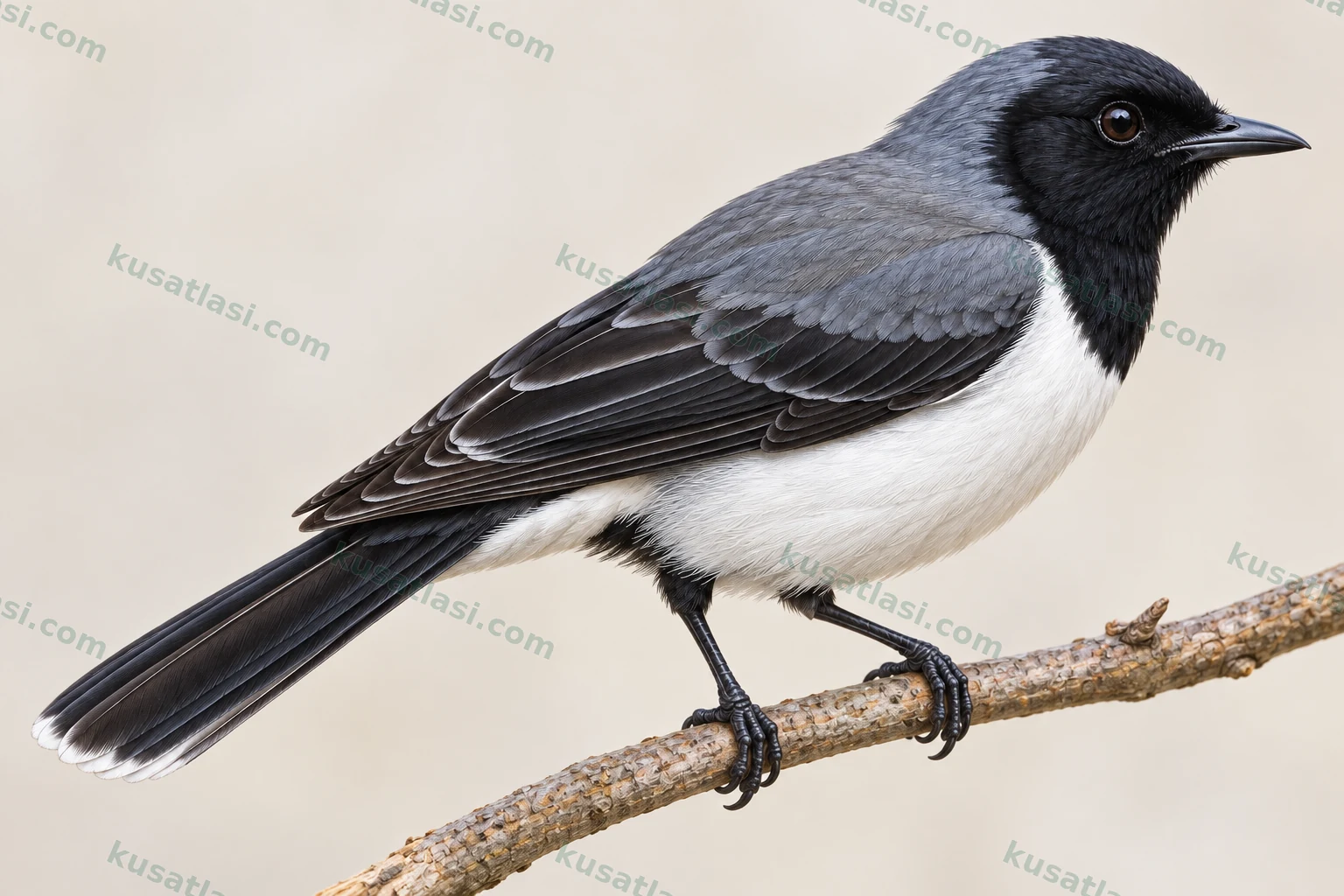
Campephagidae
Pygmy Cuckooshrike
Celebesica abbotti
Compare the colours of the back and underparts together with the dark wing feathers.
- Order
- Passeriformes
- IUCN status
- LC · Least ConcernGlobal IUCN. BirdLife v10 (2025); taxon matching: AviList 2026 / IOC 15.2; checked 29 October 2026. Checklist year is not the species assessment date. Source and method · BirdLife
At a glance
- Grey upperparts, white underparts
Compare the colours of the back and underparts together with the dark wing feathers.
- Facial difference between adult sexes
The male has a black face and throat; the same area is grey in the female. Shadow alone is not evidence of sex.
- A forest bird of the canopy
Look for it alone, in pairs or in mixed bird parties in Sulawesi’s mountain forests.
Biometrics
Length
- Male
- 20 cm
- Female
- 20 cm
Wing length
- Male
- 11.01 cm
- Female
- 11.01 cm
Weight
- Male
- Data unavailable
- Female
- Data unavailable
Length: Shared species value Wing length: Shared species value
World distribution
Pygmy Cuckooshrike
Customise map layers
Observation points
Preparing globe…
Monthly record count
Bars show record counts in this sample, not bird abundance or a breeding calendar. They are affected by recording and observation effort.
Rotate the globe and compare layers. Coloured areas are not exact observation or nest locations.
The source does not provide verified monthly range boundaries. All areas are shown; the month slider and monthly playback are therefore disabled.
- Jan
- Apr
- Jul
- Oct
- Dec
Generalised data and method
Base map: Natural Earth · Public domain
Open central bibliography ↗Calendar
No reliable data were found showing monthly changes in breeding and abundance across the entire range. The calendar does not treat missing records as the absence of the bird.
All months: Monthly data unverified.
January
February
March
April
May
June
July
August
September
October
November
December
Habitat
Sulawesi mountain forests
Watch the canopy and mixed bird parties in Sulawesi’s mountain forests.
Sound
Thin, high-pitched, short calls and a short song sequence have been reported. A written sound comparison does not replace a recording. A real bird sound recording with verified species identity, sound type, quality and recording-specific licence has not yet been linked.
Do not play recordings to attract birds; observe quietly, especially near nests.
Breeding
No verified species-specific details were found on nest location and structure, typical clutch size, incubation period or fledging age. Reports of young birds in November, December and March do not show that breeding occurs only in those months across the island. These records do not replace a definitive breeding calendar. Do not follow and disturb birds to find nests; do not publicly share potentially sensitive sites.
Compare
Compare male and female
The male has a black face and throat; the same area is grey in the female. Shadow alone is not evidence of sex.
Species information
Quick Identification
The Pygmy Cuckooshrike is a grey, black and white songbird of Sulawesi’s mountain forests. The first features to notice are the dark grey back and the pale white breast and belly. The adult male has a glossy black face and throat; in the female, these areas are grey like the back. Head colour alone is insufficient. Examine the pale underparts, dark flight feathers and overall shape together.
General Appearance and Posture
The back and the small wing coverts close to the body are slate-grey. The large flight feathers look darker; grey along their outer edges forms a fine transition towards the back on the folded wing. The central pair of tail feathers is closer to grey, while the outer feathers are dark. Historical museum specimens have been described as having grey bands near the tips of the outer tail feathers and very narrow white tip edges. These small details are not equally clear in every individual; it is incorrect to imagine that the entire tail has broad white tips.
Viewing the bird from different directions is useful. Depending on the direction of the light, the head and back may look darker than the rump; shadow must be distinguished from a real boundary in the plumage. Eye colour should also be assessed in good light.
The eye is red, and the bill and legs are black. The red eye is a small but useful feature; it can darken in leaf shade and may not be discernible at a distance. On the folded wing, the grey feathers near the body and the long black flight feathers form separate areas. In the male, the boundary between the white breast and black throat creates a stronger contrast. In the female, the grey throat blends more gently into the white breast. Two adults in the same tree may therefore have different-looking heads while sharing the same body pattern.
Males, Females and Young Birds
The male’s area between bill and eye, the area above the eye, the cheeks and the throat are parts of the distinct black patch. In the female, these areas are grey. Pale underparts and grey upperparts form the shared basic appearance of both adult sexes. A dark-looking face in a photograph does not prove the presence of the male’s black mask; check whether the boundaries remain when the light changes.
Detailed plumages of young birds and birds approaching adulthood have not been described in the reliable species account. A bird with a female’s appearance must therefore not automatically be labelled a young male. If a photograph supports only identification of the adult sex, no additional certainty about age should be assumed. Dated records and several views in natural light are more useful than a single very dark photograph.
Black thigh feathers form small dark areas beside the white belly. They should not be interpreted as a colour extending over the whole leg; bare legs and the feathers above them must be assessed separately. The prominence of the tail’s fine pale edges and grey bands varies in the historical series of males. An adult with faint feather edges cannot reliably be identified as female or young for that reason alone. The most useful visible sex difference is whether the well-lit face and throat are black or grey.
Appearance in Flight
On the upperwing, assess the relationship between the grey coverts and dark flight feathers; on the underwing, assess the white underwing coverts. White revealed when the wing opens does not mean that the whole wing is white. The upper and lower surfaces do not show the same colour pattern; identification should not be attempted before establishing which surface a flight photograph shows.
The very fine tail markings may be invisible in distant flight views. Feather replacement can also change the length of flight feathers and the appearance of the wing edge. Riley noted in his specimen study that many birds were measured while their wing feathers were being replaced. That record does not establish a particular month as the obligatory moulting season for the entire species.
Voice and Behaviour
The bird may be seen alone, in pairs or in small groups in the canopy of mountain forest; it also joins feeding parties composed of different bird species. Its presence in such a party does not mean that every bird seen belongs to the same species. Check the body, face and wing features described elsewhere in the account separately on each individual.
The call is described as a thin, high-pitched, short sound descending towards the end, which may be written as “thip”. The song begins with soft notes followed by a short four-note sequence. The flight call is a sharp sound resembling “tseet”. Different observers may write the same sound with different syllables, so these comparisons describe only the structure to listen for in a recording. When the bird remains among leaves, look towards the source of the sound; do not attribute every call in a mixed party to this species.
Similar Species
Among grey forest birds found in the same area, compare the colour boundaries between the face, upperparts and underparts together. Grey upperparts alone do not identify a Pygmy Cuckooshrike. A brief view of the head through leaves may be insufficient. Prefer a record showing the pale underparts, the head pattern appropriate to the adult sex, and the wing together. An image labelled with another scientific name does not become evidence of this species merely because the names are similar.
Edolisoma morio, also found on Sulawesi, is another dark-headed cuckooshrike. In Riley’s specimens, the males of that species vary from blackish to grey on the breast; the Pygmy Cuckooshrike’s pale white underparts are particularly important in comparison. A black head alone does not separate the two. Instead of looking only for a red eye on a grey- or dark-breasted bird, examine the entire colour pattern from head to belly. Differences suggested in the historical publication as possibly age-related must not be used as a definitive ageing key.
Comparison must be based on the parts of the bird actually seen. If leaves conceal the belly or breast, the distinction between white and grey underparts remains uncertain; wait for a second natural view without driving the bird out of cover. A rear view of the grey back may hide the white breast. On an open wing, the pale area below belongs to the coverts, not to all the long flight feathers; an upperwing photograph does not demonstrate the colour of the underwing. The red eye may not be visible in a flight photograph. Joining a flock does not mean that the bird is the same species as its neighbour. Hidden features must not be filled in from the location or another bird’s appearance.
World Distribution
The natural range is associated with mountain forests on the Indonesian island of Sulawesi. The species account reports the mountains of the north, northeast, centre and southeast. This regional description must not be drawn as a continuous area covering all the island’s coasts or all neighbouring islands.
Status Within Its Natural Range
Some historical specimens come from Rano Rano in central Sulawesi. This is the area where the original specimens associated with the scientific name were collected. The collection locality of a museum series cannot, by itself, establish every boundary of the present-day range. Current observation sites and natural habitat must be considered together.
Movements
No regular migration route has been verified, so no chain of countries or seasonal journey is drawn with arrows. The absence of movement records does not prove that no individual makes short-distance movements. Observation points must not be substituted for the natural range or breeding boundary.
Lore Lindu National Park is one of the protected areas from which the species has been reported. The historical record from Rano Rano and the park’s mention in the current species account indicate the importance of central Sulawesi; these two pieces of information are not a population census. Frequent local sightings at one place do not show that the same density occurs in every mountain area. The specialist account reviewed describes local abundance as ranging from common to scarce.
Sulawesi’s mountainous interior provides the bird’s natural geographic context. No regular journey across the sea to nearby islands has been verified. The range description is therefore not extended to the whole of Indonesia; mountain forests and national borders must be considered at different scales.
Habitat
The canopy of mountain forest is the principal setting for observations. The specialist species account highlights forests at 1200–2500 m, mostly above 1400 m. These elevations do not establish strict lower and upper limits on every slope; elevation information for local records must be assessed separately.
Nest Site
No species-specific, verified details were found for the nest tree, nest structure or height above the ground. Nesting information from other cuckooshrikes is not transferred to this bird.
Daily Use of Space
When following mixed bird parties moving through the canopy, look for small grey-and-white birds among the leaves. Use authorised paths rather than entering the forest or trying to drive birds out. Follow local guidance and conservation rules for sensitive observations.
Feeding in the canopy calls for a different approach from searching for the bird in dense shrubs at ground level. Watch the forest canopy that can be seen safely from the roadside; a grey back may appear only briefly among the leaves. As the species occurs alone, in pairs or with other species, the next sighting may not be of the same individual. Elevation and forest structure support identification but do not, by themselves, determine the species.
Forest loss is considered a possible pressure in the specialist account. As it provides no quantified assessment of the effect across the species’ entire range, no definite percentage decline is stated.
What Does It Eat?
The diet is mainly insect-based. No verified species-specific data were found on detailed prey species or their proportions; the presence of “caterpillar-eater” in its Turkish name does not mean that all its food consists of caterpillars.
How Does It Hunt?
It gleans prey among leaves in the canopy. The specialist account also cautiously reports taking prey in the air during short flights. As the proportion of feeding time devoted to this behaviour is unknown, no definite percentage is given.
Searching for prey in the upper, leafy layer shows where feeding occurs. In individuals joining a mixed party, an insect eaten by a neighbouring species must not be attributed to this bird without observing its own bill movements and contact with prey. An insect visible in the bill may show that this prey was taken, but does not, by itself, reveal the species’ entire diet or year-round preferences.
Gleaning from leaves and catching airborne prey during a short flight are different behaviours. The latter is reported in the specialist account without a definite frequency. Long-distance migration for food, descent to the ground, fruit-eating or dependence on a particular caterpillar species have not been verified and are therefore not added to the account. A mainly insect-based diet and specialisation on a particular group of insects are not the same claim.
What Do Museum Specimens Reveal?
Riley’s 1924 publication discusses seven males and four females collected at Rano Rano in December 1917. The sex difference on the head and throat is not an assumption drawn from a single image; it was explicitly compared in the specimen series. Nevertheless, eleven historical specimens do not represent all the species’ present-day variation.
A Measurement Corrected by Its Author
Riley explicitly stated that he had given measurements only for the type specimen in the original description and had written the tail length incorrectly. His presentation of ranges from the larger series in the later publication shows why an old figure should not be reused without checking its context. The source’s year and subsequent corrections are as valuable as the measurement itself.
Light and Feather Replacement
The tone of the same specimen’s head and back may change with the direction of the light. Fine feather edges on the tail also vary in prominence between individuals. Moreover, flight-feather replacement was in progress in most specimens. Pale feather edges alone are therefore not a reliable indication of a different sex, age or subspecies.
The Same Bird Under Different Historical Names
Older publications may use Celebesia abbotti or Coracina abbotti. The currently accepted name is Celebesica abbotti. Encountering an old genus name does not mean that it is another bird; the source’s taxonomic concept and date must be checked. Measurements are not transferred without matching the current species name to the identity of the historical specimens.