
World Birds
Field identification plates
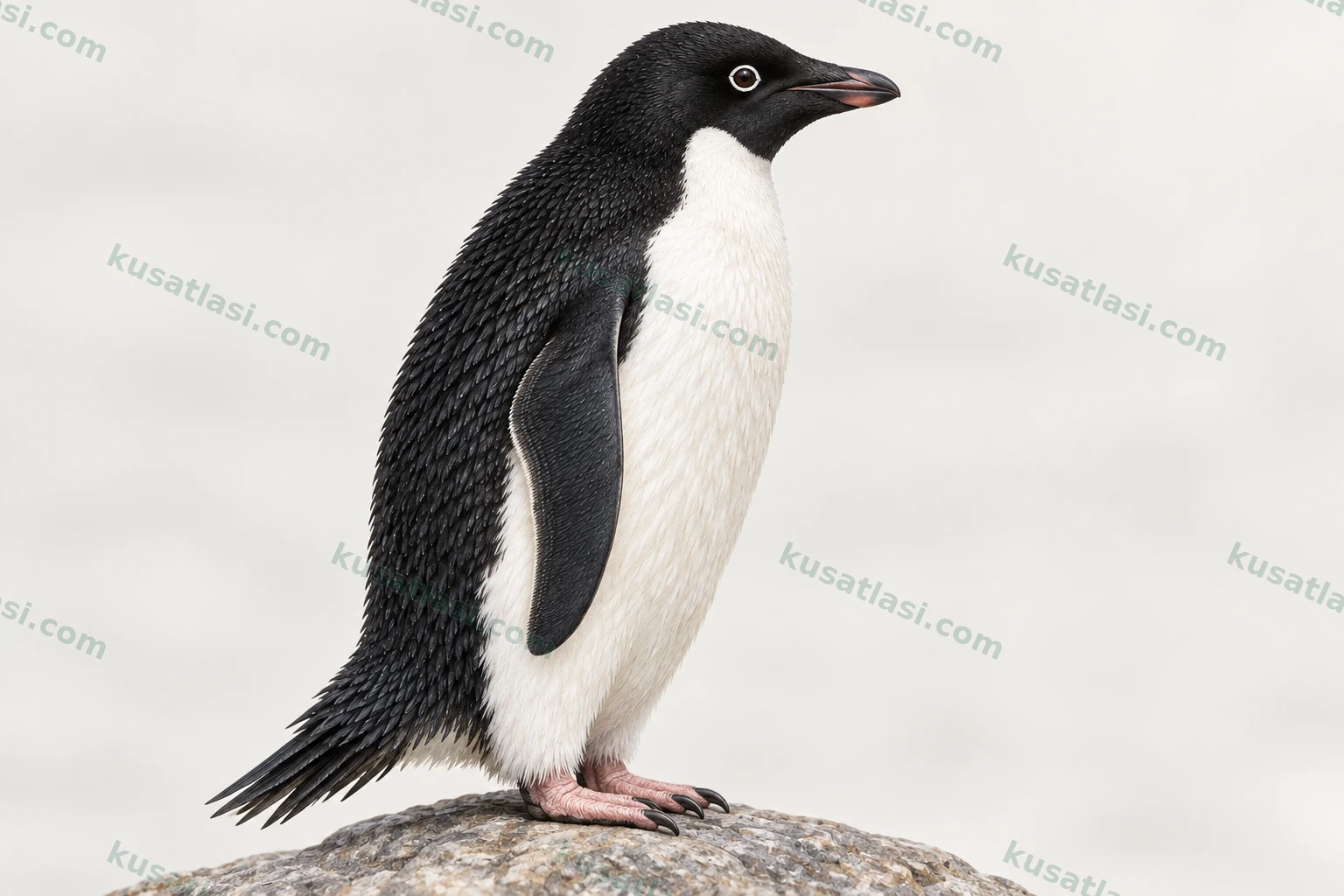
Swipe left or right between the two adult plates.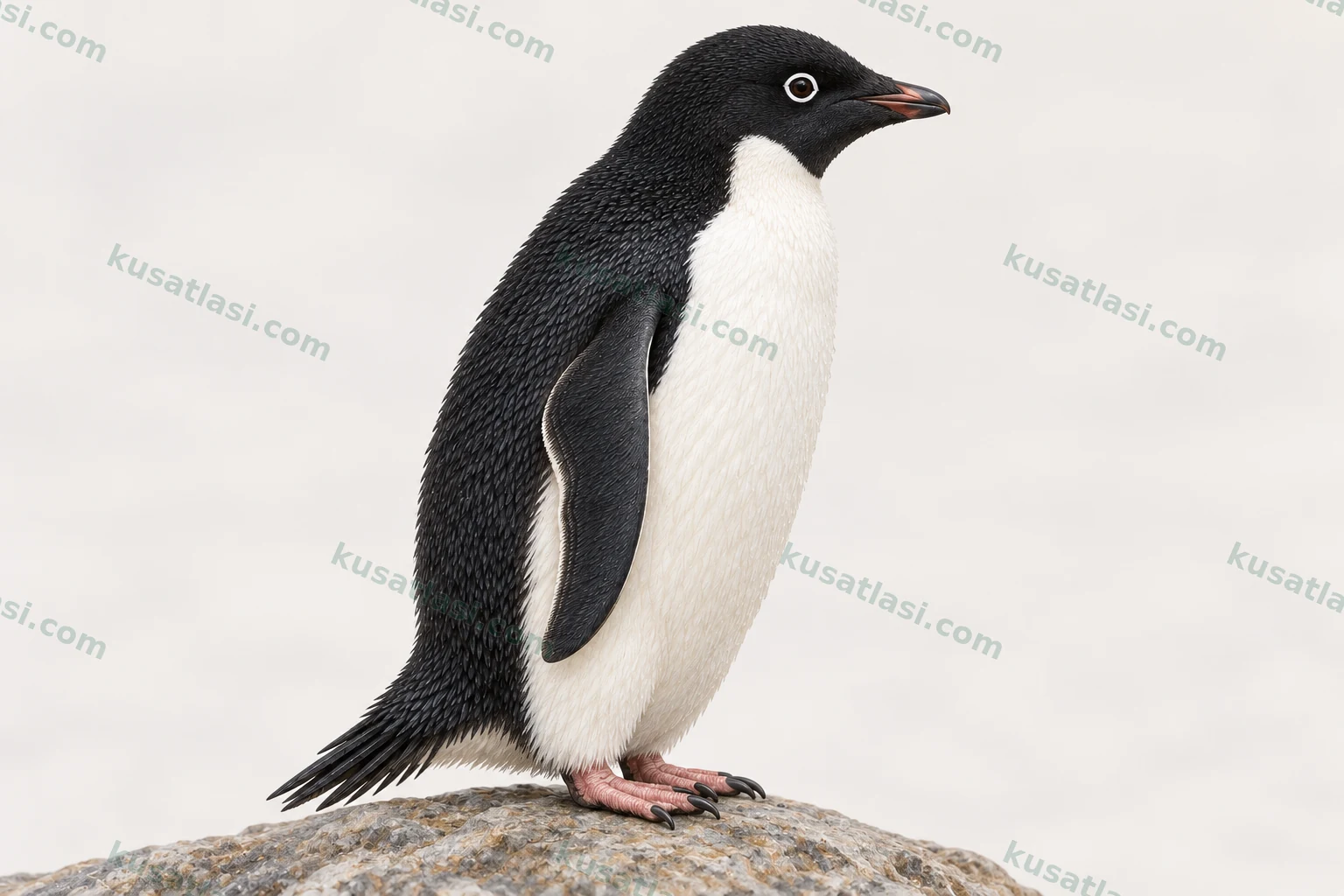
Spheniscidae
Adelie Penguin
Pygoscelis adeliae
Examine the narrow white ring on the dark head together with the bill.
- Order
- Sphenisciformes
- IUCN status
- LC · Least ConcernGlobal IUCN. BirdLife v10 (2025); taxon matching: AviList 2026 / IOC 15.2; checked 29 October 2026. Checklist year is not the species assessment date. Source and method · BirdLife
At a glance
- White eye-ring
Examine the narrow white ring on the dark head together with the bill.
- Antarctic coasts
Breeding colonies are on ice-free rocky coasts and islands.
Biometrics
Length
- Male
- 70–71 cm
- Female
- 70–71 cm
Wing length
- Male
- 9.45 cm
- Female
- 9.45 cm
Weight
- Male
- 5 kg
- Female
- 4.7 kg
Length: Shared species value Wing length: Shared species value
World distribution
Adelie Penguin
Customise map layers
Observation points
Preparing globe…
Monthly record count
Bars show record counts in this sample, not bird abundance or a breeding calendar. They are affected by recording and observation effort.
Rotate the globe and compare layers. Coloured areas are not exact observation or nest locations.
The source does not provide verified monthly range boundaries. All areas are shown; the month slider and monthly playback are therefore disabled.
- Jan
- Apr
- Jul
- Oct
- Dec
Generalised data and method
Base map: Natural Earth · Public domain
Open central bibliography ↗Calendar
It breeds in the Antarctic summer and spends winter at sea and around sea ice.
All months: Monthly data unverified.
January
February
March
April
May
June
July
August
September
October
November
December
Habitat
Antarctic coasts and surrounding sea
Look in rocky coastal colonies and, depending on the season, around sea ice.
Sound
Partners and neighbours interact vocally in crowded colonies. A written description of the voice alone does not establish identification.
Do not play recordings to attract birds; observe quietly, especially near nests.
Breeding
It builds a pebble nest on stony ground, usually with two eggs. In the Cape Royds sample, a chick hatched from the first egg after a mean of 34.8 days and from the second after 33.3 days; these durations are not generalized to other colonies.
Compare
Compare male and female
Breeding colonies are on ice-free rocky coasts and islands.
Species information
Quick Identification
Adelie Penguin Pygoscelis adeliae breeds on Antarctic coasts and nearby islands. Head and back are almost black, breast and belly white. The conspicuous white eye-ring helps comparison with other black-and-white penguins at sea or in colonies. The bill often looks dark, with feathers covering its base. Long stiff tail feathers may be visible while walking.
Penguin wings are flippers adapted for underwater propulsion, not flight.
Body mass varies widely with feeding, fasting and breeding stage.
Overall Appearance and Posture
It walks upright, with short legs and a heavy body making steps look waddling. It sometimes slides on its belly over ice, as described by the Australian Antarctic Program. Underwater the flippers propel it powerfully and its streamlined body reduces drag. Slow appearance on land does not reveal hunting ability at sea. The white eye-ring helps identify adults at distance, but light, wet feathers and angle affect visibility. Head pattern, bill and back outline are considered together to separate ages and related species in colony photographs.
Adelie Penguin belongs to Sphenisciformes and Spheniscidae. It shares Pygoscelis with Chinstrap and Gentoo Penguins. Kinship does not permit copying nest calendars, body measurements or marine prey between them. During breeding especially, flipper lengths and masses may come from adults of one colony or birds at another stage in another source. Locality, sample and method should accompany measurements. Males may average larger bills in some samples, but a distant image cannot reliably establish sex. The Edmonson Point study showed limits even to bill measurements and little improvement in classification from adding mass.
Males, Females and Young Birds
Adult male and female colour patterns are largely identical. Although Morandini and colleagues report slight measurement differences, they emphasize potentially misleading behaviour and viewing angle in field sexing.
Early chicks have fluffy insulating down; before going to sea they must acquire waterproof adult-like feathers. The Australian Antarctic Program reports chicks forming groups at about three weeks as they become less dependent on constant parental guarding, and going to sea at seven to nine weeks. This can vary with the studied colony's conditions. A chick group is not a single nest's siblings. Growth depends on food delivery and environment; adult measurements do not apply to a chick's present weight. During laying and incubation parents alternate guarding and feeding at sea.
Appearance in Flight
This species does not fly through air. Here “in flight” explains swimming, unlike upperwing and underwing identification in flying birds. On entering water it repeatedly strokes its flippers; feet and tail help steer. Black back and white underside appear from different angles against a bright surface and dark depths. This general counter-colouring is not exclusive to Adelie. If only a brief head and back appear at the surface, eye-ring, bill and Antarctic locality are sought together. False upperwing or underwing flight diagnoses must not be made.
Swimming descriptions use the real flipper and head pattern; flightlessness does not reduce the biological importance of underwater movement.
Voice and Behaviour
Partners and neighbours interact vocally in colonies; calls form part of the crowded setting where a bird finds mate or space. A written description does not prove a particular recording's identity. Where Chinstrap or Gentoo Penguins occur nearby, appearance and locality need checking too. Wind, waves and colony noise alter perception of a brief call. Observers should not block routes or disturb eggs on stony ground.
Returning adults build pebble nests; the Australian Antarctic Program explains the value of sloping exposed rock draining meltwater. Both parents guard eggs and feed young. Initially one protects the nest while the other hunts at sea; once chicks can group, both may forage. This should not be forced into fixed human gender roles for every pair. Taylor's Cape Royds study often found males arriving earlier, but that is a single colony and period.
Confusable Species
1. Chinstrap Penguin Pygoscelis antarcticus has a clear black band beneath the head. Adelie's white eye-ring and broad dark head are evaluated together; black back and white breast occur in both.
2. Gentoo Penguin Pygoscelis papua has a broad white area over the head towards the eyes and a different-looking bill. This is not the same structure as an adult Adelie's narrow eye-ring.
3. Emperor Penguin Aptenodytes forsteri is much larger, with different yellowish head-and-neck areas. Shared Antarctic occurrence does not mean equal breeding place or calendar; Emperor's winter breeding is not transferred to Adelie.
World Distribution
Adelie Penguin is circumpolar around Antarctica. The Australian Antarctic Program describes colonies on ice-free rocky coasts and coastal islands. Marine habitat changes seasonally with sea ice and the open-water edge. A breeding colony is not the entire winter range, nor one winter tracking line the whole species' compulsory corridor.
Status in Its Natural Range
Two winter studies following 18 and 5 birds from East Antarctica found most moving west after breeding, then north with the ice edge and southeast on return. Takahashi and colleagues' result belongs to that colony and those years. Map scale should show Antarctic coasts without colouring the whole continental interior as occupied habitat.
Migration Journey
Departure from colonies and seasonal movements with sea ice are part of annual life. The Australian Antarctic Program describes winter marine use around drifting ice. East Antarctic birds followed by Takahashi and colleagues took clear ice-edge-related directions; this does not establish that every Antarctic colony follows the same 1,500 km path. Return to a nest site does not imply remaining coastal in winter. Routes and distances require season, colony and ice conditions.
Breeding Habitat
Rock and pebbles exposed in Antarctic summer form colony habitat. The Australian Antarctic Program describes slopes where meltwater does not pool. Access to sea and feeding areas matters; thick coastal ice can make parents walk farther in some years. This does not determine equal colony success annually. Rocky breeding ground and winter sea ice are distinct stages, not one flat map colour.
Nest Site
Partners build a small pebble mound and cup on the ground. The Australian Antarctic Program gives two eggs as typical. In Taylor's Cape Royds study published in 1962, 150 eggs followed in 1959–1960 had mean hatching times of 34.8 days for first and 33.3 for second eggs; ranges were 33–39 and 30–37 days respectively. These are one colony's egg-order results, not one exact incubation day for all Antarctica. Both parents guard eggs alternately. Observation should avoid approaching nests.
Daily Habitat Use
During breeding, adults travel between coast colonies and marine feeding areas. The Australian Antarctic Program reports some parents foraging 5–120 km offshore for young; this is not fixed for all colonies and seasons. After breeding, birds may disperse around winter sea ice. Standing in a colony does not mean no swimming that day, nor being tracked at sea no breeding. Locality, date and life stage are recorded together.
What Does It Eat?
Adelie Penguin eats krill, fish and other small marine animals. The Australian Antarctic Program describes fish, amphipods and ice krill nearshore, Antarctic krill farther out. This distinction is read in the feeding context of the regions studied. Lohmann and colleagues' evaluation around Anvers Island for 1992–2018 found summer krill mass shares varying annually, averaging 94% with annual values of 61–100%. This high regional share is not fixed for every colony or winter. Fish and ice krill may matter separately at Ross Sea colonies. One stomach sample is not a lifetime diet.
How Does It Hunt?
It propels itself with flippers, dives and catches small prey. The Australian Antarctic Program mentions dives reaching 175 metres in some birds, while usually foraging in the upper 70 metres. The deepest record is not every typical dive. Nearshore and offshore prey differ, so capture place matters. Returning parents regurgitate food to chicks. Ice-edge location, krill abundance and breeding demands can affect foraging routes; one tracked individual's dive path is not the species' daily map.
A Pebble Nest
The Australian Antarctic Program explains the importance of sloping ground that drains snowmelt.
Ice and Food Are Different
East Antarctic winter tracking found routes related to ice movement; long-term work near Anvers studied the connection between krill shortage and local population decline. Neither is a compulsory route for all Antarctica or proof that all colonies change in the same direction. The distinction honestly shows ice effects varying with place and period.